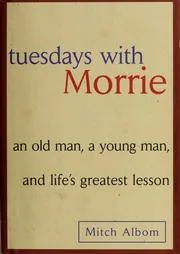
Tuesdays with Morrie
by Mitch Albom · 1994
It suits teens and adults, especially readers who like short, reflective, emotionally direct books.
199 pages, about 3 to 4.5 hours.
A short, plain-spoken memoir about learning how to live from a dying teacher. 49% taste match
What it covers
Tuesdays with Morrie is a memoir by Mitch Albom, first published in 1994. It centers on Albom's relationship with Morris S. Schwartz, known as Morrie, who taught him sociology at Brandeis University. Years after his student days, Albom returned to see his old teacher, who was living with amyotrophic lateral sclerosis, also called ALS. The two met in Schwartz's home, and the book follows those meetings as the illness advanced.
The story is set in Massachusetts in the United States, with the central events dated to 1995. It belongs to the biography and memoir category and sits within the tradition of writing about teachers and students, about patients facing terminal disease, and about death as it touches ordinary life. Nightline, the television program, also features in the background of the story. Albom writes in the first person, so the account comes directly from his own experience of those weekly visits. The book has been issued in more than one hundred editions, and a typical copy runs to about 199 pages.
The last class of my old professor's life took place once a week in his house, by a window in the study where he could watch a small hibiscus plant shed its pink leaves.
Characters
Morris S. SchwartzMitch Albom
Setting
Estados UnidosUnited StatesMassachusettsEstats Units d'AmèricaÉtats-Unis
Period
1995
Themes
memoirALSsociologyNightlineDeathBrandeis UniversityAmyotrophic lateral sclerosisFaculty
- Want to read 1,815
- Reading now 130
- Read 144
Most people shelving it are saving it for later.
Of 2089 readers who put it on a shelf, 87% want to read it, 6% are reading it now, 7% have finished it and 0% stopped before the end.
By the numbers
- The median edition runs 199 pages. Counting about 275 words a page and an adult reading pace of 250 words a minute, that is about 3.6 hours of reading.
- Open Library tracks 104 editions from 78 publishers, the earliest dated 1994 and the latest 2017, across 12 languages.
- On reader demand it ranks in the top 1% of the modern books in our catalog (15,152 of them).
- Libraries shelve it under Dewey 378.12092 B and Library of Congress class LD-0571.00000000.B418 S38312 2005.
 BookWard’s take
A short, plain-spoken memoir about learning how to live from a dying teacher
Tuesdays with Morrie is Mitch Albom's memoir of weekly visits to his old Brandeis sociology professor, Morrie Schwartz, who is dying of ALS. At 199 pages it's a comfortable length, and the opening sentence, with that hibiscus shedding its pink leaves, sets the scene at once. Where I part ways with it is in its sentiment: this book reaches for the heart openly rather than holding back. It leans on familiar tropes, the wise mentor and the deathbed lessons, so there's little here that feels new. What it does well is give you a real sense of two people through a single relationship, in plain prose, and it keeps a clear forward motion through its simple weekly meetings. It rewards readers who want feeling more than surprise.
At 199 pages it is a quick, compact read, which matches BookWard's preference for tight books.
Short chapters built around each Tuesday keep it moving at a steady, brisk clip.
The premise is moving but follows a familiar shape of mentor, lessons, and mortality, so it feels well-trodden.
The writing is deliberately simple and unadorned, which keeps the focus on the conversations.
Little happens beyond the visits, so the weight rests on the bond between teacher and student.
Despite the illness, the book emphasizes meaning, connection, and a good way to face the end.
It follows a straightforward sequence of Tuesday visits with no formal experimentation.
Humor shows up in small warm touches, but the tone stays mostly earnest and reflective.
Terminal illness casts a shadow, but the treatment is gentle and humane rather than grim.
Its emotional pull is strong and openly invited, especially as Morrie declines.
See all 50 dialsEvery position, side by side with this book
Where it lines up
- LengthBookWard 1 · book 1
- EndingBookWard 8 · book 8
- Shock for effectBookWard 9 · book 9
Where it pulls apart
- Familiar tropesBookWard 10 · book 3
- Rigor (nonfiction)BookWard 9 · book 2
- SentimentBookWard 8 · book 2
At 199 pages it is a quick, compact read, which matches BookWard's preference for tight books.
The opening image of a dying professor watching his hibiscus draws you in gently rather than with a jolt.
The wise dying mentor and life-lessons frame is a well-worn pattern, which falls short of BookWard's taste for freshness.
The weekly-visit structure is simple and consistent, so the book holds together cleanly from start to finish.
Short chapters built around each Tuesday keep it moving at a steady, brisk clip.
The premise is moving but follows a familiar shape of mentor, lessons, and mortality, so it feels well-trodden.
Morrie comes through vividly, though the portrait is built from his sayings more than from layered complexity.
The book follows the illness to its close, giving a clear and resolved ending that BookWard appreciates.
It leans openly into tenderness and uplift, well away from BookWard's preference for restraint.
The darkness here is the real course of a terminal illness, not shock used for effect, so it is earned.
It is a personal recollection built on conversations and memory, not documented research or analysis.
Albom's plain, warm first-person voice is recognizable and approachable, if not strikingly singular.
The book is shaped by Morrie's reflections on living and dying, with the visits serving as a frame.
Morrie often states his lessons outright rather than letting scenes imply them, which BookWard likes less.
Short, self-contained chapters keep energy even, with little drift across its brief length.
The writing is deliberately simple and unadorned, which keeps the focus on the conversations.
Little happens beyond the visits, so the weight rests on the bond between teacher and student.
Despite the illness, the book emphasizes meaning, connection, and a good way to face the end.
It follows a straightforward sequence of Tuesday visits with no formal experimentation.
Humor shows up in small warm touches, but the tone stays mostly earnest and reflective.
Short chapters and clear language make it an easy, accessible read.
Everything is told from Albom's single first-person perspective.
The visits move forward in order as the illness advances, with only light backward glances.
This is a grounded true account with no fantastical elements.
The focus stays almost entirely on two people, giving it a very small cast.
It is an intimate story set largely in one room of one house.
The weight falls on conversation and reflection, with very little outward action.
Much of the book unfolds through exchanges between Albom and Morrie, so dialogue carries it.
Romance is not a concern here; the central bond is between teacher and student.
The setting is a familiar American home and campus world that most readers will recognize.
Set in 1995 and published in 1994, it reads as recent past rather than strictly present day.
Its questions about death, regret, and what matters have kept it widely read for decades.
Albom narrates his own experience directly, so the account is plainly his own telling.
The lessons are stated plainly and sincerely, leaving little ambiguity about what the book wants you to take away.
Description is functional and brief, with the occasional image like the hibiscus rather than rich scene-painting.
It is told as a personal narrative of visits, not as analysis or argument.
As a first-person memoir, it is intensely personal and close to the author's own feelings.
It stands on its own as a single complete book.
The book follows a known arc with little in the way of surprise.
It is largely consoling and affirming, offering comfort more than provocation.
Terminal illness casts a shadow, but the treatment is gentle and humane rather than grim.
Its emotional pull is strong and openly invited, especially as Morrie declines.
When humor appears it is mild and warm, closer to gentle than broad.
There is no violence beyond the physical toll of illness.
The book contains essentially no sexual content.
Politics sits well in the background, with the focus on personal values.
The language is plain and conversational throughout.
Both Albom and Morrie share strong views on how to live, and the book presents them with conviction.
Much of the book looks back on a relationship and on lessons about a life nearly lived.
It believes in love, forgiveness, and connection as answers, an earnest and idealistic outlook.
Review written by BookWard, dial version 1, November 2026.
Who is Tuesdays with Morrie right for?
It suits teens and adults, especially readers who like short, reflective, emotionally direct books. It deals with terminal illness and death, which may be difficult for readers who have recently lost someone.
Short chapters and clear language make it an easy, accessible read.
Terminal illness casts a shadow, but the treatment is gentle and humane rather than grim.
Its emotional pull is strong and openly invited, especially as Morrie declines.
There is no violence beyond the physical toll of illness.
Book CompanionTuesdays with Morrie: ideas, characters, themes
A former student returns weekly to his dying professor and finds in those conversations a way of thinking about what makes a life meaningful.
- A teacher's last class. The book frames Morrie's final months as one more course, with Tuesdays as the meeting day and life as the subject.
- Visits at the window. The opening image of the hibiscus by the study window sets a quiet, observant tone for the visits that follow.
- ALS as the clock. Morrie's illness, ALS, gradually advances, giving the visits their urgency and shape.
- A memoir in first person. Albom tells the story directly from his own experience, so we see Morrie through the student who returns.
- Teacher and student. The relationship between professor and former student, rooted in Brandeis, is the heart of the book.
Characters
Mitch Albom
Narrator and author
The former student who returns to visit his old professor and tells the story in the first person.
Morrie Schwartz
Professor
Albom's former sociology professor at Brandeis, living with ALS and meeting him at his home.
Themes
How a person faces the end of life and what that confrontation reveals.
The lasting influence a teacher can have on a student long after school.
What a person decides truly matters when time is short.
Returning to an old relationship and finding it still has something to give.
How a person lives with a deteriorating body while keeping a sense of self.
Discussion questions
- Why do you think the author frames each visit as a class meeting on a Tuesday?
- What does Albom gain from returning to see Morrie, and what does he risk by waiting so long?
- How does knowing Morrie's illness will progress change the way you read each visit?
- Does the book's openly emotional tone strengthen its message, or does it make the lessons feel too neat?
- Which of Morrie's ideas would you want to test in your own life?
Personalize your Book Companion
This is the general edition. In BookWard, the Companion is written for you: your reading profile, your notes, and spoiler-safe to the page you are on.
Buy, listen or borrow Tuesdays with Morrie
Each link opens a search for this book on that store, in a new tab.
Read on a device
Borrow
Reviews and community
If you liked Tuesdays with Morrie
A dying professor's farewell, told with humor and a lot of heart
ChrysanthemumKevin HenkesA gentle, funny picture book about a name worth keeping
GutsRaina TelgemeierA graphic memoir where a stomachache becomes a story about anxiety
The Art of Racing in the RainGarth SteinA philosophizing dog narrates a family's hardest years, tenderly and plainly
Sources: Open Library.
Track Tuesdays with Morrie and find your next favorite
Add it to your shelf, rate what you have read, and BookWard will recommend what fits you.
Free to start. No credit card needed.