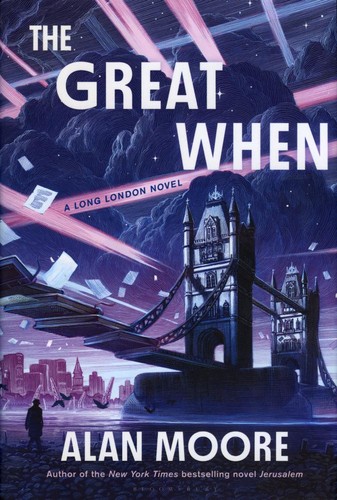
The Great When
by Alan Moore
★ Top 25 book of 2024 · #15 on Best Books of 2024
Alan Moore launches The Long London Quintet with this opening volume, planned as the first of five fantasy novels. It marks the English author's entry into a multi-book fantasy cycle set in the capital.
Best for: Readers who want to start a new multi-book fantasy series from the beginning
The Great When is #15 on BookWard's Best Books of 2024, out of 34 2024 books that cleared our data bar.
What The Great When is about
It is 1949, and eighteen-year-old Dennis Knuckleyard works in a second-hand bookshop in Shoreditch. Sent by his employer, Ada Benson, to collect some rare books by Arthur Machen, he comes back with something extra: a small volume called A London Walk. Ada tells him it comes from another London and was never meant to exist, and she wants it returned at once.
What follows takes Dennis out of his ordinary life and into a hidden version of the city, one with its own rules and its own dangers. Along the way he meets helpers, a few frightening figures from London's underworld, and real people from the period, including the painter Austin Spare. Alan Moore opens a planned five-book series here, mixing fantasy, the occult and crime with a deep fondness for old London. Readers who enjoy secret histories and strange, atmospheric adventures will feel at home.
The Great When on the Best Books of 2024
The Great When came out in 2024. Of the 34 books first published in 2024 that met BookWard's data bar, it ranks #15 on our Best Books of 2024 list.
Why it made the list: 300 readers have shelved it on Open Library; its Wikipedia page averaged 2,854 views a month recently. The list ranks each year’s books on how many readers have picked them up, how highly readers rate them, and how many are reading them right now.
Nearby on the 2024 list
- Someone You Can Build a Nest in John Wiswell, #13
- Absolution Jeff VanderMeer, #14
- The Anxious Generation Jonathan Haidt, #16
- The Boyfriend Freida McFadden, #17
See all Best Books of 2024 Best books by year
More years: Best Books of 2023 Best Books of 2025.
The numbers behind it
- Readers: 5 want to read it, 0 are reading it now and 2 have read it, according to Open Library.
- Wikipedia: its article averaged 2,854 views a month recently.
| Signal | This book (0 to 100) | Weight |
|---|---|---|
| Reach | 76 | 45% |
| Reader love | 74 | 20% |
| Being read right now | 47 | 15% |
| Attention | 47 | 20% |
Questions about The Great When
When was The Great When published?
The Great When by Alan Moore was first published in 2024.
Was The Great When one of the best books of 2024?
The Great When is #15 on BookWard's Best Books of 2024, out of 34 2024 books that cleared our data bar. 300 readers have shelved it on Open Library; its Wikipedia page averaged 2,854 views a month recently.
Why is The Great When on the Best Books of 2024 list?
300 readers have shelved it on Open Library; its Wikipedia page averaged 2,854 views a month recently.
More of the best books of 2024
- Wind and Truth Brandon Sanderson, #1
- The Let Them Theory Mel Robbins, #2
- The Tainted Cup Robert Jackson Bennett, #3
- Lights Out Navessa Allen, #4
- The Women Kristin Hannah, #5
- Funny Story Emily Henry, #6
See the full Best Books of 2024, the Top 100, or new books on Rising.
How we know
This page uses public data: Open Library reader counts and ratings, and Wikipedia page views for recent years. The description is paraphrased from real source text. Rankings reflect reading interest, not quality or sales, and can be affected by data gaps. Lists update monthly.
Best suited to adult readers and older teens comfortable with dense, richly written fantasy.
Depends on the edition you pick.
A bookshop errand drops a teenager into a stranger, hungrier London. 55% taste match
 BookWard’s take
A bookshop errand drops a teenager into a stranger, hungrier London
Alan Moore's first Long London Quintet novel opens in 1949 with eighteen-year-old Dennis Knuckleyard, a second-hand bookshop assistant sent to collect rare books. One stray volume, A London Walk, turns the errand sour, and the hook lands fast: a body, a hasty flight, and a gate into a London where the very surroundings try to eat him. It grabs at once, which is exactly how I like a book to begin. The voice is distinctive and unmistakable. The book is inventive and boldly fantastical, layering a hidden city over a real postwar one, with real figures such as Austin Spare and Prince Monolulu walking through. Expect the description to run rich and the prose toward the ornate, a touch more than I usually like. As the first of five, it is bound to leave an open thread or two.
A first volume of a planned five, built on a scale that invites a long, expansive read, longer than BookWard's tight preference.
Events chase Dennis quickly through the early chapters, close to BookWard's preferred speed.
A living, hostile double of London peopled by real figures is a fresh angle that BookWard rewards.
Moore is known for dense, richly worked language, leaning more ornate than BookWard's middle ground.
Dennis's predicament drives events, and the plot and the people share the load fairly evenly.
A frightening, hungry city sits against a young man's resilience, leaving the outlook balanced.
The book follows a quest-like line while moving between two Londons, so mildly unconventional.
Colorful period characters and a wry tone give it moments of humor under the menace.
A death, pursuit, and a city that tries to devour a person give it a darker edge.
Dennis's fear and weeping are felt, though the tone stays wry.
See all 50 dialsEvery position, side by side with this book
Where it lines up
- OriginalityBookWard 9 · book 9
- OpeningBookWard 10 · book 9
- PaceBookWard 8 · book 7
Where it pulls apart
- LengthBookWard 1 · book 7
- Internal logicBookWard 10 · book 6
- Familiar tropesBookWard 10 · book 7
A first volume of a planned five, built on a scale that invites a long, expansive read, longer than BookWard's tight preference.
A bookshop errand, a dead man and a flight through a gate all arrive early, matching BookWard's love of an immediate pull.
Hidden-London fantasy has a lineage, but real historical figures and an eating landscape keep it from feeling stock.
The otherworldly London runs on its own strange rules, which feel deliberate, though not always airtight.
Events chase Dennis quickly through the early chapters, close to BookWard's preferred speed.
A living, hostile double of London peopled by real figures is a fresh angle that BookWard rewards.
Dennis is a vivid young everyman, with a large supporting cast of colorful, specific figures.
As book one of a quintet, it leaves threads open, which sits below BookWard's love of resolution.
Moore tends toward wry observation over easy feeling, a reasonable match for BookWard.
The early death and the menace feel purposeful to the story rather than gratuitous.
Moore's voice is unmistakable and unlike anyone else's, which is exactly what BookWard prizes.
Story drives the early chapters, though the book carries a layer of ideas about London itself.
The world is revealed through Dennis stumbling into it, mostly shown, with some explaining by helpers.
The opening is propulsive, and a long book with a planned sequence risks some unevenness later.
Moore is known for dense, richly worked language, leaning more ornate than BookWard's middle ground.
Dennis's predicament drives events, and the plot and the people share the load fairly evenly.
A frightening, hungry city sits against a young man's resilience, leaving the outlook balanced.
The book follows a quest-like line while moving between two Londons, so mildly unconventional.
Colorful period characters and a wry tone give it moments of humor under the menace.
Dense prose and layered references ask for attention, slightly beyond BookWard's easy middle.
The story follows Dennis closely, so the viewpoint stays mostly narrow.
The tale runs forward from 1949 without any obvious time-shifting.
A hidden, otherworldly London that tries to eat people puts it firmly in fantasy.
Dennis meets a wide parade of named figures, from bookshop owners to painters and gangsters.
One young man's errand grows into something with larger stakes, in a planned five-book arc.
Events and encounters outweigh introspection as Dennis is pursued and sheltered in turn.
Encounters with a string of distinctive talkers carry much of the story.
Romance is not the focus of the opening.
A second London that is hostile and strange makes the setting highly unfamiliar.
Set in 1949, the book looks firmly back at postwar London.
Rooted in a specific era but built on enduring myth about the city, it should last.
The narration follows Dennis straightforwardly with no sign of deception.
The question of what A London Walk is and who should have it is murky rather than clean.
The environment itself is a threat, so the setting is described richly and strangely.
The first of five intended novels, so it is clearly part of a larger series.
A single stray book upends an errand and keeps the surprises coming.
It pushes the reader through a strange world and dense language rather than offering comfort.
A death, pursuit, and a city that tries to devour a person give it a darker edge.
Dennis's fear and weeping are felt, though the tone stays wry.
The comedy is more observational and character-based than broad.
Menace and a death appear early, though the opening is not relentlessly bloody.
A prostitute character appears, though the opening is not built around sexual content.
Political concerns are not front and center in the opening.
Period London speech and layered allusion make the language richer than plain.
Moore's narration carries personality and attitude, not a neutral tone.
It looks backward to 1949 and to London's older layers.
Wonder and menace coexist, so the worldview stays between cynical and idealistic.
Review written by BookWard, dial version 1, November 2026.
Who is The Great When right for?
Best suited to adult readers and older teens comfortable with dense, richly written fantasy. It includes a death, pursuit and menace, plus a prostitute character and period crime.
Dense prose and layered references ask for attention, slightly beyond BookWard's easy middle.
A death, pursuit, and a city that tries to devour a person give it a darker edge.
Dennis's fear and weeping are felt, though the tone stays wry.
Menace and a death appear early, though the opening is not relentlessly bloody.
Book CompanionThe Great When: ideas, characters, themes
A teenage bookshop assistant takes a book that should not exist and finds a second London that wants to consume him.
- The errand. In 1949 Dennis Knuckleyard, working at a Shoreditch second-hand bookshop, is sent to collect rare Arthur Machen books near Charing Cross Road.
- The stray book. Among the goods sits A London Walk by the Reverend Thomas Hampole, an item that does not belong with the rest.
- The warning. Ada says the book comes from another London and is not meant to exist, and demands it be returned.
- The other London. Fleeing pursuers, Dennis passes through a gate into an otherworldly area where the environment tries to eat him.
- The search for help. Dennis is directed to surrealist painter Austin Spare, who offers help and suggests Dennis keep the book for now.
Characters
Dennis Knuckleyard
Protagonist
An eighteen-year-old assistant at a Shoreditch second-hand bookshop who ends up carrying a dangerous book.
Ada Benson
Bookshop proprietor
Dennis's employer, who grows troubled about A London Walk and insists it be returned.
Maurice Calendar
Local guide
A resident of the strange London who takes Dennis to safety and points him toward Austin Spare.
Austin Spare
Surrealist painter
A Brixton artist who agrees to help Dennis and suggests he keep the book with him.
Grace Shilling
Sheltering stranger
A prostitute who finds Dennis weeping on the curb and shelters him out of curiosity.
Themes
The idea that another, older version of the city lies beneath or beside the one people know.
An object whose mere existence is a threat to those who hold it.
A young, ordinary person pulled out of routine into forces far beyond him.
The city and its landscape act as living, even hostile, presences.
Actual historical figures share the page with a fantastical secret world.
Discussion questions
- Why might a single book be considered something that is not meant to exist?
- How does making the landscape itself hostile change the feel of a chase?
- What does mixing real historical figures into a fantasy add or take away?
- How does Dennis's youth shape the way he reacts to what he finds?
- What do you expect the rest of a five-book sequence to need to resolve?
Personalize your Book Companion
This is the general edition. In BookWard, the Companion is written for you: your reading profile, your notes, and spoiler-safe to the page you are on.
Buy, listen or borrow The Great When
Each link opens a search for this book on that store, in a new tab.
Read on a device
Borrow
Reviews and community
If you liked The Great When
A murder mystery inside a succession contest, narrated with a wink
Preludes & NocturnesNeil GaimanA dark, strange opening chapter for the Sandman saga
The Amulet of SamarkandJonathan StroudA sarcastic djinni steals the show in magical London
The Vampire LestatAnne RiceA rock-star vampire tells his own story, grandly and unapologetically
Find your own best books
Add what you have read, rate it, and BookWard will recommend what to read next.
Free to start. No credit card needed.