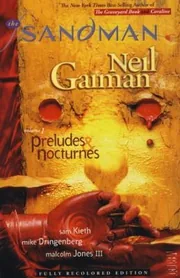
Preludes & Nocturnes
by Neil Gaiman, Sam Kieth · 1991
Best suited to mature teens and adults, since it contains horror imagery and violence.
240 pages, about 4 to 5.5 hours.
A dark, strange opening chapter for the Sandman saga. 55% taste match
The story
Preludes & Nocturnes is a fantasy graphic novel from 1991, the first collected volume of The Sandman, published under the DC Vertigo imprint. It gathers the opening eight issues of the series. Neil Gaiman wrote it, with art by Sam Kieth, Mike Dringenberg and Malcolm Jones III, colors by Robbie Busch and lettering by Todd Klein. The book runs to roughly 240 pages and has appeared in fifteen editions.
The story follows Morpheus, also known as Dream of the Endless, who is held captive for decades by an occultist after immortality. Once free and diminished in strength, he sets out to recover his scattered objects of power. His search takes him from London to Hell and back to his own realm, the Dreaming, and brings him into contact with figures such as John Constantine, Lucifer, John Dee and Doctor Destiny. The narrative moves across a span from the early 1900s to 1988, and it blends horror and fantasy with a missing persons thread. Readers looking for the starting point of the Sandman series will find it here.
Characters
DreamMorpheusJohn ConstantineLuciferJohn DeeDr Destiny
Setting
The DreamingHellLondon
Period
Early 1900's to 1988
Themes
DreamEndlessgraphic novelDC VertigoLong Now Manual for CivilizationNew York Times bestsellerLiteratureComics & graphic novels, horror
- Want to read 166
- Reading now 4
- Read 105
Readers are split between finishing it and saving it for later.
Of 275 readers who put it on a shelf, 60% want to read it, 1% are reading it now, 38% have finished it and 0% stopped before the end.
By the numbers
- The median edition runs 240 pages. Counting about 275 words a page and an adult reading pace of 250 words a minute, that is about 4.4 hours of reading.
- Open Library tracks 15 editions from 10 publishers, the earliest dated 1991 and the latest 2022.
- On reader demand it ranks in the top 2% of the modern books in our catalog (15,152 of them).
- Libraries shelve it under Dewey 741.5973 and Library of Congress class PN-6737.00000000.G3 2010.
 BookWard’s take
A dark, strange opening chapter for the Sandman saga
Preludes & Nocturnes is where The Sandman begins, and it begins with a captive. Morpheus, Dream of the Endless, is held for decades by an occultist and must rebuild his power once free. The hook is immediate, and it grabs you from the first pages. The mythology is strikingly original: Dream, Hell and the Dreaming fit together into a world that feels invented rather than borrowed. The voice is distinctive too, with Gaiman's writing paired with art by Sam Kieth, Mike Dringenberg and Malcolm Jones III. The early issues lean toward horror and shock more than later volumes do, so readers wary of darkness should go in knowing that. The pace is brisk across eight collected issues, and the book works as a starting point for the series rather than a sealed standalone.
At roughly 240 pages collecting eight issues, it is compact, close to BookWard's preference for tight books.
Eight issues move quickly from one confrontation to the next, a little below BookWard's fast preference.
Dream as a character among the Endless is an inventive premise, close to what BookWard values.
Gaiman's captions and dialogue are lyrical without being heavily ornate.
The quest structure drives events, with Morpheus's character secondary to the chase.
Dream's captivity and the horrors he meets give the book a bleak, shadowed outlook.
It stitches together separate issues, so it reads as a sequence of episodes more than one seamless tale.
Humor is rare here, as the tone stays grave and eerie.
Captivity, horror and Hell give it a decidedly dark content level.
The mood is brooding and eerie more than overtly intense.
See all 50 dialsEvery position, side by side with this book
Where it lines up
- Authorial voiceBookWard 9 · book 9
- OpeningBookWard 10 · book 9
- PaceBookWard 8 · book 7
Where it pulls apart
- Internal logicBookWard 10 · book 6
- LengthBookWard 1 · book 4
- Familiar tropesBookWard 10 · book 7
At roughly 240 pages collecting eight issues, it is compact, close to BookWard's preference for tight books.
It opens on Morpheus's capture and imprisonment, so the premise lands straight away, which BookWard rewards.
Occultists, Hell and gods of dreams are familiar fantasy ground, though the Endless give them a fresh frame.
The quest to recover objects of power gives it a clear rule set, though early issues roam between episodes.
Eight issues move quickly from one confrontation to the next, a little below BookWard's fast preference.
Dream as a character among the Endless is an inventive premise, close to what BookWard values.
Morpheus is vivid and distinctive, but this opening volume spends more effort on setup than depth.
The quest reaches a firm conclusion, though it also sets up a long series ahead.
The tone is cold and mythic rather than sentimental, which fits BookWard's restrained taste.
Horror elements in the early issues lean on the grotesque, which sits slightly below BookWard's ideal.
This is a work of fiction, so rigor does not apply.
Gaiman's mythic voice and the shared art team give it a clear identity, which BookWard prizes.
It is driven by a quest and its encounters, with mythology supporting the story more than leading it.
Much is conveyed through image and scene, though the mythology is sometimes explained outright.
Short issues keep it moving, though the episodic detours slightly loosen the line.
Gaiman's captions and dialogue are lyrical without being heavily ornate.
The quest structure drives events, with Morpheus's character secondary to the chase.
Dream's captivity and the horrors he meets give the book a bleak, shadowed outlook.
It stitches together separate issues, so it reads as a sequence of episodes more than one seamless tale.
Humor is rare here, as the tone stays grave and eerie.
The comic format keeps it accessible, though the mythology asks for some attention.
Mostly Morpheus, but the story passes through several other figures and settings.
The story spans from the early 1900s to 1988, so time stretches across decades.
Dream, Hell and the Dreaming put it deep in fantasy territory.
Constantine, Lucifer, John Dee and Doctor Destiny make for a fair-sized cast.
Moving between London, Hell and the Dreaming gives it a wide, mythic reach.
Adventure and confrontations lead, with Morpheus's inner state shown in quieter moments.
Captions and speech balloons carry steady talk without dominating the page.
Romance plays no part in the premise, which centers on captivity and recovery.
The Dreaming and Hell are unfamiliar realms rendered with real invention.
It reaches from the early 1900s to 1988, set well before the present day.
Its myth-making has kept it in print and readable across many editions.
The story is told straightforwardly, without an unreliable voice.
Characters like Lucifer and Morpheus operate in gray territory rather than neat good versus evil.
The visual storytelling and its settings are richly drawn across dream and nightmare spaces.
This is fiction, so nonfiction style does not apply.
This is fiction, so a personal or detached nonfiction stance does not apply.
It is the first collected volume of The Sandman, built to lead into more.
Encounters bring some reversals, but the quest follows a readable path.
Dark themes and mythic strangeness push it past comfort without turning punishing.
Captivity, horror and Hell give it a decidedly dark content level.
The mood is brooding and eerie more than overtly intense.
Where wit appears, it is dry and sparing rather than broad.
Horror elements bring a fair amount of violence to the page.
Sexual content is limited and not central to the story.
Politics is absent as a theme; the story focuses on myth and quest.
The language is plain and accessible, with the mythic register as the main flourish.
Captions are measured and atmospheric rather than pushing a clear viewpoint.
The story leans on myth, memory and old powers, looking more to the past.
A shadowy, cold tone leaves the worldview closer to cynical than idealistic.
Review written by BookWard, dial version 1, November 2026.
Who is Preludes & Nocturnes right for?
Best suited to mature teens and adults, since it contains horror imagery and violence. Readers sensitive to dark or disturbing material may want to preview it first.
The comic format keeps it accessible, though the mythology asks for some attention.
Captivity, horror and Hell give it a decidedly dark content level.
The mood is brooding and eerie more than overtly intense.
Horror elements bring a fair amount of violence to the page.
Book CompanionPreludes & Nocturnes: ideas, characters, themes
A powerful being of dreams, freed after decades of captivity, must reclaim his lost tools to restore himself and his realm.
- A captive god. Morpheus is imprisoned for decades by an occultist seeking immortality, setting the story in motion.
- Recovering power. Weakened after escape, Dream must find his scattered objects of power.
- Journey across realms. The search carries him from London to Hell and back to the Dreaming.
- Meeting other figures. Along the way he crosses paths with figures such as John Constantine, Lucifer, John Dee and Doctor Destiny.
- Start of a series. It gathers the first eight issues of The Sandman and opens a much larger saga.
Characters
Morpheus
Protagonist
Dream of the Endless, a being whose realm is the Dreaming.
John Constantine
Figure Dream encounters
An occult figure who crosses Morpheus's path.
Lucifer
Ruler of Hell
Met when the search leads to Hell.
Doctor Destiny
Antagonist
A madman whose power poses a serious threat to Dream.
Themes
What it costs to be held, and what it takes to recover oneself afterward.
How a being of vast power copes with being diminished.
The blurred line between the waking world and the Dreaming.
Old powers and hidden knowledge as forces that shape human lives.
Discussion questions
- Why might the story begin with Morpheus captured rather than at full strength?
- How does moving from London to Hell to the Dreaming change the mood?
- What does the book gain from combining horror and fantasy?
- How do the contributions of different artists shape your reading of the story?
- Does this volume stand on its own, or does it work mainly as an opening to the series?
Personalize your Book Companion
This is the general edition. In BookWard, the Companion is written for you: your reading profile, your notes, and spoiler-safe to the page you are on.
Buy, listen or borrow Preludes & Nocturnes
Each link opens a search for this book on that store, in a new tab.
Read on a device
Borrow
Reviews and community
If you liked Preludes & Nocturnes
An empire that mines its dead sorcerers, seen through several fighters
The Book of ElsewhereKeanu ReevesAn immortal fighter wants to die, and a black-ops deal is his way out
AbsolutionJeff VanderMeerVanderMeer returns to Area X with a stranger, sharper, multi-part novel
The Drawing of the ThreeStephen KingDoorways on a beach, and a gunslinger who needs allies
Sources: Open Library.
Track Preludes & Nocturnes and find your next favorite
Add it to your shelf, rate what you have read, and BookWard will recommend what fits you.
Free to start. No credit card needed.