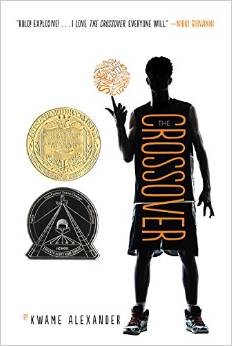
The Crossover
by Kwame Alexander
★ Top 25 book of 2014 · #19 on Best Books of 2014
Twin brothers Josh and Jordan are basketball stars, and Josh also pours his talent into rhymes and rhythm. When a new girl arrives at school, their close bond begins to unravel during a winning season.
Best for: Young readers who love basketball, poetry-style rhythm and stories about brotherhood
The Crossover is #19 on BookWard's Best Books of 2014, out of 66 2014 books that cleared our data bar.
What The Crossover is about
Josh Bell is a basketball phenom with a gift for rhymes, and the whole story is told in verse. He and his twin brother Jordan are standouts on the court, thanks to their dad. Their winning season should be a celebration, but things around them begin to change. When Jordan meets the new girl at school, the close bond between the twins starts to come apart. A story about brotherhood, family, and growing up, it asks what matters more than winning. It won the 2015 Newbery Medal and was named a Coretta Scott King Award Honor book. Young readers who love sports, poetry, or both will find a lot to enjoy, and so will the grown-ups who share it with them.
The Crossover on the Best Books of 2014
The Crossover came out in 2014. Of the 66 books first published in 2014 that met BookWard's data bar, it ranks #19 on our Best Books of 2014 list.
Why it made the list: 408 readers have shelved it on Open Library; readers rate it 4.5 out of 5 (18 ratings); 33 are reading it right now. The list ranks each year’s books on how many readers have picked them up, how highly readers rate them, and how many are reading them right now.
Nearby on the 2014 list
- Red Rising Pierce Brown, #17
- Archer's Voice Mia Sheridan, #18
- The Obstacle Is the Way Ryan Holiday, #20
- Everblaze Shannon Messenger, #21
See all Best Books of 2014 Best books by year
More years: Best Books of 2013 Best Books of 2015.
The numbers behind it
- Readers: 352 want to read it, 33 are reading it now and 23 have read it, according to Open Library.
- Ratings: 4.5 out of 5 from 18 Open Library ratings.
| Signal | This book (0 to 100) | Weight |
|---|---|---|
| Reach | 55 | 55% |
| Reader love | 82 | 25% |
| Being read right now | 71 | 20% |
Questions about The Crossover
When was The Crossover published?
The Crossover by Kwame Alexander was first published in 2014.
Was The Crossover one of the best books of 2014?
The Crossover is #19 on BookWard's Best Books of 2014, out of 66 2014 books that cleared our data bar. 408 readers have shelved it on Open Library; readers rate it 4.5 out of 5 (18 ratings); 33 are reading it right now.
Why is The Crossover on the Best Books of 2014 list?
408 readers have shelved it on Open Library; readers rate it 4.5 out of 5 (18 ratings); 33 are reading it right now.
More of the best books of 2014
- To All the Boys I've Loved Before Jenny Han, #1
- The Long Haul Jeff Kinney, #2
- Zero to One Peter A. Thiel, #3
- Surrounded by Idiots Thomas Erikson, #4
- After (After Series, Book 1) Anna Todd, #5
- Ugly Love Colleen Hoover, #6
See the full Best Books of 2014, the Top 100, or new books on Rising.
How we know
This page uses public data: Open Library reader counts and ratings, and Wikipedia page views for recent years. The description is paraphrased from real source text. Rankings reflect reading interest, not quality or sales, and can be affected by data gaps. Lists update monthly.
It suits middle-grade readers and up, and works well for reluctant readers thanks to its short poems.
Depends on the edition you pick.
A slam-dunk verse novel about twins, basketball and a fracturing bond. 71% taste match
 BookWard’s take
A slam-dunk verse novel about twins, basketball and a fracturing bond
The Crossover is told entirely in verse, and that form is the whole trick: Josh Bell raps his way through a winning basketball season while his bond with twin brother Jordan begins to change. The opening is a strong one, because the voice grabs you on the first page, and the short poems move at a sprint. That voice is distinctive and the book feels genuinely original, a hoops story you can't mistake for anyone else's. The characters have real depth despite the economy of the form, and the book is about as tight as they come. It is driven more by character than by plot, and the ending is resolved without turning sugary. A quick read that leaves a mark.
A verse novel built from short poems, it is brief and compact, exactly the economy BookWard favors.
Short poems and game-day momentum keep it moving fast, close to BookWard's preference.
Telling a basketball story entirely in verse is a distinctive choice that sets it apart from typical sports fiction.
The language is musical and rhythmic but plain-spoken, a lean verse style rather than ornate writing.
Plot matters, but the heart of the book is the changing relationship between the twins.
There is real pain in it, yet the book leans toward warmth and connection.
Verse in place of prose is an unusual format, though the arc itself runs in a straightforward line.
There is playful swagger and wordplay, but the tone is mostly earnest.
It deals with loss and family strain but stays suitable for a young audience.
The brothers' bond and what tests it hit with real feeling.
See all 50 dialsEvery position, side by side with this book
Where it lines up
- LengthBookWard 1 · book 1
- Character depthBookWard 8 · book 8
- EndingBookWard 8 · book 8
Where it pulls apart
- Familiar tropesBookWard 10 · book 6
- Internal logicBookWard 10 · book 8
- ViewpointsBookWard 7 · book 2
A verse novel built from short poems, it is brief and compact, exactly the economy BookWard favors.
Josh's rapping voice grabs you from the first poem, which suits BookWard's love of an immediate opening.
A sports story with a family drama at its core uses some familiar beats, but the verse form keeps it fresh.
Events follow cleanly from character choices across the season, with nothing that feels arbitrary.
Short poems and game-day momentum keep it moving fast, close to BookWard's preference.
Telling a basketball story entirely in verse is a distinctive choice that sets it apart from typical sports fiction.
Josh and Jordan feel like individuals, and their shifting bond gives the book real emotional weight.
It resolves its central tension rather than leaving it hanging, which matches BookWard's taste for closure.
It is openly heartfelt, but it earns its feeling through the brothers' story rather than pouring it on.
The emotional turns grow out of the characters and the family's situation instead of being there to jolt you.
Josh's rhythmic, rhyming narration is unmistakable and carries the entire book.
This is firmly story-led, built around a season and a relationship rather than an argument.
Information arrives through Josh's poems and the action, not through explanation, which BookWard prizes.
Brief poems and a driving season structure leave little room for the middle to drag.
The language is musical and rhythmic but plain-spoken, a lean verse style rather than ornate writing.
Plot matters, but the heart of the book is the changing relationship between the twins.
There is real pain in it, yet the book leans toward warmth and connection.
Verse in place of prose is an unusual format, though the arc itself runs in a straightforward line.
There is playful swagger and wordplay, but the tone is mostly earnest.
Short poems and a clear story make it an easy, fast read.
Everything is filtered through Josh, a single narrator.
The season unfolds in order, with a simple forward line.
It is entirely grounded in school, home and the basketball court.
The focus stays on a small circle of family and teammates.
The stakes are personal and family-sized, played out in one season and one household.
Game action and Josh's inner feelings share the page in roughly equal measure.
Voices and banter drive many poems, though the verse form keeps the exchanges brief.
A new girl at school matters to the plot, but she is a catalyst rather than the focus.
School, home and the court are familiar settings for most readers.
It is set in a recognizably contemporary world.
The brotherhood and family themes should carry well beyond its moment.
Josh narrates sincerely, and you read his account at face value.
The book has a clear heart, though it lets some of the family's choices stay complicated.
The poems sketch scenes economically, with energy rather than detail.
It is intimate and first-person throughout, as personal as narration gets.
This is a standalone book, though a companion series exists.
The big turns come from life changing the brothers, with few plot surprises.
It is accessible and emotional, with some hard moments but little that strains the reader.
It deals with loss and family strain but stays suitable for a young audience.
The brothers' bond and what tests it hit with real feeling.
Humor runs on swagger and wordplay, a mix of sly and playful.
There is essentially no violence on the page beyond competitive play.
The content stays suitable for young readers.
Politics are largely absent, with the focus kept on family and sport.
The language is plain and rhythmic, easy to follow aloud or silently.
Josh's strong voice colors everything, so the narration is quite opinionated.
The book looks ahead as the brothers face growing up and change.
It believes in family, effort and growth without ignoring the hurt.
Review written by BookWard, dial version 1, November 2026.
Who is The Crossover right for?
It suits middle-grade readers and up, and works well for reluctant readers thanks to its short poems. It deals with family strain and emotional hardship that younger readers may want to talk through.
Short poems and a clear story make it an easy, fast read.
It deals with loss and family strain but stays suitable for a young audience.
The brothers' bond and what tests it hit with real feeling.
There is essentially no violence on the page beyond competitive play.
Book CompanionThe Crossover: ideas, characters, themes
Told in verse by a young basketball star, it follows twin brothers whose close bond is tested as their lives start to change.
- Verse as voice. The entire story is told in poems, giving Josh a rhythmic, rapping voice that defines the book.
- Twins on the court. Josh and Jordan are standouts at basketball, thanks in large part to their dad.
- A winning season. The book follows the twins through a successful season as things around them shift.
- The new girl. When Jordan meets the new girl in school, the brothers' tight-knit bond begins to unravel.
- More than a game. The story argues that life doesn't come with a playbook and that winning isn't everything.
Characters
Josh Bell
Narrator and basketball player
A basketball phenom with a gift for rhymes who tells the story in verse.
Jordan Bell
Josh's twin brother
A fellow star on the court whose changing life strains the twins' closeness.
Their dad
Father and the twins' basketball influence
The reason both boys excel on the court.
Themes
The closeness between siblings and how it can strain and change.
Facing change without a clear playbook.
How basketball shapes who the brothers are.
Using rhyme and poetry to find rhythm when it counts.
A father's influence on his sons' lives and choices.
Discussion questions
- Why might the author have chosen verse rather than ordinary prose to tell this story?
- How does Josh's rapping voice shape the way you see his brother?
- What first begins to pull the twins apart, and could it have been avoided?
- What does the book suggest about winning versus what matters more?
- How does their father's influence show up in the way each boy plays and lives?
Personalize your Book Companion
This is the general edition. In BookWard, the Companion is written for you: your reading profile, your notes, and spoiler-safe to the page you are on.
Buy, listen or borrow The Crossover
Each link opens a search for this book on that store, in a new tab.
Read on a device
Borrow
Reviews and community
If you liked The Crossover
A bully's own story, told with humor and real heart
Double ActJacqueline WilsonTwo ten-year-old twins, one accounts book, and a family coming apart
Harriet the SpyLouise FitzhughA sharp, unsentimental school story that still bites
The Indian in the CupboardLynne Reid BanksA boy, a cupboard, and a toy brought to life
Find your own best books
Add what you have read, rate it, and BookWard will recommend what to read next.
Free to start. No credit card needed.