It suits upper elementary and middle-grade readers, and adults revisiting a favorite.
298 pages, about 4.5 to 7 hours.
A sharp, unsentimental school story that still bites. 69% taste match
About the book
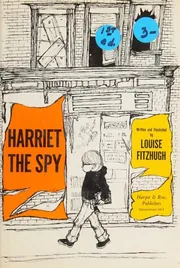
Harriet the Spy is a children's novel by Louise Fitzhugh, first published in 1960 and written and illustrated by the author. It belongs to the school story and spy story traditions, with elements of the mystery and detective genre, and it is widely counted among the classics of juvenile fiction in English. The book follows Harriet M. Welsch, a girl who watches the people around her and keeps track of what she sees.
Harriet's world is made up of school and the friends and classmates who fill it, among them Sport, Pinky Whitehead, and Marion Hawthorne. Friendship runs through the story alongside Harriet's habit of observing others, and the narrative opens with Harriet trying to teach Sport how to play a game called Town. The edition most often found runs to about 298 pages, and the book has appeared in 63 editions, which makes it easy to find in many formats for young readers and for anyone returning to a childhood favorite.
Harriet was trying to explain to Sport how to play Town.
Characters
Harriet M. WelschSportPinky WhiteheadMarion Hawthorne
Themes
Harriet the Spy (Fictitious character)SchoolsSchool storiesFriendshipSpy storiesClassicsGirls & WomenMysteries & Detective Stories
- Want to read 178
- Reading now 13
- Read 33
- Stopped 1
Most people shelving it are saving it for later.
Of 225 readers who put it on a shelf, 79% want to read it, 6% are reading it now, 15% have finished it and 0% stopped before the end.
By the numbers
- The median edition runs 298 pages. Counting about 275 words a page and an adult reading pace of 250 words a minute, that is about 5.5 hours of reading.
- Open Library tracks 63 editions from 32 publishers, the earliest dated 1960 and the latest 2025, across 4 languages.
- On reader demand it ranks in the top 6% of the classic books in our catalog (8,749 of them).
- Libraries shelve it under Dewey 813.54 and Library of Congress class PZ-0007.00000000.F5768 Har 2000.
 BookWard’s take
A sharp, unsentimental school story that still bites
Harriet the Spy is a book about watching people, and it watches closely itself. The voice is unmistakable: Harriet is blunt, funny and sometimes unkind, and the book never smooths her over. Her characterization runs unusually deep for a children's novel, and a girl who keeps notebooks on her neighbors was far from the usual children's heroine, so it feels fresh rather than familiar. The opening works because the story starts inside Harriet's routines and her friendship with Sport instead of easing the reader in. Sentiment is restrained for a children's book, and the humor is dry rather than broad. The pace is brisk without being rushed, and the setting stays grounded in school and city streets. Fitzhugh also illustrated it, which adds to its personality. A children's classic that adults can reread with pleasure.
At about 298 pages it is compact for a classic, and it stays focused on Harriet's world, which suits BookWard's taste for tight books.
It moves along through short scenes of school and neighborhood, brisk enough but gentler than BookWard's preferred speed.
Its unsentimental, observant protagonist set it apart from other children's fiction of its time, which BookWard rewards.
The writing is clear and direct, with no ornament, a little plainer than BookWard's middle position.
What happens grows out of who Harriet is and how she treats people, making it clearly character-driven.
It ends on a note of recovery, though the book is willing to be uncomfortable along the way.
A conventional narrative of school days, with notebook entries as a light touch, nothing experimental.
Harriet's bluntness and the comic types around her give it real humor alongside its serious beats.
See all 50 dialsEvery position, side by side with this book
Where it lines up
- Character depthBookWard 8 · book 8
- Shock for effectBookWard 9 · book 9
- Authorial voiceBookWard 9 · book 9
Where it pulls apart
- Internal logicBookWard 10 · book 7
- LengthBookWard 1 · book 3
- OpeningBookWard 10 · book 8
At about 298 pages it is compact for a classic, and it stays focused on Harriet's world, which suits BookWard's taste for tight books.
It opens straight into Harriet's world and her friendship with Sport, with her observing habit established early, which fits BookWard's love of a fast start.
A girl who spies on neighbors and classmates and records it in notebooks was a fresh heroine, and the book avoids neat moral packaging.
Harriet's observations and routines hold together consistently, so the story's cause and effect feel sound within a child's world.
It moves along through short scenes of school and neighborhood, brisk enough but gentler than BookWard's preferred speed.
Its unsentimental, observant protagonist set it apart from other children's fiction of its time, which BookWard rewards.
Harriet is drawn with flaws and sharp edges, and the classmates around her feel individual rather than stock types.
The story works toward a satisfying resolution rather than leaving things hanging, in line with BookWard's preference.
It keeps feelings plain and unadorned, avoiding easy sweetness, though it is warmer than BookWard's most restrained picks.
The story's hard moments come out of Harriet's own behavior and consequences, not from gratuitous darkness, which BookWard values.
Harriet's blunt, funny, self-assured perspective gives the book a strongly recognizable voice, a major plus for BookWard.
This is firmly story-led, built on Harriet's days and relationships, matching BookWard's lean toward narrative.
Information comes through scenes and Harriet's notebook entries rather than lectures, which BookWard prefers.
The scenes keep their energy and purpose through the middle, with little drift, in keeping with BookWard's taste.
The writing is clear and direct, with no ornament, a little plainer than BookWard's middle position.
What happens grows out of who Harriet is and how she treats people, making it clearly character-driven.
It ends on a note of recovery, though the book is willing to be uncomfortable along the way.
A conventional narrative of school days, with notebook entries as a light touch, nothing experimental.
Harriet's bluntness and the comic types around her give it real humor alongside its serious beats.
Written for young readers in plain language, it is an easy read for adults, lighter than BookWard's usual effort.
The story stays close to Harriet's perspective rather than moving among many minds.
Entirely realistic, set in ordinary school and city life with no fantasy elements.
A modest circle of classmates, family and neighbors, enough variety without becoming crowded.
The stakes are personal: friendships, school life and one girl's neighborhood.
It balances Harriet's thoughts and notes with her movements around the neighborhood, near the middle.
Conversation among Harriet and her classmates carries much of the story, putting it on the heavy side.
Friendship is the emotional center; romance is not part of the story.
The setting is an everyday school and neighborhood, familiar to most readers.
Its status as a children's classic and its lasting appeal suggest it has lasted beyond its era.
The narration is straightforward and trustworthy rather than playing tricks on the reader.
It refuses easy lessons, showing Harriet's mixed motives and leaving room for judgment, which BookWard enjoys.
Description serves the scenes and illustrations without lingering, so it is moderate rather than rich.
Review written by BookWard, dial version 1, November 2026.
Who is Harriet the Spy right for?
It suits upper elementary and middle-grade readers, and adults revisiting a favorite. Some of Harriet's behavior is unkind to others, which makes it a good prompt for talking about honesty and consequences.
Written for young readers in plain language, it is an easy read for adults, lighter than BookWard's usual effort.
Book CompanionHarriet the Spy: ideas, characters, themes
A girl who records what she sees of everyone around her discovers that watching people is not the same as understanding them.
- A watcher at the center. Harriet M. Welsch observes the people in her world and keeps track of what she sees, and the book is built around that habit.
- School as the stage. Much of the story plays out among classmates such as Sport, Pinky Whitehead and Marion Hawthorne.
- Friendship under pressure. Friendship runs through the story alongside Harriet's spying, and the two pull against each other.
- Spy story with a difference. It draws on the spy and detective traditions but applies them to everyday life and ordinary people.
- Words and pictures. Louise Fitzhugh wrote and illustrated it herself, giving the book a unified personality.
Characters
Harriet M. Welsch
Protagonist
A girl who watches the people around her and keeps track of what she sees.
Sport
Friend
A friend of Harriet's; the story opens with her teaching him a game called Town.
Pinky Whitehead
Classmate
One of the schoolmates in Harriet's world.
Marion Hawthorne
Classmate
Another classmate who is part of Harriet's school life.
Themes
Watching others closely, and the gap between seeing and understanding.
How closeness is built, tested and sometimes damaged.
The cost and value of saying or writing what you truly think.
Learning to deal with other people's feelings as well as your own.
Discussion questions
- Why does Harriet feel the need to watch and record other people?
- How does the book treat Harriet's flaws, and did you want her to change?
- What makes Sport a good friend to Harriet?
- Is spying on people ever justified, and where does the book draw its line?
- Why do you think this book has remained a classic?
Personalize your Book Companion
This is the general edition. In BookWard, the Companion is written for you: your reading profile, your notes, and spoiler-safe to the page you are on.
Buy, listen or borrow Harriet the Spy
Each link opens a search for this book on that store, in a new tab.
Read on a device
Borrow
Reviews and community
If you liked Harriet the Spy
Sedaris at his sharpest: family, odd jobs, and failing at French
Are You There God? It's Me, MargaretJudy BlumeA short, honest classic about faith, puberty and belonging
Hyperbole and a HalfAllie BroshA funny, honest memoir in cartoons, depression chapters included
CrashJerry SpinelliA bully's own story, told with humor and real heart
Sources: Open Library.
Track Harriet the Spy and find your next favorite
Add it to your shelf, rate what you have read, and BookWard will recommend what fits you.
Free to start. No credit card needed.