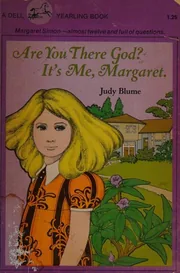
Are You There God? It's Me, Margaret
by Judy Blume · 1970
It suits middle-grade readers and up, especially those starting to ask big questions about growing up and belief.
154 pages, about 2.5 to 3.5 hours.
A short, honest classic about faith, puberty and belonging. 67% taste match
The story
Judy Blume's Are You There God? It's Me, Margaret., first published in 1970, is a middle-grade novel of contemporary realistic fiction. Its narrator is Margaret Simon, a sixth-grader who moves with her family from New York City to Farbrook, New Jersey. Her parents' interfaith marriage means she has been raised without a religious affiliation, and she sets out to work out which faith, if any, is hers, speaking to God in her own private prayers along the way.
Alongside that search, the book follows the everyday concerns of an early adolescent girl: puberty, menstruation, her first bra, and growing interest in boys. Margaret's circle includes classmates such as Nancy Wheeler, Gretchen Potter and Janie Loomis, and her family includes her parents Barbara and Herbert Simon and her grandmother Sylvia. The story's party games include Seven Minutes in Heaven. The book runs about 154 pages in its median edition and has appeared in 66 editions.
Are you there God?
Characters
Margaret SimonBarbara SimonHerbert SimonSylvia SimonNancy WheelerGretchen Potter
Setting
New York CityFarbrookNew JerseyHeaven
Themes
Children's Middle Grade Booksyoung adult novelspubertymenarcheChristiansJewsprayersanitary napkins
- Want to read 827
- Reading now 58
- Read 60
Most people shelving it are saving it for later.
Of 945 readers who put it on a shelf, 88% want to read it, 6% are reading it now, 6% have finished it and 0% stopped before the end.
By the numbers
- The median edition runs 154 pages. Counting about 275 words a page and an adult reading pace of 250 words a minute, that is about 2.8 hours of reading.
- Open Library tracks 66 editions from 47 publishers, the earliest dated 1970 and the latest 2024, across 4 languages.
- On reader demand it ranks in the top 1% of the classic books in our catalog (8,749 of them).
- Libraries shelve it under Dewey [Fic] and Library of Congress class PZ-0073.00000000.B62 1983.
 BookWard’s take
A short, honest classic about faith, puberty and belonging
At 154 pages, this is a tight book, and it opens with a direct address to God that pulls you in at once. Margaret Simon, a sixth-grader moving from New York City to Farbrook, New Jersey, narrates her own search for a religion that fits, and the voice is distinctive and unforced. That fits BookWard's taste for a strong Hook and a distinctive Authorial voice. Its Character depth is real: Margaret's worries about her first bra and first period feel specific, not generic. The Sentiment stays restrained and the Ending resolves cleanly. Its Familiar tropes are mostly its own invention, since later books borrowed from it. Where it parts from BookWard is on Pace: it is gentle and episodic, not fast.
At 154 pages it is compact and never overstays, which suits BookWard's love of short books.
It moves in short, episodic chapters at a gentle clip, slower than BookWard's taste for speed.
Its candid, private-prayer approach to growing up broke new ground in its day, though it now reads as familiar.
The language is plain and conversational, deliberately pitched to a sixth-grader's own voice.
What happens matters because of how Margaret feels about it, so character drives the story.
It runs in a straightforward sequence of episodes with a single narrator, which is conventional.
Wry, self-aware humor runs through Margaret's worries, lightening a sincere story.
The worries are everyday and tender, with little that is dark.
Feelings run warm and real without becoming overwrought.
See all 50 dialsEvery position, side by side with this book
Where it lines up
- LengthBookWard 1 · book 1
- Character depthBookWard 8 · book 8
- Shock for effectBookWard 9 · book 9
Where it pulls apart
- Familiar tropesBookWard 10 · book 8
- Internal logicBookWard 10 · book 8
- PaceBookWard 8 · book 5
At 154 pages it is compact and never overstays, which suits BookWard's love of short books.
It opens with a prayer addressed straight to God, which grabs attention immediately, as BookWard likes.
Its frank, specific treatment of puberty and belief feels fresh, not formulaic, close to BookWard's preference.
Margaret's choices and reactions follow naturally from her situation, so the story holds together well.
It moves in short, episodic chapters at a gentle clip, slower than BookWard's taste for speed.
Its candid, private-prayer approach to growing up broke new ground in its day, though it now reads as familiar.
Margaret's doubts, embarrassments and hopes are drawn with specific, believable detail, matching BookWard's taste.
It treats tender moments plainly and with humor, avoiding syrup, though it is warmer than BookWard's restraint.
Its frank subjects are handled with honesty, not for effect, so the candor feels earned.
Margaret's confiding, funny narration is instantly recognizable and carries the whole book.
It is led by Margaret's daily experience, with the faith question woven through the story.
Ideas surface through scenes, conversations and prayers, not lectures, which BookWard values.
Short chapters and steady incident keep the middle lively from start to finish.
The language is plain and conversational, deliberately pitched to a sixth-grader's own voice.
What happens matters because of how Margaret feels about it, so character drives the story.
It runs in a straightforward sequence of episodes with a single narrator, which is conventional.
Wry, self-aware humor runs through Margaret's worries, lightening a sincere story.
Short sentences and a clear storyline make it very easy to read.
Everything is seen through Margaret alone.
Events unfold in order across a school year.
It is a grounded, contemporary realistic story with no fantasy elements.
Margaret's family and a handful of classmates make a manageable, well-defined circle.
The story stays close to one girl's home, school and neighborhood.
Most of the action is Margaret's inner life, shown through her private conversations with God.
Chatter between friends and family carries much of the story.
Crushes and party games feature, but they sit beside the faith and puberty threads.
Suburban New Jersey and New York City are ordinary, recognizable settings.
It is rooted in 1970, so its details feel of the past, even as its feelings stay current.
Its worries about growing up, belonging and belief still land with new readers.
Margaret tells it straight and openly, so she is a reliable guide.
It leaves questions of faith open for Margaret to work out, without handing down a verdict.
Settings and people are sketched lightly, with attention kept on feelings and talk.
It is told in the first person from inside Margaret's own head.
It stands alone as a complete story.
The pleasures are small and human, not plot reversals.
It is gentle to read, though its frankness has stirred controversy.
The worries are everyday and tender, with little that is dark.
Feelings run warm and real without becoming overwrought.
The humor is gentle and observational, sitting between dry and broad.
There is essentially none on the page.
Puberty and crushes are discussed frankly, but nothing is explicit.
It is absent; the concerns are personal and family-sized.
The language is plain, everyday and easy.
Margaret's own views and feelings color everything she narrates.
It lingers in a particular moment of childhood, though it points toward growing up.
It trusts that honesty and kindness help a girl find her footing.
Review written by BookWard, dial version 1, November 2026.
Who is Are You There God? It's Me, Margaret right for?
It suits middle-grade readers and up, especially those starting to ask big questions about growing up and belief. Frank talk of puberty and religion is why it has been challenged, so some families may want to read it together.
Short sentences and a clear storyline make it very easy to read.
The worries are everyday and tender, with little that is dark.
Feelings run warm and real without becoming overwrought.
There is essentially none on the page.
Book CompanionAre You There God? It's Me, Margaret: ideas, characters, themes
A sixth-grader raised without religion goes looking for her own faith while navigating the everyday worries of puberty.
- A move to a new place. Margaret leaves New York City for Farbrook, New Jersey, and has to find her footing among new classmates.
- Prayers in her own words. She talks to God privately and informally, and these talks give the book its voice and shape.
- No inherited religion. Her parents' interfaith marriage means no faith was handed to her, so she decides to explore for herself.
- Growing up together. Questions about bras, periods and boys are shared with her friends, so they bind the group.
- Party games and crushes. Seven Minutes in Heaven and similar moments show the thrill and awkwardness of early adolescence.
Characters
Margaret Simon
Narrator and protagonist
A sixth-grader who is curious, anxious and funny as she searches for her own beliefs.
Barbara Simon
Margaret's mother
One of Margaret's parents, whose interfaith marriage leaves Margaret without an inherited religion.
Herbert Simon
Margaret's father
Margaret's other parent, part of the family that moves to Farbrook.
Sylvia Simon
Margaret's grandmother
A family member who is part of Margaret's wider circle.
Nancy Wheeler
Classmate
One of the girls in Margaret's new circle of friends.
Themes
Margaret tests what belief means without being handed an answer.
Puberty and first experiences mark the move from childhood toward adolescence.
Margaret wants to fit in with her friends and find her place in a new town.
Her parents' different backgrounds shape what she inherits and what she must choose.
The book speaks plainly about topics young readers rarely saw discussed.
Discussion questions
- Why does Margaret talk to God in private rather than in a religious setting?
- How does her parents' interfaith marriage shape her choices?
- Which worries in the book feel unchanged today, and which feel dated?
- Why might some adults object to the way the book discusses puberty and religion?
- What does Margaret gain from her friendships as she works through these questions?
Personalize your Book Companion
This is the general edition. In BookWard, the Companion is written for you: your reading profile, your notes, and spoiler-safe to the page you are on.
Buy, listen or borrow Are You There God? It's Me, Margaret
Each link opens a search for this book on that store, in a new tab.
Read on a device
Borrow
Reviews and community
If you liked Are You There God? It's Me, Margaret
A graphic memoir where a stomachache becomes a story about anxiety
CrashJerry SpinelliA bully's own story, told with humor and real heart
Harriet the SpyLouise FitzhughA sharp, unsentimental school story that still bites
There's a Boy in the Girl's Bathroom (Cascades)Louis SacharA short, funny school story about a kid everyone has written off
Sources: Open Library.
Track Are You There God? It's Me, Margaret and find your next favorite
Add it to your shelf, rate what you have read, and BookWard will recommend what fits you.
Free to start. No credit card needed.