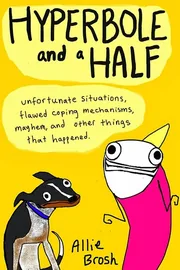
Hyperbole and a Half
by Allie Brosh · 2013
Suits teens and adults who enjoy comic memoir and personal humor.
384 pages, about 6 to 9 hours.
A funny, honest memoir in cartoons, depression chapters included. 62% taste match
The story
Hyperbole and a Half is a humor and essay collection by Allie Brosh, first published in 2013. It grew out of her webcomic and blog of the same name, which she began in 2009, and pairs short written pieces with her hand-drawn, simply styled cartoons. The book is a memoir in comic form, moving between childhood recollections and reflections on her own thinking and behavior.
Among the subjects are her struggles with depression, the habits and misunderstandings of her dogs, and everyday attempts at good conduct that go sideways. Some chapters come from the original website, while others were written for the book, which runs to roughly 384 pages in full color. Brosh's life in the western United States, including Idaho, Montana and Oregon, forms the backdrop, with stories reaching back to the 1990s and up to the present day. It sits within the tradition of comedic personal writing and will suit readers who enjoy humor that handles hard emotions directly.
Characters
Allie Brosh
Setting
IdahoMontanaOregonUnited States
Period
1990s2013
Themes
hyperboleandahalfhelper dogallie broshDuncanbrilliantsimple doggeniuscomedy
- Want to read 130
- Reading now 2
- Read 56
Most people shelving it are saving it for later.
Of 188 readers who put it on a shelf, 69% want to read it, 1% are reading it now, 30% have finished it and 0% stopped before the end.
By the numbers
- The median edition runs 384 pages. Counting about 275 words a page and an adult reading pace of 250 words a minute, that is about 7.0 hours of reading.
- Open Library tracks 7 editions from 7 publishers, the earliest dated 2013 and the latest 2014, across 2 languages.
- On reader demand it ranks in the top 4% of the modern books in our catalog (15,152 of them).
- Libraries shelve it under Library of Congress class PN-6727.00000000.B7568 H96 2013b.
 BookWard’s take
A funny, honest memoir in cartoons, depression chapters included
Allie Brosh turns her blog into a memoir in comic form, and the voice is the whole draw. It is unmistakable: the deliberately crude drawings and the deadpan captions could only be hers. The pace is quick, because each chapter is a short, self-contained story that gets in, makes its point and leaves. It is a funny book, yet the depression chapters are handled with a directness that makes them the most affecting part. The humor reads as timeless, since embarrassment, stubborn dogs and self-deception do not date. The structure is a loose collection rather than one arc, so it suits dipping in as much as reading straight through.
At 384 pages of mostly drawings and short chapters it reads fast, which BookWard likes, though it is longer than it feels.
Short chapters and image-driven pages keep things moving, close to BookWard's own liking for speed.
A memoir told through crude, expressive cartoons was a fresh form when it appeared, and it still feels distinct.
The writing is plain and conversational, and the style comes from the comedic timing and the drawings.
The book runs on Brosh herself, her habits and her inner life, more than on any plot.
It faces despair honestly but is shot through with warmth, so the overall feel leans a little toward hopeful.
A set of standalone chapters mixing words and pictures is a looser shape than a standard memoir, though still easy to follow.
Humor is the engine of the book, from the dogs to her own misjudgments.
Mostly light and comic, with one section about depression that goes to a genuinely dark place.
The depression chapters in particular hit with real force beneath the jokes.
See all 50 dialsEvery position, side by side with this book
Where it lines up
- PaceBookWard 8 · book 8
- OriginalityBookWard 9 · book 9
- Character depthBookWard 8 · book 8
Where it pulls apart
- Rigor (nonfiction)BookWard 9 · book 2
- Internal logicBookWard 10 · book 6
- LengthBookWard 1 · book 4
At 384 pages of mostly drawings and short chapters it reads fast, which BookWard likes, though it is longer than it feels.
Each chapter opens straight into a story or a joke, so you are hooked within a page or two.
Her cartoon style and self-mocking angle avoid the usual memoir and humor-book formulas, which BookWard rewards.
It is a collection of anecdotes and reflections, so the logic is the loose logic of personal storytelling rather than a built system.
Short chapters and image-driven pages keep things moving, close to BookWard's own liking for speed.
A memoir told through crude, expressive cartoons was a fresh form when it appeared, and it still feels distinct.
Brosh draws herself, with all her contradictions and bad ideas, in a way that feels thoroughly known.
As a collection it closes without one big resolution, though individual chapters land their punchlines and conclusions.
She is open about feelings but undercuts them with jokes, so the emotion rarely turns syrupy.
The dark material, especially around depression, is there because it was her experience, not for effect, which BookWard values.
This is personal storytelling, not research, so rigor is not what it offers and not what it claims.
The deadpan, self-deprecating, hyperbolic voice is unmistakable and carries the entire book.
It is led by stories from her life, with ideas about behavior and mind emerging from them.
Brosh mostly shows through scenes and drawings, though her captions do narrate and explain the jokes.
Short, self-contained chapters keep energy up, with only the occasional piece landing softer than the rest.
The writing is plain and conversational, and the style comes from the comedic timing and the drawings.
The book runs on Brosh herself, her habits and her inner life, more than on any plot.
It faces despair honestly but is shot through with warmth, so the overall feel leans a little toward hopeful.
A set of standalone chapters mixing words and pictures is a looser shape than a standard memoir, though still easy to follow.
Humor is the engine of the book, from the dogs to her own misjudgments.
It is a quick, easy read with pictures doing much of the work, in line with BookWard's moderate preference.
Everything is seen through Brosh's own eyes, so it is a single viewpoint.
Stories jump between childhood and the present with no strict order, so the timeline shifts from chapter to chapter.
The stories are real, though her exaggerated cartoons add a playful, cartoonish edge.
A small circle of recurring figures, mainly Brosh, her dogs and a few family and friends.
These are small, intimate stories about home, childhood and one person's head.
Much of the book is her thinking and feeling, even when the stories involve events.
Speech appears in captions and bubbles but is not the main vehicle, so it sits in the middle.
Romance is barely a theme here, with the focus on family, pets and self.
The world is everyday American life, so the setting is familiar.
Mostly stories from the 1990s up to the present day of the blog, so recent rather than historical.
The comic observations about embarrassment, animals and the mind feel likely to hold up for years.
Brosh is candid and openly reports her own flaws and self-deceptions, so she reads as reliable.
She does not preach, and some stories leave her actions open to judgment, though the stakes are clear.
Her drawings do the describing, with the prose staying brief.
It is storytelling first, with personal anecdotes rather than analysis.
This is one of the most personal books around, built entirely on her own experience.
It stands on its own, collecting blog material in one volume.
Chapters often turn on a sudden comic or emotional swerve, though there is no overall plot to twist.
It entertains throughout, but the depression chapters are honest enough to unsettle.
Mostly light and comic, with one section about depression that goes to a genuinely dark place.
The depression chapters in particular hit with real force beneath the jokes.
Much of the humor is exaggerated and absurd, though delivered with a dry, deadpan tone.
Little physical violence appears, only slapstick-level mishaps.
Sexual content is essentially absent.
The book stays out of politics and sticks to personal life.
The language is plain, conversational and easy to follow.
Brosh's own attitudes and reactions are front and center in every chapter.
It mostly looks back at her childhood and past experiences, with some attention to the present.
She is clear-eyed about human flaws but not bitter, landing in a balanced middle.
Review written by BookWard, dial version 1, November 2026.
Who is Hyperbole and a Half right for?
Suits teens and adults who enjoy comic memoir and personal humor. It deals openly with depression, so readers sensitive to that topic may want to approach those chapters with care.
It is a quick, easy read with pictures doing much of the work, in line with BookWard's moderate preference.
Mostly light and comic, with one section about depression that goes to a genuinely dark place.
The depression chapters in particular hit with real force beneath the jokes.
Little physical violence appears, only slapstick-level mishaps.
Book CompanionHyperbole and a Half: ideas, characters, themes
A funny, honest comic memoir that uses crude cartoons and exaggeration to look at childhood, dogs, self-deception and depression.
- Memoir as comic. Brosh combines short written pieces with simple hand-drawn cartoons to tell stories from her own life.
- Childhood and family. Many chapters look back at childhood recollections, including the world of her family in the western United States.
- The dogs. Her pets supply some of the funniest material, built on their habits and misunderstandings.
- Good intentions gone wrong. Everyday attempts at conduct and self-improvement keep sliding sideways in comic ways.
- Depression. The book treats her struggle with depression directly and with the same honesty as the jokes.
Characters
Allie Brosh
Author and narrator
The cartoon version of herself at the center of every story.
Duncan
Dog
One of her dogs, named in the subject list and a source of comic stories about animal behavior.
Themes
How comedy can sit alongside, and help express, serious emotional struggle.
An honest account of living with a mental illness.
The gap between how Brosh sees herself and how she actually behaves.
How early experiences shape the adult mind and its habits.
Everyday attempts to behave well and the ways they go wrong.
Discussion questions
- Why might simple, crude drawings carry emotion so effectively?
- How does the humor change when she writes about depression?
- Which chapter felt most true to your own experience, and why?
- What does the book suggest about the stories we tell ourselves?
- Does mixing jokes with serious subjects make the serious parts hit harder or softer?
Personalize your Book Companion
This is the general edition. In BookWard, the Companion is written for you: your reading profile, your notes, and spoiler-safe to the page you are on.
Buy, listen or borrow Hyperbole and a Half
Each link opens a search for this book on that store, in a new tab.
Read on a device
Borrow
Reviews and community
If you liked Hyperbole and a Half
A funny, warm memoir of friendship, bad dates and growing up
Harriet the SpyLouise FitzhughA sharp, unsentimental school story that still bites
Me Talk Pretty One DayDavid SedarisSedaris at his sharpest: family, odd jobs, and failing at French
SolitaireAlice OsemanA sharp, sad school mystery narrated by a cynic who won't admit she cares
Sources: Open Library.
Track Hyperbole and a Half and find your next favorite
Add it to your shelf, rate what you have read, and BookWard will recommend what fits you.
Free to start. No credit card needed.