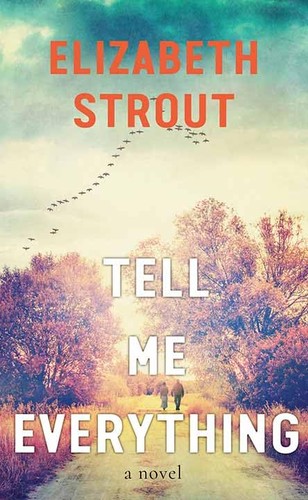
Tell Me Everything
by Elizabeth Strout
Elizabeth Strout gathers Lucy Barton, Olive Kitteridge and Bob Burgess in the fictional town of Crosby, Maine. Characters from several of her earlier books share one setting in this 2024 novel.
Best for: Readers of Strout's earlier books who want familiar characters reunited
Tell Me Everything ranked #24 on BookWard's Best Books of 2024 when we last measured it, in October 2026.
What Tell Me Everything is about
Elizabeth Strout gathers some familiar faces in the small, fictional town of Crosby, Maine, over one autumn. Bob Burgess, a semi-retired lawyer in his sixties, takes on the defense of a solitary man accused of killing his elderly mother, whose body was found in a quarry pool. Bob also keeps up his regular walks with his close friend Lucy Barton, a writer, and the two talk about their lives, fears and regrets.
Olive Kitteridge, now ninety and living in a retirement community, has her own ideas about Bob and Lucy, and she asks to meet Lucy. When they sit down together, they swap stories about people they have known, the lives Olive calls unrecorded. Strout writes with quiet attention about friendship, unspoken love and the worth of ordinary lives. Readers who know her earlier novels will enjoy the reunion, and newcomers can settle in easily too.
Tell Me Everything on the Best Books of 2024
Tell Me Everything came out in 2024. When we last measured it, in October 2026, it ranked #24 on our Best Books of 2024 list. It is not among the top books of 2024 on this month’s list, and the numbers on this page are the latest we have.
The numbers behind it
- Readers: 19 want to read it, 0 are reading it now and 3 have read it, according to Open Library.
- Wikipedia: its article averaged 2,691 views a month recently.
| Signal | This book (0 to 100) | Weight |
|---|---|---|
| Reach | 79 | 45% |
| Reader love | 58 | 20% |
| Being read right now | 45 | 15% |
| Attention | 42 | 20% |
Questions about Tell Me Everything
When was Tell Me Everything published?
Tell Me Everything by Elizabeth Strout was first published in 2024.
Was Tell Me Everything one of the best books of 2024?
Tell Me Everything ranked #24 on BookWard's Best Books of 2024 when we last measured it, in October 2026. 300 readers have shelved it on Open Library; its Wikipedia page averaged 2,691 views a month recently.
Why is Tell Me Everything on the Best Books of 2024 list?
300 readers have shelved it on Open Library; its Wikipedia page averaged 2,691 views a month recently.
More of the best books of 2024
- Wind and Truth Brandon Sanderson, #1
- The Let Them Theory Mel Robbins, #2
- The Tainted Cup Robert Jackson Bennett, #3
- Lights Out Navessa Allen, #4
- The Women Kristin Hannah, #5
- Funny Story Emily Henry, #6
See the full Best Books of 2024, the Top 100, or new books on Rising.
How we know
This page uses public data: Open Library reader counts and ratings, and Wikipedia page views for recent years. The description is paraphrased from real source text. Rankings reflect reading interest, not quality or sales, and can be affected by data gaps. Lists update monthly.
Best suited to adult readers, though the plain language makes it accessible to older teens.
Depends on the edition you pick.
Strout gathers Lucy, Olive and Bob in one quiet Maine autumn. 60% taste match
 BookWard’s take
Strout gathers Lucy, Olive and Bob in one quiet Maine autumn
Elizabeth Strout's 2024 novel returns to Crosby, Maine, where Bob Burgess defends a man accused of murdering his mother while his walks with Lucy Barton carry an unspoken tension. Olive Kitteridge, now ninety, enters the story and trades tales of "unrecorded lives" with Lucy. This is a book about people rather than plot, and it should not be approached as a mystery. It earns your attention from the first pages through voice rather than incident. The prose is plain and clear, and Strout shows feeling in conversation instead of announcing it, which gives the emotion its quiet force. The pace is unhurried. Readers new to Strout can follow it, but it pays off most for those who know these characters from her earlier books.
Unhurried walks and kitchen-table conversations set a slow pace, which sits apart from BookWard's preference for momentum.
The crossover of Lucy, Olive and Bob is distinctive, though the small-town Maine terrain is familiar Strout ground.
The sentences are clean and direct with little ornament, a bit plainer than BookWard's middle ground.
The murder case is present but this is a novel about people and their relationships, not plot machinery.
It is sober about regret and loneliness, yet it holds real warmth and the comfort of friendship.
Mostly conventional, built from linked conversations and stories, with some looseness in how it moves between voices.
Olive's bluntness brings dry moments, but the book is serious in tone overall.
A death sits at its center, but the treatment is subdued and reflective.
Feeling runs steady and quiet, with moments that land hard but few outbursts.
See all 50 dialsEvery position, side by side with this book
Where it lines up
- SentimentBookWard 8 · book 8
- Shock for effectBookWard 9 · book 9
- Authorial voiceBookWard 9 · book 9
Where it pulls apart
- OpeningBookWard 10 · book 6
- PaceBookWard 8 · book 3
- LengthBookWard 1 · book 4
It opens with a murder case and an unspoken friendship, but draws you in through quiet voice rather than a grabbing first page.
A murder defense and a late-life friendship could be stock material, but Strout avoids easy resolutions and stock gestures.
The murder case resolves coherently, though the book cares more about human behavior than airtight mechanics.
Unhurried walks and kitchen-table conversations set a slow pace, which sits apart from BookWard's preference for momentum.
The crossover of Lucy, Olive and Bob is distinctive, though the small-town Maine terrain is familiar Strout ground.
Bob, Lucy and Olive are drawn with long, specific histories, and their inner lives carry the whole book.
The case is resolved, but the romantic tension and the question of Bob's father's death stay open, so closure is partial.
Strout lets feeling surface in what characters say and avoid saying, never pushing the reader toward tears.
The killing is a framework for the characters, not a spectacle, and nothing here is darkness for effect.
Not applicable to a novel.
Strout's voice is unmistakable, plain, observant and gently wry, and it holds the whole book together.
Story-led, though Lucy and Olive's debate about what "unrecorded lives" mean gives it a thoughtful undercurrent.
Lives are revealed through scene and talk, not explained outright, which fits BookWard's taste.
The episodic structure of walks and visits keeps a steady texture, though the middle drifts at times.
The sentences are clean and direct with little ornament, a bit plainer than BookWard's middle ground.
The murder case is present but this is a novel about people and their relationships, not plot machinery.
It is sober about regret and loneliness, yet it holds real warmth and the comfort of friendship.
Mostly conventional, built from linked conversations and stories, with some looseness in how it moves between voices.
Olive's bluntness brings dry moments, but the book is serious in tone overall.
Easy to read in style and language, with the only demand being familiarity with the earlier books.
The story moves among Bob, Lucy, Olive and the tales they tell, giving it several viewpoints.
Told in a linear autumn in the present, with memory surfacing mainly through conversation.
Entirely grounded, set in an ordinary Maine town.
A handful of central figures plus townspeople who surface through their stories, a moderate cast.
A single town over one season, intimate in focus.
Much of the book is talk and reflection, with little action on the page.
Walks and visits are built on conversation, so dialogue carries much of the book.
Bob and Lucy's unresolved feelings run underneath, but the book is about more than romance.
Small-town Maine and a retirement community are everyday, familiar settings.
Set in the recent past and the present, shaped by the aftermath of the pandemic.
Its concerns about regret, friendship and ordinary lives should outlast the moment, though it leans on earlier books.
A steady, trustworthy narration with no games played on the reader.
Guilt, loyalty and blame are left uncertain, and the book resists neat verdicts.
Setting is sketched economically, as the book stays close to people and talk.
Not applicable to a novel.
Not applicable to a novel.
It draws on Lucy Barton, Olive Kitteridge and Bob Burgess stories from earlier books, so it rewards prior reading.
A gentle, humane read that asks little of the reader, with only some mild unease about mortality.
A death sits at its center, but the treatment is subdued and reflective.
Feeling runs steady and quiet, with moments that land hard but few outbursts.
What humor there is comes through dry, blunt remarks, especially from Olive.
Little sexual content beyond the nude portraits mentioned in passing.
Politics stays in the background of daily life.
Plain, accessible language with no heavy dialect.
Strout stays mostly neutral, letting characters speak without steering the reader.
It looks back at old lives and regrets, with some attention to what is left of the future.
It leans toward kindness and attention to others while staying clear-eyed about human failure.
Review written by BookWard, dial version 1, November 2026.
Who is Tell Me Everything right for?
Best suited to adult readers, though the plain language makes it accessible to older teens. It deals with a death, loneliness and regret, handled quietly and without graphic detail.
Easy to read in style and language, with the only demand being familiarity with the earlier books.
A death sits at its center, but the treatment is subdued and reflective.
Feeling runs steady and quiet, with moments that land hard but few outbursts.
Book CompanionTell Me Everything: ideas, characters, themes
Ordinary, unrecorded lives carry meaning, and listening to them is how people stay close to one another.
- A Maine town reunites old characters. The book brings Lucy Barton, Olive Kitteridge and Bob Burgess together in the fictional town of Crosby.
- Bob takes on a murder defense. Bob, a semi-retired lawyer, defends an isolated man accused of killing his elderly mother.
- Walks between Bob and Lucy. Their regular walks bring out fears, regrets and unspoken feelings for each other.
- Olive and Lucy trade stories. In Olive's apartment they swap tales of people they have known and argue over what such stories mean.
- Resolution without full closure. The case reaches an answer, while the older question about Bob's father's death stays unsettled.
Characters
Bob Burgess
Semi-retired lawyer
A man in his mid-sixties who takes on the murder defense and is close to Lucy while married to Margaret.
Lucy Barton
Writer
A well-known writer in her sixties who moved to Crosby during the pandemic and walks regularly with Bob.
Olive Kitteridge
Retirement-home resident
Ninety years old and blunt, she suspects Bob and Lucy are in love and asks to meet Lucy.
Margaret
Bob's second wife
A Unitarian minister who shares a home with Bob.
Themes
The idea that ordinary people's stories matter even when no one writes them down.
How closeness, loyalty and unspoken feeling shape people in their sixties and beyond.
The way past choices and losses stay with people and color how they see themselves.
How a death raises questions about responsibility that are never fully settled.
The isolation of people living on the edges of a small community.
Discussion questions
- Why does Lucy say the point of her stories is simply "people and the lives they lead", and do you agree?
- How does the murder case function in a book more interested in character than in plot?
- What do Bob and Lucy's walks reveal that they could not say elsewhere?
- How does Olive's bluntness change the way the other characters talk about their own lives?
- Does leaving the older family question unresolved feel honest or frustrating?
Personalize your Book Companion
This is the general edition. In BookWard, the Companion is written for you: your reading profile, your notes, and spoiler-safe to the page you are on.
Buy, listen or borrow Tell Me Everything
Each link opens a search for this book on that store, in a new tab.
Read on a device
Borrow
Reviews and community
If you liked Tell Me Everything
A quiet standalone about one man's hidden despair and a family secret
Harriet the SpyLouise FitzhughA sharp, unsentimental school story that still bites
Maybe You Should Talk to SomeoneLori GottliebA therapist on the couch, and four patients who mirror her
IntermezzoSally RooneyTwo grieving brothers, two tangled love lives, one quiet novel
Find your own best books
Add what you have read, rate it, and BookWard will recommend what to read next.
Free to start. No credit card needed.