Updated November 2, 2026 · reading data through October 2026
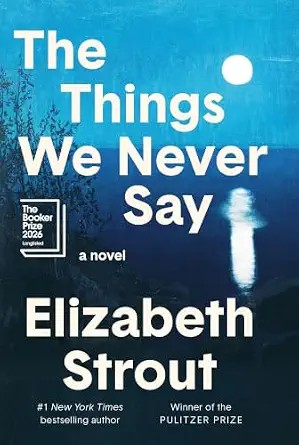
The Things We Never Say
by Elizabeth Strout
Artie Dam is living a double life. By day he teaches history to eleventh graders and lends a kind word to those who need it, while another part of his life stays hidden.
Best for: Readers who like quiet, character-driven literary fiction.
The Things We Never Say is #19 on BookWard's Rising chart for November 2026: the hottest new books published in the past two years.
What The Things We Never Say is about
Artie Dam is 57, a respected high school history teacher in a quiet Massachusetts coastal town, and he is lonely in a way almost no one around him suspects. He has been privately thinking about ending his life. A decade ago his son Rob was behind the wheel in a crash that killed his girlfriend, and Rob has been withdrawn ever since. Artie and his wife Evie, married thirty years, have drifted apart. On weekends he takes his sailboat out on the bay, and he keeps wondering how little people really know about those closest to them.
The story runs through the summer and autumn of 2024, with the presidential election drawing near in the background. When Artie learns a secret that could overturn his world, he has to look again at the people he thought he understood. Elizabeth Strout writes here about a new central character, outside the linked world of her earlier books. Readers who value quiet, humane fiction about marriage, family and the distance between people will find a lot to think about.
Why The Things We Never Say is on the Rising chart
Its Wikipedia page had 23,956 views last month. The Rising score blends six public signals, each scored from 0 to 100 against the other new books and weighted as shown.
| Signal | This book | Weight |
|---|---|---|
| Reader pace | 39 | 28% |
| Buzz | 89 | 24% |
| Growth | 8 | 18% |
| Being read right now | 43 | 12% |
| Reader love | 57 | 10% |
| Newness | 100 | 8% |
Holding strong Wikipedia attention is steady (within -20% to +25% of the two months before).
The numbers behind it
- Wikipedia: 23,956 page views last month, against an average of 28,218 in the two months before (down 15%). Read the article.
- Open Library readers: 12 want to read, 0 reading now, 3 have read it.
- Ratings: 4 out of 5 from 1 Open Library ratings.
The Things We Never Say on the Rising chart: history
| Month | Rank | Score |
|---|---|---|
| November 2026 | #19 | 53 |
| October 2026 | #21 | 53 |
Questions about The Things We Never Say
Is The Things We Never Say a new book?
Yes. The Things We Never Say by Elizabeth Strout was first published in 2026, and BookWard's Rising chart only includes books published in the past two years.
Why is The Things We Never Say on the Rising chart?
Its Wikipedia page had 23,956 views last month.
More new books readers are finding
- Life of M Rachel Cusk
- Dream Count Chimamanda Ngozi Adichie
- John of John Douglas Stuart
- Switzy Emma Cline
Prefer proven favorites? See the Top 100, or all Rising books.
How we know
This page uses public data: Open Library reader counts and ratings, and Wikipedia page views. The description is paraphrased from real source text (Open Library or Wikipedia). A book is on the Rising chart only if it was published in 2025 or 2026 and its readers are active and its interest is not falling. Rankings reflect reading interest, not quality or sales. Read the full methodology.
Suits adult readers who appreciate quiet literary fiction.
Depends on the edition you pick.
A quiet standalone about one man's hidden despair and a family secret. 60% taste match
 BookWard’s take
A quiet standalone about one man's hidden despair and a family secret
Strout steps away from her recurring Maine towns and gives us Artie Dam, a well-liked history teacher on the Massachusetts coast who hides how alone he feels. The story runs through the summer and autumn of 2024, up to the election. This is a book that lives in its characters: Strout draws ordinary people in close, patient detail, and her prose stays plain and restrained, letting feeling build without being pushed. It is firmly character-led, so the pace is slower than you might want if you like a story that moves quickly, and the opening builds quietly rather than grabbing you by the collar. The ending leans toward resolution rather than staying open. It suits readers who want emotional truth over momentum.
A standalone domestic novel of one man's season, likely compact in the way Strout's work usually is, which suits BookWard's tight preference.
A character-led novel about isolation moves slowly and reflectively, well below BookWard's fast preference.
The premise of a hidden inner life is well-worn, but Strout's compassionate angle gives it a distinct feel.
Strout's prose is spare and conversational rather than ornate, a little plainer than BookWard's middle ground.
Events serve Artie's inner reckoning, making this clearly character-driven, a touch more than BookWard's lean.
It faces despair directly but ends with renewed reconsideration, sitting near the middle of bleak and hopeful.
A single protagonist moving through one season in order is a conventional shape, near BookWard's middle.
Suicidal thoughts and a fatal crash in the past make this serious, though it is not graphic.
Loneliness and love run strong beneath a calm surface, felt rather than shouted.
See all 50 dialsEvery position, side by side with this book
Where it lines up
- Authorial voiceBookWard 9 · book 9
- Character depthBookWard 8 · book 9
- SentimentBookWard 8 · book 7
Where it pulls apart
- OpeningBookWard 10 · book 5
- PaceBookWard 8 · book 3
- Familiar tropesBookWard 10 · book 7
A standalone domestic novel of one man's season, likely compact in the way Strout's work usually is, which suits BookWard's tight preference.
Suburban teacher in midlife crisis is familiar ground, though Strout's close attention keeps it from feeling stock.
The family secret and Artie's reassessment follow from character and circumstance, so the story holds together soundly.
A character-led novel about isolation moves slowly and reflectively, well below BookWard's fast preference.
The premise of a hidden inner life is well-worn, but Strout's compassionate angle gives it a distinct feel.
Artie is drawn from the inside, with his marriage, son and loneliness examined closely, matching BookWard's love of depth.
Artie's arc moves toward reassessment and a new course, so the book resolves more than it leaves hanging.
Strout writes feeling plainly and without syrup, which fits BookWard's taste for restraint.
The darkness of suicidal thoughts and a past crash is handled seriously, not used as spectacle.
This is a novel, so the nonfiction dial does not apply.
Strout's plain, observant, unmistakable voice is the main draw and matches BookWard's love of distinct narration.
It is story-led, built around one man and his family, though it carries a big question about knowing each other.
Strout lets character and scene carry meaning rather than explaining it outright, as BookWard prefers.
A quiet, interior novel can drift in its middle, but the near-drowning and the family secret give it fixed turning points.
Strout's prose is spare and conversational rather than ornate, a little plainer than BookWard's middle ground.
Events serve Artie's inner reckoning, making this clearly character-driven, a touch more than BookWard's lean.
It faces despair directly but ends with renewed reconsideration, sitting near the middle of bleak and hopeful.
A single protagonist moving through one season in order is a conventional shape, near BookWard's middle.
The plain prose and single focus make it easy to read, though the subject matter weighs on you.
The story follows Artie almost entirely, so it sits well toward a single viewpoint.
Events run through summer and autumn of 2024 in sequence, with little jumping around in time.
It is a thoroughly grounded realist novel set on the Massachusetts coast.
A teacher, his wife, his son and a few colleagues and neighbors make a small, close cast.
The stakes are one family's private life, though the election gives it a faint wider backdrop.
Most of the action happens inside Artie's thoughts and feelings, well toward the inner pole.
The marriage matters to the plot, but this is not a love story at its center.
A coastal Massachusetts town and a school are everyday settings, very familiar.
Set in 2024 and published in 2026, it is as present-day as a novel gets.
Its questions about loneliness and knowing others are lasting, though the election ties it to a moment.
The book asks who we really know, and right and wrong are not simple, but it is not murky.
Strout uses spare, telling detail rather than lush scene-painting, so description stays moderate.
This is fiction, so the nonfiction dial does not apply.
The novel sits intimately inside one man's experience rather than observing from a distance.
It is explicitly a standalone, a break from her interconnected earlier books.
A son's revelation about Evie reshapes the story, but it is a quiet, character-based surprise.
The subject of hidden despair is heavy and unsettling, though the treatment is compassionate.
Suicidal thoughts and a fatal crash in the past make this serious, though it is not graphic.
Loneliness and love run strong beneath a calm surface, felt rather than shouted.
Humor is rare and dry where it appears.
The fatal crash is in the past and the near-drowning is brief, so little is shown.
Nothing in the premise points to sexual content as a feature.
The 2024 election is a backdrop that deepens Artie's alienation, present but not the main subject.
The language is plain, conversational American English with nothing hard to parse.
The narration stays close to Artie's feelings rather than pushing a viewpoint of its own.
It dwells on the past and a present reckoning more than on any imagined future.
Compassion for each character leans toward belief in human connection despite a dark mood.
Review written by BookWard, dial version 1, November 2026.
Who is The Things We Never Say right for?
Suits adult readers who appreciate quiet literary fiction. It deals directly with suicidal thoughts, a fatal accident and family grief, so it may be hard going for readers in a fragile place.
The plain prose and single focus make it easy to read, though the subject matter weighs on you.
Suicidal thoughts and a fatal crash in the past make this serious, though it is not graphic.
Loneliness and love run strong beneath a calm surface, felt rather than shouted.
The fatal crash is in the past and the near-drowning is brief, so little is shown.
Book CompanionThe Things We Never Say: ideas, characters, themes
How can we know so little about even those closest to us, and what does it take to keep going once a hidden truth surfaces?
- A double life. Artie is a beloved teacher and husband on the outside while privately contemplating suicide.
- The old crash. Ten years earlier his son Rob was driving when a car crash killed Rob's girlfriend, leaving Rob withdrawn.
- Drifting apart. Artie feels estranged from his wife Evie and senses growing distance between them.
- A near-drowning. Slipping while moving from his dinghy to his sailboat, Artie is rescued and briefly feels a renewed wish to live.
- A secret revealed. Rob tells Artie something about Evie that forces him to rethink his marriage and family.
Characters
Artie Dam
Protagonist
A 57-year-old high school history teacher, well liked but privately isolated and struggling.
Evie
Artie's wife
His wife of about three decades, from whom he feels increasingly distant.
Rob
Artie's son
Survived a car crash a decade ago and has since become withdrawn.
Themes
Feeling cut off even while surrounded by people who care.
How much of a person, even a spouse, stays unknown to others.
The lingering weight of a past tragedy on a family.
The 2024 election as a source of dread and disconnection.
Having to reassess a long relationship once a secret surfaces.
Discussion questions
- Why might Artie keep his despair hidden from everyone who seems to love him?
- What does the near-drowning change for him, and how lasting is it?
- How does the family secret change your view of Artie and Evie's marriage?
- What role does the election backdrop play in Artie's unraveling?
- Is it possible to truly know another person, and does this book think so?
Personalize your Book Companion
This is the general edition. In BookWard, the Companion is written for you: your reading profile, your notes, and spoiler-safe to the page you are on.
Buy, listen or borrow The Things We Never Say
Each link opens a search for this book on that store, in a new tab.
Read on a device
Borrow
Reviews and community
If you liked The Things We Never Say
Two grieving brothers, two tangled love lives, one quiet novel
Normal PeopleSally RooneyA quiet, exact love story about class and miscommunication
If I Was Your GirlMeredith RussoA tender, earnest first love story about a girl guarding her past
Tell Me EverythingElizabeth StroutStrout gathers Lucy, Olive and Bob in one quiet Maine autumn
Find new books before everyone else
Add what you have read, rate it, and BookWard will recommend what to read next.
Free to start. No credit card needed.