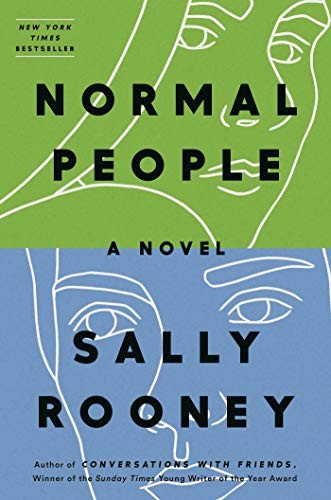
Normal People
by Sally Rooney
★ Top 10 book of 2018 · #7 on Best Books of 2018
Two Irish teenagers from different social positions form a hidden bond that carries through their university years. Drifting apart and back again, they face how far they will go for each other.
Best for: Readers who like spare, psychologically sharp stories of first love and class
Normal People is #7 on BookWard's Best Books of 2018, out of 60 2018 books that cleared our data bar.
What Normal People is about
At school, Connell and Marianne act as though they barely know each other. He is easygoing, well liked and the star of the soccer team. She is proud, lonely and fiercely private. Their paths cross because Connell's mother cleans Marianne's house, and when he comes to collect her, a connection forms that both teenagers are determined to keep hidden.
A year on, they are both at Trinity College in Dublin, but the positions have reversed: Marianne has found her place socially, while Connell feels shy and unsure. Over the college years they drift toward other people and keep being pulled back to each other. As Marianne spirals into self-destruction and Connell looks for meaning elsewhere, each has to face how much they would risk for the other. Sally Rooney's 2018 novel is told in spare, precise prose, with a quiet focus on class, first love and the difficulty of saying what you mean.
Normal People on the Best Books of 2018
Normal People came out in 2018. Of the 60 books first published in 2018 that met BookWard's data bar, it ranks #7 on our Best Books of 2018 list.
Why it made the list: 1,962 readers have shelved it on Open Library; readers rate it 4 out of 5 (84 ratings); 46 are reading it right now. The list ranks each year’s books on how many readers have picked them up, how highly readers rate them, and how many are reading them right now.
Nearby on the 2018 list
- Five Feet Apart Rachael Lippincott, #5
- Verity Colleen Hoover, #6
- Then She Was Gone Lisa Jewell, #8
- Circe Madeline Miller, #9
See all Best Books of 2018 Best books by year
More years: Best Books of 2017 Best Books of 2019.
The numbers behind it
- Readers: 1,779 want to read it, 46 are reading it now and 137 have read it, according to Open Library.
- Ratings: 4 out of 5 from 84 Open Library ratings.
| Signal | This book (0 to 100) | Weight |
|---|---|---|
| Reach | 90 | 55% |
| Reader love | 53 | 25% |
| Being read right now | 88 | 20% |
Questions about Normal People
When was Normal People published?
Normal People by Sally Rooney was first published in 2018.
Was Normal People one of the best books of 2018?
Normal People is #7 on BookWard's Best Books of 2018, out of 60 2018 books that cleared our data bar. 1,962 readers have shelved it on Open Library; readers rate it 4 out of 5 (84 ratings); 46 are reading it right now.
Why is Normal People on the Best Books of 2018 list?
1,962 readers have shelved it on Open Library; readers rate it 4 out of 5 (84 ratings); 46 are reading it right now.
More of the best books of 2018
- Heartstopper, Volume 1 Alice Oseman, #1
- Where the Crawdads Sing Delia Owens, #2
- The Laws of Human Nature Robert Greene, #3
- Atomic Habits James Clear, #4
- Five Feet Apart Rachael Lippincott, #5
- Verity Colleen Hoover, #6
See the full Best Books of 2018, the Top 100, or new books on Rising.
How we know
This page uses public data: Open Library reader counts and ratings, and Wikipedia page views for recent years. The description is paraphrased from real source text. Rankings reflect reading interest, not quality or sales, and can be affected by data gaps. Lists update monthly.
Best suited to older teens and adults, as the book deals frankly with sex and an emotionally difficult relationship.
Depends on the edition you pick.
A quiet, exact love story about class and miscommunication. 58% taste match
 BookWard’s take
A quiet, exact love story about class and miscommunication
Normal People follows Connell and Marianne from their last years of school in a small Irish town through university in Dublin, and it earns its attention through depth of character and restraint. The prose is spare and the sentiment stays controlled, which suits a story about two people who badly want to say the right thing and can't. It is driven by character more than plot, so the pull comes from watching them circle one another and return. Class sits under every scene without ever being announced. The ending is quieter than resolved, which may leave readers who want a firmer close wanting a little more. The opening is gentle rather than explosive, but the relationship keeps moving. Few books capture first love this precisely.
A compact novel that covers several years without padding, close to BookWard's preference for tightness.
Short scenes and time jumps keep it moving, though it is a gentle forward drift, not a rush.
The premise is well-worn, but the treatment is fresh enough to stand out without being strikingly new.
Plain, clean sentences with little ornament, a bit plainer than BookWard's middle-of-the-road taste.
Almost everything turns on the two leads' inner lives, more character-driven than BookWard's own lean.
Neither bleak nor sunny, it holds a cautious, mixed outlook.
Told in a linear sequence of dated chapters, with no real formal experiment.
There is dry wit in places, but the book is largely serious.
Moments of depression, cruelty and emotional harm give it a real shadow.
Feeling runs high beneath a calm surface, and it lands with force.
See all 50 dialsEvery position, side by side with this book
Where it lines up
- SentimentBookWard 8 · book 8
- Story or ideasBookWard 3 · book 3
- ExpositionBookWard 2 · book 2
Where it pulls apart
- OpeningBookWard 10 · book 6
- Familiar tropesBookWard 10 · book 6
- LengthBookWard 1 · book 4
A compact novel that covers several years without padding, close to BookWard's preference for tightness.
It opens on a small, charged situation between two teenagers rather than a jolt, so it builds more than it grabs.
The love-story frame is familiar, but the class and communication details feel specific and unforced.
Characters behave consistently with who they are, so their choices hold together even when frustrating.
Short scenes and time jumps keep it moving, though it is a gentle forward drift, not a rush.
The premise is well-worn, but the treatment is fresh enough to stand out without being strikingly new.
Connell and Marianne are drawn with great interior detail, which matches BookWard's love of deeply drawn people.
It settles on a note that feels earned but leaves some uncertainty, a little looser than BookWard prefers.
Emotion is handled with restraint and understatement, which sits well with BookWard.
Darker moments come from the characters' lives and are treated seriously, not used for effect.
Not a nonfiction book, so this dial does not apply.
The cool, precise narration is recognizable and distinct, and BookWard values that.
It is story and relationship first, with social themes carried inside the scenes.
Feelings and class tensions are shown through scenes and dialogue, rarely explained outright.
The structure of separations and reunions keeps tension steady across the whole book.
Plain, clean sentences with little ornament, a bit plainer than BookWard's middle-of-the-road taste.
Almost everything turns on the two leads' inner lives, more character-driven than BookWard's own lean.
Neither bleak nor sunny, it holds a cautious, mixed outlook.
Told in a linear sequence of dated chapters, with no real formal experiment.
There is dry wit in places, but the book is largely serious.
Short, clear sentences make it an easy read, though emotionally absorbing.
It moves between two main perspectives, so the range is narrow.
Mostly forward-moving with brief jumps, so the time structure stays easy to follow.
Entirely realistic, set in ordinary contemporary Irish life.
The focus stays on two people with a small circle of friends and family around them.
A deeply personal story about two lives, not a wide canvas.
Most of the drama happens in thought, feeling and conversation, not action.
Conversation carries much of the story, and much is left unsaid within it.
The relationship between the two leads is the spine of the whole book.
A recognizable present-day setting of school, university and family life.
Set in recent years, in a world close to the reader's own.
The subject of young love and class is lasting, though the details feel tied to its time.
A straightforward third-person narration that does not mislead.
The characters hurt each other without villains, so right and wrong stay muddy.
Settings are sketched lightly, with attention given to people over places.
A standalone novel.
Tension comes from emotional turns, not plot surprises.
Emotionally honest in ways that can unsettle, though never punishing.
Moments of depression, cruelty and emotional harm give it a real shadow.
Feeling runs high beneath a calm surface, and it lands with force.
Any humor is dry and understated, never broad.
Little physical violence on the page, though some difficult moments exist.
Intimacy is a recurring and frank part of the relationship.
Class and social standing matter throughout, but politics stays in the background.
The language is plain and easy to follow.
The narration observes and rarely editorializes.
Rooted in the characters' present, with a modest look ahead.
Neither cynical nor starry-eyed, it treats love as real but fragile.
Review written by BookWard, dial version 1, November 2026.
Who is Normal People right for?
Best suited to older teens and adults, as the book deals frankly with sex and an emotionally difficult relationship. It also touches on depression, self-harm and abusive treatment.
Short, clear sentences make it an easy read, though emotionally absorbing.
Moments of depression, cruelty and emotional harm give it a real shadow.
Feeling runs high beneath a calm surface, and it lands with force.
Little physical violence on the page, though some difficult moments exist.
Book CompanionNormal People: ideas, characters, themes
Two people who deeply understand each other keep failing to say what matters, shaped by class, shyness and timing.
- Class beneath the surface. Differences in background shape how Connell and Marianne are seen and how they see themselves.
- Silence and miscommunication. What goes unsaid between them drives much of the conflict.
- Two timelines of growth. School and university show how the same people change in new settings.
- Intimacy and power. The relationship explores closeness, dependence and who holds the upper hand.
- Spare, controlled style. The plain prose keeps feeling in check and lets small gestures carry weight.
Characters
Connell
One of the two leads
Popular and well-adjusted at school, but shy and uncertain once at university.
Marianne
One of the two leads
Lonely, proud and intensely private at school, finding her footing socially at university.
Themes
How money and background shape status, confidence and relationships.
The intensity and uncertainty of an early, formative attachment.
The gap between what people feel and what they manage to say.
How a person's sense of value affects the way they love and are loved.
Discussion questions
- Why do Connell and Marianne struggle to say what they mean to each other?
- How does class shape the way each of them is treated and sees themselves?
- Does the change of setting from school to university change who they are?
- Is the relationship good for them, bad for them, or both?
- How does the plain style affect the way you feel about the characters?
Personalize your Book Companion
This is the general edition. In BookWard, the Companion is written for you: your reading profile, your notes, and spoiler-safe to the page you are on.
Buy, listen or borrow Normal People
Each link opens a search for this book on that store, in a new tab.
Read on a device
Borrow
Reviews and community
If you liked Normal People
Two grieving brothers, two tangled love lives, one quiet novel
The Things We Never SayElizabeth StroutA quiet standalone about one man's hidden despair and a family secret
If I Was Your GirlMeredith RussoA tender, earnest first love story about a girl guarding her past
Heart the LoverLily KingA campus love triangle, revisited decades later by the one it shaped
Find your own best books
Add what you have read, rate it, and BookWard will recommend what to read next.
Free to start. No credit card needed.