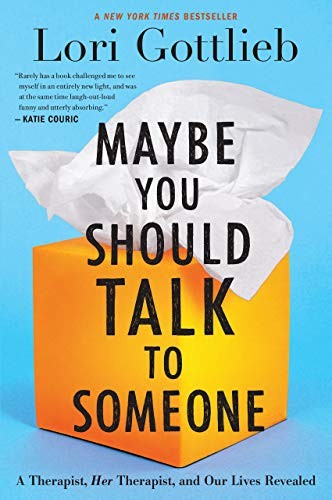
Maybe You Should Talk to Someone
by Lori Gottlieb
★ Top 25 book of 2019 · #15 on Best Books of 2019
Therapist Lori Gottlieb finds herself sitting in a colleague's office as a patient after a crisis upends her life. Alongside her own sessions, she shares the struggles of the people she treats, with humor and candor.
Best for: Readers curious about therapy, human behavior and the questions we all struggle with
Maybe You Should Talk to Someone is #15 on BookWard's Best Books of 2019, out of 83 2019 books that cleared our data bar.
What Maybe You Should Talk to Someone is about
Lori Gottlieb is a Los Angeles psychotherapist and advice columnist, and this memoir shows her life from both sides of the therapy room. After her long-time boyfriend ends things because he cannot live with a kid, she finds herself seeking help from Wendell, a quirky, seasoned therapist in a cardigan and khakis. Her friends push her to go, even though she is a trained therapist herself.
Alongside her own sessions, we meet the people she treats: John, a successful producer who thinks everyone around him is an idiot; Julie, a newlywed facing a terminal cancer diagnosis; Rita, who is turning seventy and says she does not want to live anymore if life does not get better; and Charlotte, a twenty-something who drinks too much and keeps choosing the wrong men. The questions they wrestle with turn out to be the ones Gottlieb brings to Wendell. Warm, candid and often funny, it will appeal to anyone curious about therapy, grief, regret, and the stories we tell ourselves.
Maybe You Should Talk to Someone on the Best Books of 2019
Maybe You Should Talk to Someone came out in 2019. Of the 83 books first published in 2019 that met BookWard's data bar, it ranks #15 on our Best Books of 2019 list.
Why it made the list: 887 readers have shelved it on Open Library; readers rate it 3.8 out of 5 (35 ratings); 32 are reading it right now. The list ranks each year’s books on how many readers have picked them up, how highly readers rate them, and how many are reading them right now.
Nearby on the 2019 list
- Find Me André Aciman, #13
- Ultralearning Scott Young, #14
- Daisy Jones & the Six Taylor Jenkins Reid, #16
- On Earth We're Briefly Gorgeous Ocean Vuong, #17
See all Best Books of 2019 Best books by year
More years: Best Books of 2018 Best Books of 2020.
The numbers behind it
- Readers: 814 want to read it, 32 are reading it now and 41 have read it, according to Open Library.
- Ratings: 3.8 out of 5 from 35 Open Library ratings.
| Signal | This book (0 to 100) | Weight |
|---|---|---|
| Reach | 93 | 55% |
| Reader love | 22 | 25% |
| Being read right now | 89 | 20% |
Questions about Maybe You Should Talk to Someone
When was Maybe You Should Talk to Someone published?
Maybe You Should Talk to Someone by Lori Gottlieb was first published in 2019.
Was Maybe You Should Talk to Someone one of the best books of 2019?
Maybe You Should Talk to Someone is #15 on BookWard's Best Books of 2019, out of 83 2019 books that cleared our data bar. 887 readers have shelved it on Open Library; readers rate it 3.8 out of 5 (35 ratings); 32 are reading it right now.
Why is Maybe You Should Talk to Someone on the Best Books of 2019 list?
887 readers have shelved it on Open Library; readers rate it 3.8 out of 5 (35 ratings); 32 are reading it right now.
More of the best books of 2019
- Red, White & Royal Blue Casey McQuiston, #1
- A Good Girl's Guide to Murder Holly Jackson, #2
- Heartstopper, Volume 2 Alice Oseman, #3
- Guts Raina Telgemeier, #4
- The Silent Patient Alex Michaelides, #5
- Into the Pit (Five Nights at Freddy’s Scott Cawthon, #6
See the full Best Books of 2019, the Top 100, or new books on Rising.
How we know
This page uses public data: Open Library reader counts and ratings, and Wikipedia page views for recent years. The description is paraphrased from real source text. Rankings reflect reading interest, not quality or sales, and can be affected by data gaps. Lists update monthly.
Best for adults and mature teens interested in psychology and personal growth.
Depends on the edition you pick.
A therapist on the couch, and four patients who mirror her. 60% taste match
 BookWard’s take
A therapist on the couch, and four patients who mirror her
Lori Gottlieb splits her attention between her own sessions with a therapist named Wendell and the patients she treats in her Los Angeles practice. That double vantage is the book's big idea, and it makes the structure feel fresh rather than familiar. The opening hooks at once: her world comes crashing down on page one, and we are in Wendell's office soon after. The characters are where it shines, with a Hollywood producer, a newlywed facing a terminal diagnosis, an older woman at a breaking point, and a young woman repeating the same mistakes. It keeps sentiment fairly restrained and leans on dry, observant humor over tears. Expect a personal, warm voice and a story-led read that teaches by example rather than lecture.
Short scenes and alternating threads keep it moving, though it is reflective rather than brisk.
Seeing a therapist's work and her own therapy side by side is a distinctive angle on a crowded genre.
The writing is plain, conversational and clear rather than ornate, in service of the stories.
Driven by people and their inner change rather than events, which BookWard enjoys.
Despite grief and illness, the book leans toward growth and the possibility of change.
Alternating between her therapy and her patients adds shape, but it is not formally experimental.
Wry, self-deprecating humor runs through a serious subject without undercutting it.
Terminal illness, despair and grief appear, handled with care and a light touch.
Moments of grief, fear and release hit hard even when told with humor.
See all 50 dialsEvery position, side by side with this book
Where it lines up
- Authorial voiceBookWard 9 · book 9
- Character depthBookWard 8 · book 9
- EndingBookWard 8 · book 7
Where it pulls apart
- Rigor (nonfiction)BookWard 9 · book 4
- LengthBookWard 1 · book 4
- Familiar tropesBookWard 10 · book 7
A breakup that upends a therapist's life opens the book and puts her in Wendell's office quickly, which BookWard prizes.
Therapy memoir and self-help conventions are present, though the therapist-as-patient frame keeps it from feeling stock.
Each patient arc and her own sessions connect cleanly, so the book's structure holds together well.
Short scenes and alternating threads keep it moving, though it is reflective rather than brisk.
Seeing a therapist's work and her own therapy side by side is a distinctive angle on a crowded genre.
Four patients and Gottlieb herself are drawn with real depth, which is exactly what BookWard rewards.
The threads come to a reasonably satisfying resolution rather than trailing off, a good match for BookWard.
It is emotional and sometimes tender, but humor and candor keep it from tipping into sappiness.
Hard moments, including illness and despair, are treated as part of real life rather than used for effect.
It is a memoir built on anecdote and case stories rather than data or formal argument.
Gottlieb's warm, wry, self-aware voice is the book's signature and a clear strength.
The ideas about change and self-deception arrive through stories, so it is story-led.
Insight mostly emerges inside therapy scenes, with occasional direct explanation from Gottlieb.
Switching among several patients and her own sessions keeps momentum fairly steady throughout.
The writing is plain, conversational and clear rather than ornate, in service of the stories.
Driven by people and their inner change rather than events, which BookWard enjoys.
Despite grief and illness, the book leans toward growth and the possibility of change.
Alternating between her therapy and her patients adds shape, but it is not formally experimental.
Wry, self-deprecating humor runs through a serious subject without undercutting it.
Easy, conversational reading that asks little beyond attention and openness.
We see the therapist's chair and the patient's chair, plus several patients' lives.
Mostly present-day sessions with some looking back at her career and background.
This is a grounded, real-world memoir with nothing fantastical in it.
A small core of five central figures, with a few supporting people around them.
Intimate by design, set in therapy rooms and private lives.
Almost entirely about thoughts, feelings and conversations rather than action.
Therapy sessions are built from conversation, so dialogue carries much of the book.
A breakup sets things in motion, but love is a theme rather than the center.
Therapy rooms and a Los Angeles practice are an everyday setting for most readers.
Set in the present-day era, drawing on contemporary life and published in 2019.
Its questions about grief, love and change will outlast the moment it was written.
Gottlieb narrates her own life candidly and reliably, including her flaws.
The book mostly invites understanding rather than judgment, though some choices are clearly framed.
Characters and rooms are sketched economically rather than richly described.
It reads as narrative memoir, told through scenes and stories rather than analysis.
Deeply personal, with the author as both narrator and subject.
A standalone memoir with no sequels required to follow it.
Revelations about patients' histories land, but surprise is not the point.
It gently challenges how we see ourselves while staying warm and accessible.
Terminal illness, despair and grief appear, handled with care and a light touch.
Moments of grief, fear and release hit hard even when told with humor.
The humor is dry and wry rather than broad or slapstick.
Violence is essentially absent, with distress shown in emotional rather than physical terms.
Relationships and a patient's dating life come up, but nothing is explicit.
Politics sits in the background, as the focus stays on personal lives.
Plain, clear language that is easy to follow throughout.
Gottlieb offers frank personal views and reflections but stops short of preaching.
Rooted in present-day lives, it looks toward change and growth as much as the past.
It believes people can change and connect, with a clear-eyed view of how hard that is.
Review written by BookWard, dial version 1, November 2026.
Who is Maybe You Should Talk to Someone right for?
Best for adults and mature teens interested in psychology and personal growth. It touches on terminal illness, suicidal thoughts and grief, handled with care but emotionally weighty.
Easy, conversational reading that asks little beyond attention and openness.
Terminal illness, despair and grief appear, handled with care and a light touch.
Moments of grief, fear and release hit hard even when told with humor.
Violence is essentially absent, with distress shown in emotional rather than physical terms.
Book CompanionMaybe You Should Talk to Someone: ideas, characters, themes
We tell ourselves stories to avoid painful truths, and real change begins when someone helps us see them honestly.
- Therapist and patient. Gottlieb shows both sides of the room, revealing that the helper needs help too.
- A crisis opens the door. A breakup throws her life into disarray and sends her to Wendell's office.
- Four patients, four struggles. A producer, a newlywed facing terminal illness, an older woman in despair and a young woman repeating mistakes each mirror her own questions.
- The stories we tell. Much of the book examines the truths and fictions people use to get through life.
- Candor as a method. Her honesty about her own flaws makes the lessons feel earned rather than preached.
Characters
Lori Gottlieb
Author and narrator, a therapist
A Los Angeles psychotherapist who becomes a patient after her life is upended.
Wendell
Gottlieb's therapist
A quirky, seasoned therapist who turns out to be far more perceptive than his appearance suggests.
John
A patient
A successful Hollywood producer who blames everyone around him and is hard to like at first.
Themes
The stories people tell themselves to avoid facing what hurts.
How people carry and eventually work through painful endings.
Whether and how people can become different from who they have been.
The courage it takes to be honest with others and with ourselves.
How being truly heard shapes healing.
Discussion questions
- Why might a therapist need therapy, and what does the book gain from showing both sides?
- Which patient's story stayed with you most, and why?
- How do the stories we tell ourselves protect us, and how do they hold us back?
- What did Wendell do as a therapist that surprised you?
- Would you try therapy after reading this, and what would you hope to get from it?
Personalize your Book Companion
This is the general edition. In BookWard, the Companion is written for you: your reading profile, your notes, and spoiler-safe to the page you are on.
Buy, listen or borrow Maybe You Should Talk to Someone
Each link opens a search for this book on that store, in a new tab.
Read on a device
Borrow
Reviews and community
If you liked Maybe You Should Talk to Someone
A lonely teenager chases the story behind a famous painting
Anxious PeopleFredrik BackmanA botched bank robbery turns into a warm, funny group portrait
Tomorrow, and Tomorrow, and TomorrowGabrielle ZevinA thirty-year friendship told through the games two people build
Everything I Know About LoveDolly AldertonA funny, warm memoir of friendship, bad dates and growing up
Find your own best books
Add what you have read, rate it, and BookWard will recommend what to read next.
Free to start. No credit card needed.