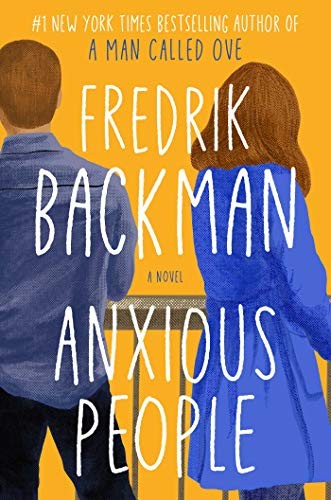
Anxious People
by Fredrik Backman
★ Top 25 book of 2019 · #22 on Best Books of 2019
On New Year's Eve, a clumsy but polite bank robber takes a group of apartment viewers hostage. As police wait outside, the nervous strangers start to discover they share more than they expected.
Best for: Readers who enjoy warm, humorous ensemble stories about ordinary people in a tight spot
Anxious People is #22 on BookWard's Best Books of 2019, out of 83 2019 books that cleared our data bar.
What Anxious People is about
A bank robber needs money for rent so his children will not be taken from him. His plan collapses when he finds the bank is cashless, and he flees into an apartment building where an open viewing is under way on New Year's Eve. Suddenly a small group of strangers are his hostages: Anna-Lena and Roger, who buy up apartments to fill the hole in their marriage; Julia and Ro, panicky parents-to-be; 87-year-old Estelle; and Zara, a lonely bank manager. A man in a bunny suit turns up in the bathroom.
Outside, police officer Jim and his son Jack, also a policeman, work the case, and an old tragedy tied to Zara lingers in the background. Fredrik Backman writes with warmth and humor about anxiety, loneliness, marriage and parenthood, and about the kindness strangers can show each other.
Anxious People on the Best Books of 2019
Anxious People came out in 2019. Of the 83 books first published in 2019 that met BookWard's data bar, it ranks #22 on our Best Books of 2019 list.
Why it made the list: 372 readers have shelved it on Open Library; readers rate it 4.3 out of 5 (23 ratings). The list ranks each year’s books on how many readers have picked them up, how highly readers rate them, and how many are reading them right now.
Nearby on the 2019 list
- Invisible Women Caroline Criado Perez, #20
- This Is How You Lose the Time War Amal El-Mohtar, #21
- The House in the Cerulean Sea T. J. Klune, #23
- Permanent Record Edward Snowden, #24
See all Best Books of 2019 Best books by year
More years: Best Books of 2018 Best Books of 2020.
The numbers behind it
- Readers: 332 want to read it, 10 are reading it now and 30 have read it, according to Open Library.
- Ratings: 4.3 out of 5 from 23 Open Library ratings.
| Signal | This book (0 to 100) | Weight |
|---|---|---|
| Reach | 67 | 55% |
| Reader love | 84 | 25% |
| Being read right now | 49 | 20% |
Questions about Anxious People
When was Anxious People published?
Anxious People by Fredrik Backman was first published in 2019.
Was Anxious People one of the best books of 2019?
Anxious People is #22 on BookWard's Best Books of 2019, out of 83 2019 books that cleared our data bar. 372 readers have shelved it on Open Library; readers rate it 4.3 out of 5 (23 ratings).
Why is Anxious People on the Best Books of 2019 list?
372 readers have shelved it on Open Library; readers rate it 4.3 out of 5 (23 ratings).
More of the best books of 2019
- Red, White & Royal Blue Casey McQuiston, #1
- A Good Girl's Guide to Murder Holly Jackson, #2
- Heartstopper, Volume 2 Alice Oseman, #3
- Guts Raina Telgemeier, #4
- The Silent Patient Alex Michaelides, #5
- Into the Pit (Five Nights at Freddy’s Scott Cawthon, #6
See the full Best Books of 2019, the Top 100, or new books on Rising.
How we know
This page uses public data: Open Library reader counts and ratings, and Wikipedia page views for recent years. The description is paraphrased from real source text. Rankings reflect reading interest, not quality or sales, and can be affected by data gaps. Lists update monthly.
Suits adult readers and mature teens who enjoy warm, funny ensemble stories.
Depends on the edition you pick.
A botched bank robbery turns into a warm, funny group portrait. 59% taste match
 BookWard’s take
A botched bank robbery turns into a warm, funny group portrait
A bank robber who cannot find any cash flees into an apartment viewing and ends up with a room of hostages. Backman uses that setup to look at what ordinary people carry around with them. The opening is easy to praise: the situation lands on page one and keeps throwing odd, funny details at you. The voice is distinctive, a chatty, digressive narrator who comments on his own characters as he goes. The sentiment is where I part ways with the book a little, because it wants you to feel warmly and says so. Character depth is a real strength, as each hostage gets a backstory that reframes them. If you like your comedy gentle, your ideas humane and your ending tied off, it delivers.
A moderate novel built around one standoff, shorter than its sprawling cast might suggest, which suits BookWard's taste for tight books.
Scenes move briskly, though the narrator's digressions slow things down now and then, a little under BookWard's fast preference.
The comic-hostage premise and the digressive, empathetic treatment feel fresh, close to what BookWard looks for.
The sentences are plain and conversational rather than ornate, close to BookWard's slightly plain preference.
The standoff sets the frame, but what matters is who these people are, so it leans character-driven like BookWard.
Despite grief and desperation, the book steers consistently toward kindness and consolation.
Interview fragments and shifting backstory add some play on top of an otherwise straightforward story.
Comedy runs throughout, from the apologetic robber to the bunny-suited man in the bathroom, and BookWard enjoys it.
It handles suicide and despair but balances them with humor, landing in the middle on content.
Feeling runs high and it is intended to move you, a bit above BookWard's restrained-leaning middle.
See all 50 dialsEvery position, side by side with this book
Where it lines up
- Character depthBookWard 8 · book 8
- EndingBookWard 8 · book 8
- Authorial voiceBookWard 9 · book 9
Where it pulls apart
- Familiar tropesBookWard 10 · book 5
- Internal logicBookWard 10 · book 6
- SentimentBookWard 8 · book 3
A moderate novel built around one standoff, shorter than its sprawling cast might suggest, which suits BookWard's taste for tight books.
A failed robbery and a flight into an apartment viewing arrive almost immediately, exactly the instant hook BookWard rewards.
The hostage-situation frame is familiar, but the story keeps swerving away from the expected beats, so it half-avoids the trope pile.
The premise is deliberately absurd and the events run on coincidence, so it is less airtight than BookWard prefers.
Scenes move briskly, though the narrator's digressions slow things down now and then, a little under BookWard's fast preference.
The comic-hostage premise and the digressive, empathetic treatment feel fresh, close to what BookWard looks for.
Each hostage is given a hidden history and private fear, which is where the book does its best work and matches BookWard.
Loose ends are gathered up and the emotional questions answered, which BookWard values.
The book openly reaches for warmth and consolation, which is more sentimental than BookWard's restrained taste.
The darker material, including a suicide in the backstory, is tied to the characters' pain rather than used for effect.
This is a novel, so the nonfiction rigor dial does not apply.
The wry, chatty narrator is unmistakable and a big part of the appeal, squarely in BookWard's wheelhouse.
Story leads, with a plotted standoff, though it carries a clear message about compassion that nudges it toward ideas.
The narrator often explains what characters feel and why, more outright than BookWard likes.
The structure of reveals keeps momentum fairly steady, though the middle leans on repeated interview-and-flashback beats.
The sentences are plain and conversational rather than ornate, close to BookWard's slightly plain preference.
The standoff sets the frame, but what matters is who these people are, so it leans character-driven like BookWard.
Despite grief and desperation, the book steers consistently toward kindness and consolation.
Interview fragments and shifting backstory add some play on top of an otherwise straightforward story.
Comedy runs throughout, from the apologetic robber to the bunny-suited man in the bathroom, and BookWard enjoys it.
The writing is accessible and quick to read, easier than BookWard's middle-of-the-road comfort level.
The narration moves between several hostages, the robber and the police, so many perspectives are in play.
Present-day events are interleaved with a past thread, so time shifts but stays easy to follow.
It is a grounded contemporary story with no speculative element, though situations are comically heightened.
A handful of hostages plus police and the robber make a medium cast, about where BookWard sits.
Almost everything happens in one apartment and a few lives, an intimate story compared with BookWard's mid setting.
The action is a standoff, but the real focus is on what the characters think and feel, so it leans inward.
The hostages spend most of the book talking, so dialogue carries a lot of it, in line with BookWard.
Marriages and relationships feature, but romance is not the engine of the story.
A contemporary apartment and a bank, very familiar settings, less unfamiliar than BookWard's taste.
It is set in the present day, which matches BookWard's modern lean.
The themes of loneliness and compassion last, though the contemporary details place it in its moment.
The narrator is open and trustworthy about telling you what matters, so it is reliable, unlike BookWard's lean.
The book guides you toward sympathy for nearly everyone, so its moral stance is fairly clear.
Description is light and functional, with the interest in people rather than places, below BookWard's middle ground.
This is fiction, so the nonfiction style dial does not apply.
This is fiction, so the nonfiction perspective dial does not apply.
A standalone novel, matching BookWard's lean toward self-contained books.
Reveals about who these people are and how they connect arrive regularly, in line with BookWard.
It is a consoling read that leaves you feeling better, more comforting than BookWard's challenge-leaning taste.
It handles suicide and despair but balances them with humor, landing in the middle on content.
Feeling runs high and it is intended to move you, a bit above BookWard's restrained-leaning middle.
The humor is gentle and absurd more than slapstick, spread over dry and broad.
A gun appears but physical violence is almost absent, keeping the page gentle.
Sexual content is essentially absent from the story.
Money and economic pressure matter to the plot, but the book never turns into a political argument.
The language is plain and straightforward throughout.
The narrator freely offers asides and judgments on his characters, more opinionated than BookWard's slight lean.
The story is anchored in the present, with its eye on getting past old pain, so it sits mid-scale.
It believes people are mostly decent and frightened rather than bad, firmly on the idealistic side.
Review written by BookWard, dial version 1, November 2026.
Who is Anxious People right for?
Suits adult readers and mature teens who enjoy warm, funny ensemble stories. It touches on suicide, financial desperation and fear of parenthood, so readers sensitive to those topics should know going in.
The writing is accessible and quick to read, easier than BookWard's middle-of-the-road comfort level.
It handles suicide and despair but balances them with humor, landing in the middle on content.
Feeling runs high and it is intended to move you, a bit above BookWard's restrained-leaning middle.
A gun appears but physical violence is almost absent, keeping the page gentle.
Book CompanionAnxious People: ideas, characters, themes
People who look foolish or difficult from outside are usually carrying fear and grief, and a shared crisis can make that visible.
- A robbery that fails at once. The would-be robber discovers the bank handles no cash, panics, and runs into a nearby apartment building.
- An open viewing becomes a hostage scene. The people at the viewing see the gun and assume a robbery, and the robber reluctantly goes along with being their captor.
- A varied group of hostages. Couples, an elderly woman and a bank owner are thrown together, and each has a private worry that surfaces.
- A man in a bunny suit. One person turns up in a costume inside the bathroom, and the reason he is there becomes a small mystery with a human explanation.
- A past tragedy hangs over the present. A decade-old loss tied to a financial crash casts a shadow on events and gradually connects to the people in the room.
Characters
Zara
Bank owner among the hostages
Standoffish and defensive, she watches the bridge from the balcony and is linked to a painful episode from the past.
Estelle
Elderly hostage
An older woman who seems oddly pleased by the company in the midst of the crisis.
Anna-Lena and Roger
Apartment renovators and couple
A married pair buying up apartments, with a secret about how Roger's negotiation was set up.
Julia and Ro
Expecting mothers
A married couple preparing for a child, with Ro nitpicking apartments because she doubts she is ready to be a parent.
Themes
Everyday worries about money, parenthood and worth drive how people behave.
Understanding why someone acts as they do changes how you judge them.
Several characters are isolated and find unexpected company.
Financial strain shapes decisions, from the robbery to the apartment buying.
The book looks at how couples show love and how they fear failing at it.
Discussion questions
- Why does the book let the robber be sympathetic, and does it work?
- Which hostage's hidden fear surprised you most, and why?
- How does humor change the way heavy subjects like despair land?
- What does the narrator's habit of commenting add or take away?
- Is the book's warmth earned, or does it smooth over real pain?
Personalize your Book Companion
This is the general edition. In BookWard, the Companion is written for you: your reading profile, your notes, and spoiler-safe to the page you are on.
Buy, listen or borrow Anxious People
Each link opens a search for this book on that store, in a new tab.
Read on a device
Borrow
Reviews and community
If you liked Anxious People
A lonely teenager chases the story behind a famous painting
En Man Som Heter OveFredrik BackmanA grump, a flattened mailbox, and a heart worth the wait
Maybe You Should Talk to SomeoneLori GottliebA therapist on the couch, and four patients who mirror her
Everything I Know About LoveDolly AldertonA funny, warm memoir of friendship, bad dates and growing up
Find your own best books
Add what you have read, rate it, and BookWard will recommend what to read next.
Free to start. No credit card needed.