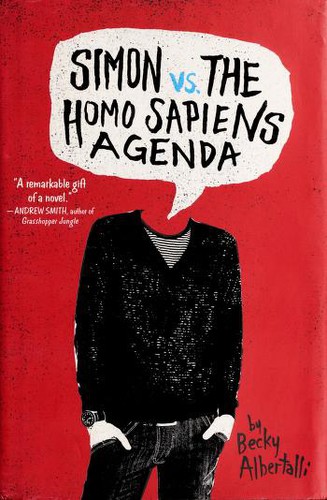
Simon Vs. the Homo Sapiens Agenda
by Becky Albertalli
★ Top 25 book of 2015 · #11 on Best Books of 2015
Simon is a sixteen-year-old who keeps his sexuality private until an email lands in the wrong hands and he is blackmailed. Meanwhile his flirty correspondence with a mystery boy named Blue keeps growing.
Best for: Teen readers wanting a warm, funny coming-out story with an email romance
Simon Vs. the Homo Sapiens Agenda is #11 on BookWard's Best Books of 2015, out of 55 2015 books that cleared our data bar.
What Simon Vs. the Homo Sapiens Agenda is about
Simon Spier is sixteen, a high school junior in a suburb of Atlanta, with a fondness for musical theater and a secret he has not shared: he is gay. He has been emailing a boy who goes by Blue, while Simon writes under the name Jacques, and their messages are growing more flirtatious as they get closer. Then a blackmailer threatens to expose the emails unless Simon helps class clown Martin win over Simon's friend Abby.
The threat puts both Simon's privacy and Blue's at risk, and strain starts to show in Simon's once tight-knit circle of friends. The title parodies the phrase "homosexual agenda" and recalls a joke between Simon and Blue that everyone, not only gay people, should have to come out.
Becky Albertalli's debut is a story of first love, friendship, and stepping out of one's comfort zone. It won the William C. Morris Award from the American Library Association. Morris Award and the German Youth Literature Prize, was longlisted for the National Book Award, and made the Wall Street Journal's list of the best young adult novels of 2015.
Simon Vs. the Homo Sapiens Agenda on the Best Books of 2015
Simon Vs. the Homo Sapiens Agenda came out in 2015. Of the 55 books first published in 2015 that met BookWard's data bar, it ranks #11 on our Best Books of 2015 list.
Why it made the list: 653 readers have shelved it on Open Library; readers rate it 4.2 out of 5 (52 ratings). The list ranks each year’s books on how many readers have picked them up, how highly readers rate them, and how many are reading them right now.
Nearby on the 2015 list
- Corrupt Penelope Douglas, #9
- Tales from a Not-So-Perfect Pet Sitter Rachel Renée Russell, #10
- The Bazaar of Bad Dreams Stephen King, #12
- Everything, Everything Nicola Yoon, #13
See all Best Books of 2015 Best books by year
More years: Best Books of 2014 Best Books of 2016.
The numbers behind it
- Readers: 574 want to read it, 18 are reading it now and 61 have read it, according to Open Library.
- Ratings: 4.2 out of 5 from 52 Open Library ratings.
| Signal | This book (0 to 100) | Weight |
|---|---|---|
| Reach | 82 | 55% |
| Reader love | 69 | 25% |
| Being read right now | 62 | 20% |
Questions about Simon Vs. the Homo Sapiens Agenda
When was Simon Vs. the Homo Sapiens Agenda published?
Simon Vs. the Homo Sapiens Agenda by Becky Albertalli was first published in 2015.
Was Simon Vs. the Homo Sapiens Agenda one of the best books of 2015?
Simon Vs. the Homo Sapiens Agenda is #11 on BookWard's Best Books of 2015, out of 55 2015 books that cleared our data bar. 653 readers have shelved it on Open Library; readers rate it 4.2 out of 5 (52 ratings).
Why is Simon Vs. the Homo Sapiens Agenda on the Best Books of 2015 list?
653 readers have shelved it on Open Library; readers rate it 4.2 out of 5 (52 ratings).
More of the best books of 2015
- Six of Crows Leigh Bardugo, #1
- The Hired Girl Laura Amy Schlitz, #2
- Queen of Shadows Sarah J. Maas, #3
- November 9 Colleen Hoover, #4
- Red Queen Victoria Aveyard, #5
- The Sword of Summer Rick Riordan, #6
See the full Best Books of 2015, the Top 100, or new books on Rising.
How we know
This page uses public data: Open Library reader counts and ratings, and Wikipedia page views for recent years. The description is paraphrased from real source text. Rankings reflect reading interest, not quality or sales, and can be affected by data gaps. Lists update monthly.
Suits young adult readers and older readers who enjoy warm contemporary stories.
Depends on the edition you pick.
A warm, funny blackmail story about coming out on your own terms. 60% taste match
 BookWard’s take
A warm, funny blackmail story about coming out on your own terms
Simon Spier is sixteen, closeted, and quietly emailing a boy known only as Blue when a classmate gets hold of the messages and demands a favor. The premise gives the book an immediate hook, and that opening is where it earns much of its keep. It plays with a well-worn high school frame but gives it a specific, loving take. The friendships and family are drawn with real depth, and the story moves briskly. The tone is funny and the outlook hopeful, though the sentiment runs warmer than I usually like. The ending is well resolved. It is a debut that won the William C. Morris Award, and its voice is conversational and distinctive. A readable, big-hearted book that keeps its stakes human-sized.
A standard-length young adult novel that moves along without padding, close to BookWard's taste for the tight.
Short chapters and a ticking secret keep things moving at a pace close to BookWard's quick preference.
The premise is well executed but sits within a recognizable genre, so it falls a little short of BookWard's appetite for originality.
The prose is plain, conversational and unadorned, a touch simpler than BookWard's middle-ground taste.
Though a plot hangs on the blackmail, the real engine is Simon's inner life and relationships, close to BookWard's lean.
It is an optimistic book that believes in kindness and acceptance, a little warmer than BookWard's usual outlook.
The story is told straight, with email exchanges woven in, a modest departure from convention that sits near BookWard's taste.
Simon's wry humor runs throughout, which suits BookWard's appetite for funny.
Content stays mild, with the blackmail the main source of tension, gentler than BookWard's middle.
Feelings run warm and sometimes intense, close to BookWard's taste.
See all 50 dialsEvery position, side by side with this book
Where it lines up
- EndingBookWard 8 · book 8
- Shock for effectBookWard 9 · book 9
- Story or ideasBookWard 3 · book 3
Where it pulls apart
- Familiar tropesBookWard 10 · book 5
- Internal logicBookWard 10 · book 7
- SentimentBookWard 8 · book 4
A standard-length young adult novel that moves along without padding, close to BookWard's taste for the tight.
The blackmail setup lands early and pulls you in fast, matching BookWard's love of an immediate hook.
A high school coming-out story works familiar ground, though its email framing and warmth freshen it; BookWard wants more avoidance of tropes.
The blackmail and the secret email thread hold together cleanly, if a little conveniently, which suits BookWard's taste for sound logic.
Short chapters and a ticking secret keep things moving at a pace close to BookWard's quick preference.
The premise is well executed but sits within a recognizable genre, so it falls a little short of BookWard's appetite for originality.
Simon, his friends and his family feel lived-in and specific, which BookWard values.
The story resolves its central questions satisfyingly, in line with BookWard's preference for closure.
It leans warm and tender rather than restrained, which sits softer than BookWard's usual taste.
The darkness is modest and arises from the plot's real stakes rather than shock for effect, which BookWard appreciates.
Simon's chatty, self-aware narration is distinctive and does much of the book's work, which BookWard rates highly.
This is firmly story-led, built around one boy's secret and his friendships, a good match for BookWard.
Information comes through scenes and emails rather than explanation, which fits BookWard's preference for showing.
The blackmail thread and the email romance keep tension up across the middle, which BookWard likes.
The prose is plain, conversational and unadorned, a touch simpler than BookWard's middle-ground taste.
Though a plot hangs on the blackmail, the real engine is Simon's inner life and relationships, close to BookWard's lean.
It is an optimistic book that believes in kindness and acceptance, a little warmer than BookWard's usual outlook.
The story is told straight, with email exchanges woven in, a modest departure from convention that sits near BookWard's taste.
Simon's wry humor runs throughout, which suits BookWard's appetite for funny.
It reads easily and quickly, lighter than BookWard's slightly demanding preference.
The story stays inside Simon's perspective, fewer viewpoints than BookWard tends to enjoy.
The events unfold in order across a school year, plainer than BookWard's shifting-timeline taste.
Entirely grounded in realistic suburban life, a touch more real than BookWard's middle-ground taste.
A friend group, family and classmates give a medium-sized cast, close to BookWard's preference.
The stakes are intimate, centered on one teenager's life, a little smaller than BookWard's middle ground.
Most of the drama is inward, Simon's feelings and decisions, though the plot gives it outer motion too.
Conversations and email exchanges carry much of the story, which fits BookWard's love of dialogue.
The email romance with Blue is central to the book, more romance than BookWard's usual taste.
A familiar American suburban high school, more everyday than BookWard's appetite for the unfamiliar.
Set in the contemporary present, matching BookWard's leaning toward the current.
Its core of identity and friendship should last, though the email-era details may date it.
Simon is an honest narrator who tells us his story plainly, more reliable than BookWard's taste.
The right and wrong in the blackmail plot is clear, less ambiguous than BookWard prefers.
Setting and appearance are sketched lightly, sparser than BookWard's middle-ground preference.
A first-person account told from inside one character's head, very personal.
A standalone story that wraps up on its own, near BookWard's lean.
The mystery of Blue's identity creates some surprise, but the story is not twist-heavy.
It is gentle and affirming rather than difficult, more comforting than BookWard's usual taste.
Content stays mild, with the blackmail the main source of tension, gentler than BookWard's middle.
Feelings run warm and sometimes intense, close to BookWard's taste.
The humor is observational and affectionate, closer to the dry side than broad.
Virtually none on the page, below BookWard's middle ground.
Content is minimal and tame, lighter than BookWard's middle ground.
Identity and acceptance run through the story without turning it into a political tract.
The language is plain and contemporary, simpler than BookWard's middle ground.
Simon's voice is full of opinions and asides, slightly more opinionated than BookWard's lean.
It looks ahead toward growth and acceptance, matching BookWard's forward-leaning taste.
It is an idealistic book that trusts in kindness and honesty, a bit warmer than BookWard's lean.
Review written by BookWard, dial version 1, November 2026.
Who is Simon Vs. the Homo Sapiens Agenda right for?
Suits young adult readers and older readers who enjoy warm contemporary stories. It deals with a teen's sexual orientation, outing and blackmail, handled gently, with mild content throughout.
It reads easily and quickly, lighter than BookWard's slightly demanding preference.
Content stays mild, with the blackmail the main source of tension, gentler than BookWard's middle.
Feelings run warm and sometimes intense, close to BookWard's taste.
Virtually none on the page, below BookWard's middle ground.
Book CompanionSimon Vs. the Homo Sapiens Agenda: ideas, characters, themes
A closeted teenager is forced to confront his secret when a blackmailer threatens to expose his anonymous email romance.
- A secret made public. Simon's private emails with Blue are found by a classmate, turning a personal choice into someone else's leverage.
- Blackmail with a price. Martin demands Simon help him with Abby, putting Simon's friendships under strain.
- An anonymous romance. Simon's flirtatious email thread with Blue, whose identity he does not know, drives the emotional core.
- Friends under pressure. Simon's tight group of friends begins to shift as secrets and favors complicate their dynamics.
- Stepping out of comfort. Simon, who resists change, has to decide how to act before he is pushed into the open.
Characters
Simon Spier
Protagonist
A sixteen-year-old, closeted and fond of musical theater, living near Atlanta.
Blue
Email correspondent
The anonymous boy Simon has been writing to and falling for.
Martin
Blackmailer
The class clown who finds the emails and demands Simon's help.
Abby
Friend
Simon's friend, whom Martin wants Simon to help him win over.
Themes
Who gets to decide when and how someone shares who they are.
The right to keep personal things personal, and what is lost when that is taken away.
How bonds are tested when secrets and favors enter the picture.
Becoming comfortable with who you are before the world weighs in.
The thrill and nervousness of falling for someone you have never met in person.
Discussion questions
- Why does the book frame coming out as something everyone should have to do?
- How does anonymity change the way Simon and Blue speak to each other?
- Is Simon's choice to go along with the blackmail understandable, and where does it go wrong?
- How do Simon's friendships change under pressure, and which feel strongest?
- What does the title's parody of a political phrase suggest about the book's tone?
Personalize your Book Companion
This is the general edition. In BookWard, the Companion is written for you: your reading profile, your notes, and spoiler-safe to the page you are on.
Buy, listen or borrow Simon Vs. the Homo Sapiens Agenda
Each link opens a search for this book on that store, in a new tab.
Read on a device
Borrow
Reviews and community
If you liked Simon Vs. the Homo Sapiens Agenda
A rule-bound geneticist hunts for a wife by questionnaire
Holding Up the UniverseJennifer NivenTwo teens, one secret each, and a love story with real feeling
Beach ReadEmily HenryA rom-com about two writers who swap genres for a summer
She Drives Me CrazyKelly QuindlenA fake-dating YA romcom that trades surprise for warmth and laughs
Find your own best books
Add what you have read, rate it, and BookWard will recommend what to read next.
Free to start. No credit card needed.