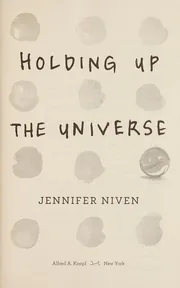
Holding Up the Universe
by Jennifer Niven · 2016
It suits teens and adults who enjoy contemporary YA romance.
400 pages, about 6.5 to 9.5 hours.
Two teens, one secret each, and a love story with real feeling. 55% taste match
The story
Holding Up the Universe is a young adult romance by Jennifer Niven, first published in 2016. It follows two teenagers at MVB High, Libby Strout and Jack Masselin, whose paths cross at school.
Libby became widely known in her childhood for her weight, and she has spent the time since her mother's death at home, grieving alongside her father. Now she is ready to return to high school and take part in everything it offers. Jack is the confident, well-liked student who knows how to fit in, and he is hiding the fact that he cannot recognize faces, not even those of his own brothers. The two end up caught in a cruel school game that sends them to group counseling and community service.
The novel deals with prosopagnosia, grief, and discrimination against overweight people, set within a love story between two teenagers. It runs to about 400 pages and has appeared in 21 editions.
Characters
Libby StroutJack Masselin
Themes
ProsopagnosiaBrainMan-woman relationshipsObesityOverweight teenagersWounds and injuriesRomanceSocial Themes
- Want to read 418
- Reading now 27
- Read 29
Most people shelving it are saving it for later.
Of 474 readers who put it on a shelf, 88% want to read it, 6% are reading it now, 6% have finished it and 0% stopped before the end.
By the numbers
- The median edition runs 400 pages. Counting about 275 words a page and an adult reading pace of 250 words a minute, that is about 7.3 hours of reading.
- Open Library tracks 21 editions from 16 publishers, the earliest dated 2016 and the latest 2020, across 5 languages.
- On reader demand it ranks in the top 2% of the recent books in our catalog (6,647 of them).
- Libraries shelve it under Dewey [Fic] and Library of Congress class PZ-0007.00000000.N6434.
 BookWard’s take
Two teens, one secret each, and a love story with real feeling
Holding Up the Universe is a young adult romance that runs on warmth and emotion rather than surprise. Its premise, a girl returning to school after grief and a boy who cannot recognize faces, feels fresher than the usual teen love story, and the alternating viewpoints keep things moving at a brisk clip. Character depth is the draw: Libby and Jack are built around specific wounds, not types. Where it parts ways with my own preferences is in its sentiment, since the book leans openly into feeling and hope, and in its familiar tropes, since the cruel school game and the shape of the romance follow well-worn paths. The ending is hopeful and resolved, which suits me fine. It is an easy, quick read at 400 pages, best taken as a tender, accessible story about being seen.
At about 400 pages it runs fuller than BookWard's preference for tight reads, though the short chapters and dual voices keep it moving.
Alternating viewpoints and a steady run of school scenes keep it moving at close to BookWard's quick preference.
Pairing prosopagnosia with a story about body image is a fresher angle than most teen romance offers.
The prose is plain and conversational in the manner of YA, close to BookWard's preference.
The story is driven by the two leads' inner lives and growing bond rather than by external plot, in line with BookWard.
It moves from grief and isolation toward connection and self-acceptance, a more hopeful outlook than BookWard's baseline.
It uses alternating viewpoints but otherwise tells a conventional contemporary story, close to BookWard's middle.
Jack's charm and banter bring real humor to a serious subject, near BookWard's taste for lightness.
Grief, bullying and body shaming bring weight, but the tone stays warm.
Feeling runs high throughout, from grief to first love.
See all 50 dialsEvery position, side by side with this book
Where it lines up
- EndingBookWard 8 · book 8
- PaceBookWard 8 · book 7
- Character depthBookWard 8 · book 7
Where it pulls apart
- Familiar tropesBookWard 10 · book 4
- LengthBookWard 1 · book 5
- SentimentBookWard 8 · book 3
At about 400 pages it runs fuller than BookWard's preference for tight reads, though the short chapters and dual voices keep it moving.
The two-lead setup and each character's hidden struggle give it a quick way in, close to how BookWard likes to open.
The cruel school game and the high school romance arc are familiar ground, which sits below BookWard's wish to avoid tropes.
The story follows a clear cause and effect from the school game to counseling to growing closeness, which BookWard values.
Alternating viewpoints and a steady run of school scenes keep it moving at close to BookWard's quick preference.
Pairing prosopagnosia with a story about body image is a fresher angle than most teen romance offers.
Libby and Jack each carry a specific wound and secret, giving them more depth than stock YA types, in line with BookWard.
The romance and its hopeful arc lead toward a resolved close, which matches BookWard's liking for finished stories.
The book embraces open feeling and tenderness, which is warmer and less restrained than BookWard's taste.
The hurtful school game is there to expose cruelty and move the story, which BookWard can accept as earned.
This is fiction, so the dial does not apply.
Two distinct teenage narrators give it a recognizable voice, a good fit for BookWard.
This is firmly story-led, built on a relationship and its events, which is where BookWard sits.
Much is conveyed through the characters' own thoughts and scenes, though the conditions are spelled out for the reader.
Short alternating chapters keep momentum up across its length, which suits BookWard.
The prose is plain and conversational in the manner of YA, close to BookWard's preference.
The story is driven by the two leads' inner lives and growing bond rather than by external plot, in line with BookWard.
It moves from grief and isolation toward connection and self-acceptance, a more hopeful outlook than BookWard's baseline.
It uses alternating viewpoints but otherwise tells a conventional contemporary story, close to BookWard's middle.
Jack's charm and banter bring real humor to a serious subject, near BookWard's taste for lightness.
This is an accessible read pitched at teens, easier than the middle ground BookWard accepts.
The story alternates between two narrators, fewer voices than BookWard's appetite for many viewpoints.
The story moves forward in a linear way from the start of the school year.
It is a grounded contemporary story with no fantastical element.
The focus stays on the two leads and a small circle around them at school and home.
The stakes are personal, set in one school and two families, far from epic.
Most of the story lives in the characters' thoughts and feelings rather than outward action.
Banter and conversation carry many scenes, which matches BookWard's liking for talk on the page.
The love story between Libby and Jack is the center of the book.
A modern American high school is a familiar setting for most readers.
It is set in the contemporary world, which fits BookWard's present-day lean.
The themes of acceptance and being seen last, though the school setting is of its moment.
The narrators tell their own stories straightforwardly, more reliable than BookWard's preference.
The book takes a clear stance against cruelty and in favor of kindness and self-acceptance.
Description is functional, serving feeling and scene more than rich setting.
This is fiction, so the dial does not apply.
This is fiction, so the dial does not apply.
It reads as a standalone novel.
The story follows an expected arc, with surprises coming mainly through what the characters reveal.
It is gentle in approach, more comforting than challenging despite its serious themes.
Grief, bullying and body shaming bring weight, but the tone stays warm.
Feeling runs high throughout, from grief to first love.
The humor is lively and banter-based, between dry and broad.
The conflict is emotional and social, with little physical violence.
The romance is the focus, with only light sexual content typical of YA.
Social attitudes toward weight appear, but it is not a political book.
The language is plain and contemporary.
The narrators speak with strong feelings and clear views about themselves and others.
It looks forward, with characters moving toward new beginnings.
Its central belief is that being seen and accepted can change lives, an idealistic stance.
Review written by BookWard, dial version 1, November 2026.
Who is Holding Up the Universe right for?
It suits teens and adults who enjoy contemporary YA romance. It deals with bullying, body shaming, grief and depression, which some readers may find sensitive.
This is an accessible read pitched at teens, easier than the middle ground BookWard accepts.
Grief, bullying and body shaming bring weight, but the tone stays warm.
Feeling runs high throughout, from grief to first love.
The conflict is emotional and social, with little physical violence.
Book CompanionHolding Up the Universe: ideas, characters, themes
Two teenagers who are misjudged and hiding things find that being truly seen by one another changes how they see themselves.
- Two voices. The story alternates between Libby and Jack, so the reader sees each through their own eyes and through the other's.
- Seen versus known. Libby is known for her weight, and Jack cannot recognize faces, so both are tied to how people are seen.
- Grief at the start. Libby returns to school after her mother's death, and the loss shapes her father and her home.
- A forced pairing. A cruel school game leads to group counseling and community service, which brings the two together.
- Hiding in plain sight. Jack works hard to fit in and charm others so no one learns his secret.
Characters
Libby Strout
One of the two leads
A teenager once labeled "America's Fattest Teen" who is ready to return to high school after losing her mother.
Jack Masselin
One of the two leads
A confident, well-liked student who hides that he cannot recognize faces, even those of his brothers.
Themes
How people are judged on appearance and what it takes to be known for who you are.
Living with loss and rebuilding after someone dies.
The effort of keeping a private difficulty from others.
How a mean act can lead to unexpected closeness.
Fitting in versus being accepted as yourself.
Discussion questions
- Why do Libby and Jack each work so hard to control how others see them?
- How does the story use Jack's inability to recognize faces to talk about judging by appearance?
- What does Libby's return to school say about readiness and courage?
- Does a forced pairing like counseling and community service make a believable start to a friendship?
- How does the book balance serious themes with humor and romance?
Personalize your Book Companion
This is the general edition. In BookWard, the Companion is written for you: your reading profile, your notes, and spoiler-safe to the page you are on.
Buy, listen or borrow Holding Up the Universe
Each link opens a search for this book on that store, in a new tab.
Read on a device
Borrow
Reviews and community
If you liked Holding Up the Universe
A rom-com about two writers who swap genres for a summer
Happily Never AfterLynn PainterA fake-wedding revenge setup that becomes a romance with real stakes
Just for the SummerAbby JimenezA fake-dating curse premise with real family weight underneath
The Hating GameSally ThorneOffice enemies, petty games, and a kiss that complicates everything
Sources: Open Library.
Track Holding Up the Universe and find your next favorite
Add it to your shelf, rate what you have read, and BookWard will recommend what fits you.
Free to start. No credit card needed.