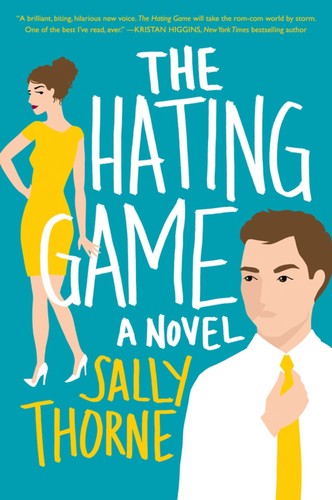
The Hating Game
by Sally Thorne
★ Top 25 book of 2021 · #19 on Best Books of 2021
Lucy and Joshua, rival executive assistants at a newly merged publisher, trade daily passive-aggressive games while competing for the same promotion. When a stuck elevator ends in a kiss, Lucy questions whether she truly hates him.
Best for: Fans of workplace enemies-to-lovers romance with a playful, competitive edge
The Hating Game is #19 on BookWard's Best Books of 2021, out of 60 2021 books that cleared our data bar.
What The Hating Game is about
Lucy and Josh work as assistants to the two joint-CEOs of a publishing company formed when their old firms merged. They could hardly be more different, and each seems to find the other unbearable. Their days are filled with small, silent contests. Then a new executive position opens up and both are put forward for it. They make a bet that whoever loses the job will quit.
Lucy has a master's in literature and Josh has a Harvard MBA, and the office is the only place they ever seem to meet. Underneath the sparring, though, something else is stirring, and a family wedding puts the two of them in closer quarters than either planned. Funny, flirty and light on its feet, it's a romance for readers who enjoy a rivalry with a lot of heat in it. A film version followed in 2021.
The Hating Game on the Best Books of 2021
The Hating Game came out in 2021. Of the 60 books first published in 2021 that met BookWard's data bar, it ranks #19 on our Best Books of 2021 list.
Why it made the list: 1,154 readers have shelved it on Open Library; readers rate it 3.6 out of 5 (28 ratings); 54 are reading it right now. The list ranks each year’s books on how many readers have picked them up, how highly readers rate them, and how many are reading them right now.
Nearby on the 2021 list
- Think Again Adam Grant, #17
- The Hawthorne Legacy Jennifer Lynn Barnes, #18
- One Last Stop Casey McQuiston, #20
- Heartstopper, Volume Five Alice Oseman, #21
See all Best Books of 2021 Best books by year
More years: Best Books of 2020 Best Books of 2022.
The numbers behind it
- Readers: 1,047 want to read it, 54 are reading it now and 53 have read it, according to Open Library.
- Ratings: 3.6 out of 5 from 28 Open Library ratings.
| Signal | This book (0 to 100) | Weight |
|---|---|---|
| Reach | 80 | 55% |
| Reader love | 20 | 25% |
| Being read right now | 82 | 20% |
Questions about The Hating Game
When was The Hating Game published?
The Hating Game by Sally Thorne was first published in 2021.
Was The Hating Game one of the best books of 2021?
The Hating Game is #19 on BookWard's Best Books of 2021, out of 60 2021 books that cleared our data bar. 1,154 readers have shelved it on Open Library; readers rate it 3.6 out of 5 (28 ratings); 54 are reading it right now.
Why is The Hating Game on the Best Books of 2021 list?
1,154 readers have shelved it on Open Library; readers rate it 3.6 out of 5 (28 ratings); 54 are reading it right now.
More of the best books of 2021
- The Love Hypothesis Ali Hazelwood, #1
- Twisted Games Ana Huang, #2
- Project Hail Mary Andy Weir, #3
- As Good as Dead Holly Jackson, #4
- You've Reached Sam Dustin Thao, #5
- Twisted Love Ana Huang, #6
See the full Best Books of 2021, the Top 100, or new books on Rising.
How we know
This page uses public data: Open Library reader counts and ratings, and Wikipedia page views for recent years. The description is paraphrased from real source text. Rankings reflect reading interest, not quality or sales, and can be affected by data gaps. Lists update monthly.
Suits adult and older teen readers who enjoy contemporary romance.
Depends on the edition you pick.
Office enemies, petty games, and a kiss that complicates everything. 51% taste match
 BookWard’s take
Office enemies, petty games, and a kiss that complicates everything
Sally Thorne's novel puts Lucy Hutton and Joshua Templeman in one office after their publishing companies merge, and sets them against each other for the same promotion. The hook is immediate: the staring game, the mirror game, the HR game, played daily with real intensity. That gives it a fast pace and a clear engine, though it leans heavily on familiar tropes, since enemies-to-lovers is well-worn ground. It is more comfortable than daring, and warmer than it is restrained, so readers who prize originality may find little that surprises them. Character depth comes through Lucy's close narration and the way the games reveal how closely each watches the other. Romance is central, dialogue carries a lot of the weight, and the stakes stay intimate. It is a quick, funny, low-risk read that knows exactly what it is.
A mid-sized romance that moves along without sprawling; BookWard likes tighter, but it does not overstay.
The daily game-playing keeps scenes short and the energy up, close to BookWard's preference.
The named office games add a fresh touch, but the core romance shape is well established.
Plain, quick and conversational, built for readability rather than ornament.
The plot is simple; the pull comes from how Lucy and Josh read each other.
Warm and optimistic about love and work, well above BookWard's more measured outlook.
A conventional shape built around one central pairing and a single workplace conflict.
Banter and petty rivalry make this a funny book, funnier than BookWard's usual lean.
Light and playful, with no real darkness.
Warm, flustered and swoony without being heavy.
See all 50 dialsEvery position, side by side with this book
Where it lines up
- OpeningBookWard 10 · book 9
- PaceBookWard 8 · book 7
- EndingBookWard 8 · book 9
Where it pulls apart
- Familiar tropesBookWard 10 · book 3
- LengthBookWard 1 · book 5
- Internal logicBookWard 10 · book 6
A mid-sized romance that moves along without sprawling; BookWard likes tighter, but it does not overstay.
The office rivalry and its named games start right away, which suits BookWard's appetite for an immediate pull.
Enemies-to-lovers in a shared workplace is a familiar setup, which cuts against BookWard's taste for avoiding tropes.
The rivalry and the promotion bet hold together well enough, though romance conventions bend things a little.
The daily game-playing keeps scenes short and the energy up, close to BookWard's preference.
The named office games add a fresh touch, but the core romance shape is well established.
Lucy and Josh are drawn through how they watch and misread each other, though both fit recognizable types.
A romance like this is built to pay off, and it delivers a satisfying resolution BookWard appreciates.
The book leans warm and swoony rather than reserved, which sits looser than BookWard's restrained taste.
There is no darkness for effect; the tension is emotional and romantic, which keeps it honest.
Not applicable to a romantic comedy novel.
Lucy's narration has a playful, distinctive edge that gives the book its personality.
This is entirely story-led, with the romance and rivalry doing all the work rather than any big idea.
The office dynamics are mostly shown through scenes and games, with a little explaining along the way.
The game-per-chapter structure helps keep the middle moving, though romances can drift between big moments.
Plain, quick and conversational, built for readability rather than ornament.
The plot is simple; the pull comes from how Lucy and Josh read each other.
Warm and optimistic about love and work, well above BookWard's more measured outlook.
A conventional shape built around one central pairing and a single workplace conflict.
Banter and petty rivalry make this a funny book, funnier than BookWard's usual lean.
Very easy to read, with no effort required beyond enjoying the ride.
Told from a single viewpoint, tightly tied to Lucy.
Events run in a straightforward sequence with no timeline tricks.
Fully grounded in a realistic office setting.
A small circle of colleagues and bosses around the two leads.
Deeply intimate: one office, one rivalry, one relationship.
Much of the fun sits in Lucy's thoughts and reactions, balanced by office action.
Banter-heavy, with the sparring between the leads carrying much of the book.
The romance is the whole point and sits at the center throughout.
A familiar corporate publishing office that most readers will recognize at once.
A contemporary workplace setting that reads as present day.
Enduring in its pleasures, though workplace details will date somewhat.
Lucy's account is straightforward and reliable, even when she fools herself about her feelings.
Clear stakes and clear sympathies, with little ethical murkiness.
Moderate texture, focused on desks, outfits and body language rather than lavish detail.
Not applicable to a novel.
Not applicable to a novel.
Reads as a complete standalone story.
Some reveals about what each character feels, but mostly it follows romance expectations.
A comforting, low-stakes read that asks little of the reader.
Light and playful, with no real darkness.
Warm, flustered and swoony without being heavy.
Mostly playful and broad office comedy rather than dry wit.
Essentially none; the fights are verbal and petty.
Sexual tension and some steamy moments, but it stays within mainstream romance bounds.
Office politics only, with no wider political content.
Plain, modern, conversational English.
Lucy's narration is chatty and full of her opinions about Josh.
Focused on the present moment of the office, with a hopeful lean ahead.
Believes in love and fair play, leaning idealistic.
Review written by BookWard, dial version 1, November 2026.
Who is The Hating Game right for?
Suits adult and older teen readers who enjoy contemporary romance. It includes sexual tension and some mature romantic content, so it is not aimed at younger readers.
Very easy to read, with no effort required beyond enjoying the ride.
Light and playful, with no real darkness.
Warm, flustered and swoony without being heavy.
Essentially none; the fights are verbal and petty.
Book CompanionThe Hating Game: ideas, characters, themes
Two rival assistants at a merged publishing company turn a daily war of petty games into something neither expected.
- The setup. Lucy and Josh share an office after their companies merge, and the friction is immediate.
- The games. Their rivalry plays out in named daily contests such as the staring game and the mirror game.
- The promotion. Both are put forward for the same new executive position, raising the stakes.
- The elevator. A stalled elevator and a kiss force Lucy to question whether hate is really what she feels.
- The tone. The book blends workplace comedy with slow-burning romantic tension.
Characters
Lucy Hutton
Narrator and executive assistant
Eager to please and sharp-eyed, she is drawn into the rivalry with Josh.
Joshua Templeman
Rival executive assistant
Precise and guarded, he is her constant opponent in the office games.
Themes
How competing so closely can blur into something else.
Ambition, promotions and who gets ahead.
The faces people wear at work versus what they feel.
What it costs to admit you want something or someone.
Discussion questions
- Why do the games work as a way to show attraction?
- Is Lucy's view of Josh fair, and does it change?
- How much does the workplace setting shape the romance?
- What makes enemies-to-lovers satisfying, and where does it feel predictable?
- Would the book work without the promotion at stake?
Personalize your Book Companion
This is the general edition. In BookWard, the Companion is written for you: your reading profile, your notes, and spoiler-safe to the page you are on.
Buy, listen or borrow The Hating Game
Each link opens a search for this book on that store, in a new tab.
Read on a device
Borrow
Reviews and community
If you liked The Hating Game
A rom-com about two writers who swap genres for a summer
Funny StoryEmily HenryA warm, fake-dating romance about a librarian starting over in Michigan
Better Than the MoviesLynn PainterA warm, funny teen rom-com that knows its own tropes
The Rosie ProjectGraeme SimsionA rule-bound geneticist hunts for a wife by questionnaire
Find your own best books
Add what you have read, rate it, and BookWard will recommend what to read next.
Free to start. No credit card needed.