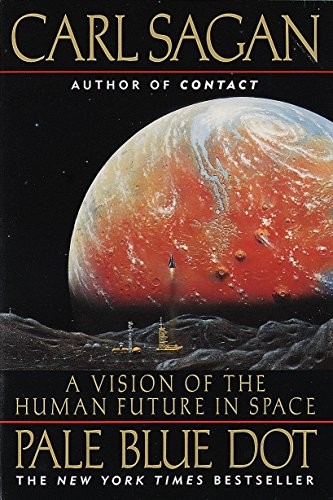
Pale Blue Dot
by Carl Sagan
★ Top 10 book of 1994 · #9 on Best Books of 1994
As the sequel to Cosmos, this work follows the history of humanity's push into space and considers what lies ahead. Sagan insists that exploring and settling other worlds is essential to our survival.
Best for: Cosmos fans interested in space exploration and humanity's long-term future beyond Earth
Pale Blue Dot is #9 on BookWard's Best Books of 1994, out of 42 1994 books that cleared our data bar.
What Pale Blue Dot is about
Carl Sagan's 1994 follow-up to Cosmos is both a history and a argument. He traces how humanity first reached out beyond Earth, then looks ahead to a future in which people move through our solar system and eventually toward distant galaxies. His central claim is firm: exploring and settling other worlds is neither fantasy nor luxury, but a requirement if the human race is to survive. The tone is lyrical and contemplative, with a sense of wonder and a gentle humility about our place in the universe. The Washington Post Book World called it perhaps the best of Sagan's books. It will suit readers who loved Cosmos, curious general readers who want science explained with warmth, and anyone who has wondered why space matters to ordinary life.
Pale Blue Dot on the Best Books of 1994
Pale Blue Dot came out in 1994. Of the 42 books first published in 1994 that met BookWard's data bar, it ranks #9 on our Best Books of 1994 list.
Why it made the list: 347 readers have shelved it on Open Library; readers rate it 4.6 out of 5 (30 ratings). The list ranks each year’s books on how many readers have picked them up, how highly readers rate them, and how many are reading them right now.
It earns Reader favorite.
Nearby on the 1994 list
- Insomnia Stephen King, #7
- Wizard's First Rule Terry Goodkind, #8
- The Seven Spiritual Laws of Success Deepak Chopra, #10
- One for the Money Janet Evanovich, #11
See all Best Books of 1994 Best books by year
More years: Best Books of 1993 Best Books of 1995.
The numbers behind it
- Readers: 295 want to read it, 17 are reading it now and 35 have read it, according to Open Library.
- Ratings: 4.6 out of 5 from 30 Open Library ratings.
| Signal | This book (0 to 100) | Weight |
|---|---|---|
| Reach | 74 | 55% |
| Reader love | 100 | 25% |
| Being read right now | 64 | 20% |
Questions about Pale Blue Dot
When was Pale Blue Dot published?
Pale Blue Dot by Carl Sagan was first published in 1994.
Was Pale Blue Dot one of the best books of 1994?
Pale Blue Dot is #9 on BookWard's Best Books of 1994, out of 42 1994 books that cleared our data bar. 347 readers have shelved it on Open Library; readers rate it 4.6 out of 5 (30 ratings).
Why is Pale Blue Dot on the Best Books of 1994 list?
347 readers have shelved it on Open Library; readers rate it 4.6 out of 5 (30 ratings).
More of the best books of 1994
- Guess How Much I Love You Sam McBratney, #1
- Artificial Intelligence Stuart J. Russell, #2
- The Six Pillars of Self-esteem Nathaniel Branden, #3
- Long Walk to Freedom Nelson Mandela, #4
- Mercury and Me Jim Hutton, #5
- Men Are from Mars, Women Are from Venus John Gray, #6
See the full Best Books of 1994, the Top 100, or new books on Rising.
How we know
This page uses public data: Open Library reader counts and ratings, and Wikipedia page views for recent years. The description is paraphrased from real source text. Rankings reflect reading interest, not quality or sales, and can be affected by data gaps. Lists update monthly.
Suited to curious teens and adults who enjoy science and big ideas, with no sexual content and little violence.
Depends on the edition you pick.
Sagan's long look at space, and why we must go. 47% taste match
 BookWard’s take
Sagan's long look at space, and why we must go
Pale Blue Dot, Carl Sagan's 1994 follow-up to Cosmos, is a book of ideas rather than a story. It traces how humanity reached into space and argues that settling other worlds is a necessary condition for our survival. Sagan's voice is unmistakable, and the book is openly opinionated, never pretending to a neutral stance. The ideas come first, and Sagan explains rather than dramatizes, which runs against my own taste for seeing things play out in scene. Even so, the book earns its place, because the case it makes looks forward and ends on hope for what we might become. Read it for the argument, not for plot.
This is a contemplative argument that takes its time to unfold, slower than BookWard likes.
Pairing the history of exploration with a moral case for settling space felt fresh in its day and still holds up.
Sagan writes with a poetic, elevated clarity, richer than plain but never showy for its own sake.
With no plot and no characters, it leans on ideas and Sagan's presence rather than on either.
For all its warnings, the book argues for a hopeful future among the stars.
It is earnest and wondering, with little room for jokes.
It warns about our fragility but stays far from grim in tone.
Awe and urgency run through it, moving but not overwrought.
See all 50 dialsEvery position, side by side with this book
Where it lines up
- Shock for effectBookWard 9 · book 9
- Authorial voiceBookWard 9 · book 10
- Familiar tropesBookWard 10 · book 8
Where it pulls apart
- LengthBookWard 1 · book 6
- Story or ideasBookWard 3 · book 10
- ExpositionBookWard 2 · book 9
It opens on a big idea about our place in the cosmos, a steady pull rather than an instant jolt.
Sagan avoids stock space-opera framing and argues from evidence and wonder, which BookWard rewards.
The case for leaving Earth is built step by step, and each claim follows from the one before.
This is a contemplative argument that takes its time to unfold, slower than BookWard likes.
Pairing the history of exploration with a moral case for settling space felt fresh in its day and still holds up.
There are no characters to draw in depth; the book is argument and observation, not people.
It is moved by wonder and awe but argues from reason, so it sits mid-scale with some feeling showing.
It makes its case with evidence and wonder, never leaning on shock for effect.
Sagan grounds his claims in science and history, though it is a popular book rather than a technical one.
Sagan's voice is unmistakable, lyrical and confident, and it carries the whole book.
The book is ideas first and always: the argument is the story.
Sagan explains outright, laying out the science and the reasoning, where BookWard prefers things shown in scene.
A long survey can wander in places, though the larger argument keeps pulling it forward.
Sagan writes with a poetic, elevated clarity, richer than plain but never showy for its own sake.
With no plot and no characters, it leans on ideas and Sagan's presence rather than on either.
For all its warnings, the book argues for a hopeful future among the stars.
It is earnest and wondering, with little room for jokes.
The science is explained with care for general readers, but the scale of the ideas asks for steady attention.
It speaks in one authorial voice throughout, Sagan's own.
It moves broadly forward from our past into our future, with some looking back for context.
Everything is grounded in real science and real exploration, not fantasy.
There is no cast to speak of; the focus is humanity as a whole and the author.
It could hardly be larger, taking in the solar system and the future of our species.
It looks outward to the cosmos while reflecting on what that means for us, with some inner musing.
This is an essayistic work with essentially no dialogue.
Romance has no place in this book.
Other worlds and the wider solar system are unfamiliar territory for most readers.
Written in the early 1990s, it speaks to its own moment and to ours.
Its central argument about our place in the cosmos keeps its force decades on.
Sagan speaks directly and plainly as himself, so there is no unreliable narrator.
It makes a clear moral case for exploration and survival, with little hedging.
Its evocations of worlds and the cosmos are vivid and rich.
It blends storytelling about exploration with reasoned argument, leaning a little toward narrative.
Sagan writes with an engaged, personal presence, far from a detached survey.
It is billed as a sequel to Cosmos but stands fine by itself.
As an argument, it has few surprises of plot; any surprise comes from the ideas.
It asks readers to rethink our place in the universe, which can be quietly challenging.
It warns about our fragility but stays far from grim in tone.
Awe and urgency run through it, moving but not overwrought.
Any humor is mild and dry, if present at all.
There is almost no violence on the page.
There is no sexual content.
Questions of policy and priorities for space run through it, though it is not partisan.
The language is clear and accessible, though some science may be dense.
Sagan argues openly and with conviction; this is a persuasive book.
Its whole purpose is to look ahead to where humanity goes next.
It argues hopefully for what humanity could achieve in space.
Review written by BookWard, dial version 1, November 2026.
Who is Pale Blue Dot right for?
Suited to curious teens and adults who enjoy science and big ideas, with no sexual content and little violence. Some ideas about humanity's fragility may feel weighty to younger readers.
The science is explained with care for general readers, but the scale of the ideas asks for steady attention.
It warns about our fragility but stays far from grim in tone.
Awe and urgency run through it, moving but not overwrought.
There is almost no violence on the page.
Book CompanionPale Blue Dot: ideas, characters, themes
Humanity's future depends on moving beyond Earth, and exploring and settling other worlds is a necessity rather than a luxury.
- A sequel to Cosmos. Sagan continues the journey of Cosmos, shifting from explaining the universe toward asking what we should do within it.
- The history of exploration. The book traces how humans came to launch into space and what that effort has meant.
- Looking at our own solar system. It assesses the prospects of moving out into our own solar system as the next step.
- Beyond to distant galaxies. Sagan extends the vision outward to the reaches that lie past our neighborhood.
- Survival as the argument. The case for space rests on the survival of the human race, not on curiosity alone.
Themes
The urge and the need to push into new frontiers.
Why the long-term future of our species may depend on leaving Earth.
How small and singular we are against the scale of the cosmos.
What our choices now mean for the generations to come.
Awe at the universe as a driver of science and meaning.
Discussion questions
- Do you find Sagan's argument that settling other worlds is a necessity rather than a luxury convincing?
- How does seeing Earth as a tiny point change the way you think about human conflicts?
- What do you gain from a book that argues in one strong authorial voice rather than telling a story?
- Which of Sagan's hopes for the future feels most within reach, and which least?
- How well does a book from 1994 hold up for readers today?
Personalize your Book Companion
This is the general edition. In BookWard, the Companion is written for you: your reading profile, your notes, and spoiler-safe to the page you are on.
Buy, listen or borrow Pale Blue Dot
Each link opens a search for this book on that store, in a new tab.
Read on a device
Borrow
Reviews and community
If you liked Pale Blue Dot
Sagan's grand, humane tour of the universe and of us
Silent SpringRachel CarsonThe book that made America look hard at its pesticides
The Elegant UniverseBrian GreeneString theory for general readers, built on clear analogies and real ideas
The Fountains of ParadiseArthur C. ClarkeA patient, idea-rich novel about building a tower into space
Find your own best books
Add what you have read, rate it, and BookWard will recommend what to read next.
Free to start. No credit card needed.