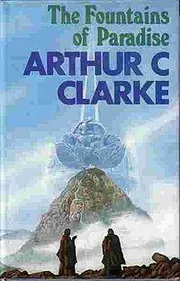
The Fountains of Paradise
by Arthur C. Clarke · 1978
Suited to teens and adults who like ideas-driven science fiction.
260 pages, about 4 to 6 hours.
A patient, idea-rich novel about building a tower into space. 54% taste match
The story
Arthur C. Clarke's science fiction novel is set in the 22nd century and follows an engineer named Vannevar Morgan, who proposes a space elevator. The structure would stretch from an equatorial island in the Indian Ocean up to a satellite in geostationary orbit, and it is meant to carry cargo into space without relying on rockets. The book centers on the design and construction of this tower and on what such a project would mean for people living beyond their home world.
The story also brings in monks and the religious significance attached to a mountain, placing questions of faith alongside the engineering work. It first appeared in 1978 and has been issued in around 35 editions, typically running to about 260 pages. It won the Hugo Award for Best Novel in 1980 and also the Nebula Award for Best Novel. Readers interested in hard science fiction, interplanetary travel, and fiction about large-scale building projects will find a good match here.
The crown grew heavier with each passing year.
Themes
MountainsElevatorsMonksDesign and constructionReligious aspects of MountainsInterplanetary voyages
- Want to read 91
- Reading now 4
- Read 34
Most people shelving it are saving it for later.
Of 129 readers who put it on a shelf, 71% want to read it, 3% are reading it now, 26% have finished it and 0% stopped before the end.
By the numbers
- The median edition runs 260 pages. Counting about 275 words a page and an adult reading pace of 250 words a minute, that is about 4.8 hours of reading.
- Open Library tracks 35 editions from 26 publishers, the earliest dated 1978 and the latest 2022, across 2 languages.
- On reader demand it ranks in the top 7% of the modern books in our catalog (15,152 of them).
- Libraries shelve it under Dewey 823.914 and Library of Congress class PR-6005.00000000.L36 F68 1980.
 BookWard’s take
A patient, idea-rich novel about building a tower into space
The big idea does most of the work here. Clarke follows the design and construction of a space elevator, and the engineering is the engine of the story rather than its backdrop. The idea is the real draw, and the logic is tight: the physics holds together and the project unfolds step by step. The prose is plain and clear, and the book leans toward explaining, which is part of the charm for readers who like to be walked through how a thing could work. The characters are less developed than the ambition around them, so the people serve the project more than the reverse. At 260 pages it asks little of the reader in sheer effort. If you like tight, logical, original fiction, the originality here still holds up, though a slower opening and a calmer pace will test anyone who wants a hook at once.
At about 260 pages it is compact for a book of such scale, which matches BookWard's liking for tight reads.
The story moves steadily through stages of construction rather than racing, a calmer tempo than BookWard prefers.
Building a tower to geostationary orbit is a distinctive centerpiece that still feels fresh, which BookWard rewards.
The style is clear and unadorned, serving the ideas rather than decorating them, close to BookWard's slightly plain leaning.
The project itself is the engine, making this plot and idea driven rather than character driven as BookWard prefers.
A confident belief in what engineering could do for humankind gives it an optimistic bent, matching BookWard.
The narrative follows the project in a mostly straightforward way with only modest formal play.
The tone is serious and measured, with little humor, quieter than BookWard's lighter side.
The tone is calm and gentle, far from the darker side of BookWard's range.
Feeling is present but controlled, leaving it a touch below BookWard's more intense pull.
See all 50 dialsEvery position, side by side with this book
Where it lines up
- EndingBookWard 8 · book 8
- Shock for effectBookWard 9 · book 9
- LengthBookWard 1 · book 2
Where it pulls apart
- OpeningBookWard 10 · book 4
- Story or ideasBookWard 3 · book 9
- ExpositionBookWard 2 · book 7
At about 260 pages it is compact for a book of such scale, which matches BookWard's liking for tight reads.
The engineering premise draws you in, but it builds gradually rather than grabbing you from the first page, which sits below BookWard's taste.
A space elevator as the central subject steers clear of well-worn plots, though some genre conventions remain.
The engineering is worked out carefully and the project follows from its own premises, which is exactly what BookWard prizes.
The story moves steadily through stages of construction rather than racing, a calmer tempo than BookWard prefers.
Building a tower to geostationary orbit is a distinctive centerpiece that still feels fresh, which BookWard rewards.
People exist largely to carry the project, so character depth is thinner than BookWard's taste for deeply drawn figures.
The construction arc reaches a clear conclusion, in line with BookWard's preference for resolved endings.
Emotion is present but kept in check by the technical focus, a fair match for BookWard.
Drama comes from the engineering challenge and its stakes rather than shock for effect, which BookWard values.
Clarke's calm, explanatory manner is recognizable, though less idiosyncratic than BookWard's strongest picks.
The engineering concept drives the book more than character incident, so it leans well toward ideas, far from where BookWard sits.
Concepts are often explained outright to the reader, a heavier hand than BookWard's preference for showing in scene.
The construction sequence keeps a forward direction, though the technical stretches can slow the middle slightly.
The style is clear and unadorned, serving the ideas rather than decorating them, close to BookWard's slightly plain leaning.
The project itself is the engine, making this plot and idea driven rather than character driven as BookWard prefers.
A confident belief in what engineering could do for humankind gives it an optimistic bent, matching BookWard.
The narrative follows the project in a mostly straightforward way with only modest formal play.
The tone is serious and measured, with little humor, quieter than BookWard's lighter side.
The writing is clear, so the effort comes mostly from following technical ideas, which fits BookWard's middle ground.
The story stays close to a small circle of perspectives rather than ranging widely.
The tower's construction unfolds in a largely forward line without heavy time shifts.
Set in the future with speculative engineering, it is rooted in plausible science and sits near BookWard's middle.
A modest group of central figures keeps the focus on the project, matching BookWard's middle position.
A structure 36,000 kilometres high is a large ambition, giving the book epic reach beyond BookWard's usual setting.
Attention goes to building and doing more than to inner life, tilting outward from BookWard's centre.
Conversations carry explanation and decision making, but the book is not dialogue heavy.
Love is not the focus here; the tower is, well below BookWard's middle.
A 22nd century setting with an equatorial island and orbital structure is unfamiliar territory, which BookWard enjoys.
Set in the 22nd century, it looks well ahead of the present, though written decades ago.
The central idea still resonates with ongoing interest in space, so it has real staying power.
The narration is straightforward and trustworthy, far from unreliable.
The question of faith versus engineering is raised without hammering a single answer.
Settings and structures are described with enough detail to picture them, a bit richer than BookWard's middle.
It stands alone as a single novel, well below BookWard's middle position.
Few jolts of surprise; interest comes from watching the project unfold, below BookWard's appetite for twists.
It asks readers to think about ambition, faith and technology without being punishing, close to BookWard's challenge.
The tone is calm and gentle, far from the darker side of BookWard's range.
Feeling is present but controlled, leaving it a touch below BookWard's more intense pull.
Humor is minimal and dry rather than broad, leaning to the quiet end.
Little violence appears on the page, below BookWard's middle comfort.
Sexual content is minimal, below BookWard's middle.
Questions of religion and large-scale projects carry some weight but not a front-and-center agenda.
The language is plain and easily read, well below BookWard's middle.
The narration mostly explains with a mild point of view rather than strong commentary.
It looks decidedly forward to what humankind might build, above BookWard's leaning.
Faith in human ingenuity runs through the book, idealistic and a little above BookWard's tilt.
Review written by BookWard, dial version 1, November 2026.
Who is The Fountains of Paradise right for?
Suited to teens and adults who like ideas-driven science fiction. Content is mild, with little violence or sexual material.
The writing is clear, so the effort comes mostly from following technical ideas, which fits BookWard's middle ground.
The tone is calm and gentle, far from the darker side of BookWard's range.
Feeling is present but controlled, leaving it a touch below BookWard's more intense pull.
Little violence appears on the page, below BookWard's middle comfort.
Book CompanionThe Fountains of Paradise: ideas, characters, themes
A visionary engineer pursues a space elevator that could change how humanity reaches space, and must reconcile that dream with ground-level obstacles including a mountain sacred to monks.
- The big proposal. Vannevar Morgan conceives an elevator reaching geostationary orbit, anchored to an equatorial island in the Indian Ocean.
- Engineering as drama. The design and construction of the tower form the main thread of the book.
- Faith and a mountain. Monks and the religious significance of a mountain add a spiritual question to the technical one.
- Why it matters. The tower is meant to lift cargo to orbit without the expense of rockets.
- Recognition. It won both the Hugo and Nebula Awards for Best Novel.
Characters
Vannevar Morgan
Engineer and visionary
He conceives the space elevator and drives the effort to build it.
Themes
The pull of an enormous goal and what it asks of the people behind it.
How religious meaning and engineering progress sit beside each other.
What a technological leap could change for humankind.
How a particular island and mountain shape a global project.
Discussion questions
- Is the space elevator a convincing answer to the problem of reaching orbit?
- How does the book treat the monks and their mountain alongside the engineering?
- Does Morgan's drive feel admirable, risky or both?
- Which parts of the technical explanation worked best for you?
- Does a book written in the 1970s still feel forward looking?
Personalize your Book Companion
This is the general edition. In BookWard, the Companion is written for you: your reading profile, your notes, and spoiler-safe to the page you are on.
Buy, listen or borrow The Fountains of Paradise
Each link opens a search for this book on that store, in a new tab.
Read on a device
Borrow
Reviews and community
If you liked The Fountains of Paradise
Sagan's hard-science first contact story, built on ideas over plot
Pale Blue DotCarl SaganSagan's long look at space, and why we must go
I, RobotIsaac AsimovNine robot puzzles that still out-argue most modern AI fiction
Tunnel in the skyRobert A. HeinleinHeinlein strands a class of students and watches society form
Sources: Open Library.
Track The Fountains of Paradise and find your next favorite
Add it to your shelf, rate what you have read, and BookWard will recommend what fits you.
Free to start. No credit card needed.