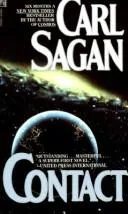
Contact
by Carl Sagan · 1985
Suited to adult readers and curious teens who enjoy science and big questions.
432 pages, about 7 to 10 hours.
Sagan's hard-science first contact story, built on ideas over plot. 56% taste match
The story
Contact is a hard science fiction novel by the American scientist Carl Sagan, first published in 1985. It follows Eleanor "Ellie" Arroway, an astronomer working in radio astronomy, and centers on the first meeting between humanity and an extraterrestrial life form far more advanced in its technology. The story is set in a near-present world and reaches out into space, with a multinational team traveling toward the stars in December, 1999.
The book belongs to the tradition of stories about interstellar communication, interplanetary voyages and encounters between people and alien beings. Its main figure is a woman scientist, and its questions run from how a signal from another world might be detected to what such an encounter could mean for those who experience it. Sagan, who lived from 1934 to 1996, had earlier written Cosmos, and here he turns from explaining the universe to imagining where it may lead. The novel has appeared in around 50 editions, and a typical copy runs to about 432 pages.
By human standards it could not possibly have been artificial: It was the size of a world.
Characters
Eleanor "Ellie" Arroway
Setting
Outer space
Themes
ExplorationHuman-alien encountersLife on other planetsRadio astronomyWomen scientistsInterstellar communicationInterplanetary voyagesLong Now Manual for Civilization
- Want to read 791
- Reading now 38
- Read 145
Most people shelving it are saving it for later.
Of 974 readers who put it on a shelf, 81% want to read it, 4% are reading it now, 15% have finished it and 0% stopped before the end.
By the numbers
- The median edition runs 432 pages. Counting about 275 words a page and an adult reading pace of 250 words a minute, that is about 7.9 hours of reading.
- Open Library tracks 50 editions from 38 publishers, the earliest dated 1985 and the latest 2023, across 8 languages.
- On reader demand it ranks in the top 1% of the modern books in our catalog (15,152 of them).
- Libraries shelve it under Dewey 813.54 and Library of Congress class PS-3569.00000000.A287 C6 1985.
Read it
A digital copy can be borrowed for free.
1 ebook provider carry it and a scanned copy is on the Internet Archive.
 BookWard’s take
Sagan's hard-science first contact story, built on ideas over plot
Contact opens with an image that grabs at once: a thing the size of a world that could not possibly be artificial. From there Sagan turns radio astronomy into a story about what it would take to hear another civilization and what it would mean to answer. The internal logic is among its great strengths, since the science is worked through with real care. It is a novel of ideas more than of plot, and it explains more than it shows, which can wear on a reader who prefers to be trusted to infer. Ellie Arroway gives it a human center, though her inner life takes second place to the questions the book wants to ask. The pace is steady rather than fast, and the staying power is considerable because the central wonder has not dated. It rewards patience.
At 432 pages it runs long for its premise, more than BookWard's love of tight books prefers.
It moves steadily and thoughtfully rather than briskly, a touch slower than BookWard likes.
The subject is familiar, but Sagan's grounded, scientific approach gives it a distinct angle.
Clear and functional rather than ornate, with the wonder carried by the ideas.
Plot and character share the load, with the central question pulling both along.
It treats the unknown with curiosity and optimism rather than dread, close to BookWard's outlook.
The telling follows a fairly conventional shape with little formal experiment.
Wonder and seriousness lead, with only light touches of levity.
The tone is curious and hopeful, with little grimness.
Feeling is present but kept in check by the scientific temperament.
See all 50 dialsEvery position, side by side with this book
Where it lines up
- Rigor (nonfiction)BookWard 9 · book 9
- Internal logicBookWard 10 · book 9
- EndingBookWard 8 · book 7
Where it pulls apart
- LengthBookWard 1 · book 6
- Familiar tropesBookWard 10 · book 6
- Story or ideasBookWard 3 · book 8
At 432 pages it runs long for its premise, more than BookWard's love of tight books prefers.
It opens on a world-sized object that cannot be artificial, a strong pull that suits BookWard well.
First contact is a well-worn subject, though the radio astronomy treatment keeps it from feeling stock.
As hard science fiction it works through the science with care, which BookWard rates highly.
It moves steadily and thoughtfully rather than briskly, a touch slower than BookWard likes.
The subject is familiar, but Sagan's grounded, scientific approach gives it a distinct angle.
Ellie Arroway is well drawn, though the ideas often take priority over the people.
The central questions are brought to a considered close, in line with BookWard's taste for resolution.
The book keeps a scientist's measured tone, though wonder is never far away.
Its big moments come from the ideas rather than from cheap shock, which BookWard values.
Sagan's scientific grounding is the backbone of the book and a real match for BookWard.
A scientist's clear, curious voice gives the book a recognizable character.
The ideas drive the book more than the plot, further toward ideas than BookWard usually goes.
It often explains its science outright, which cuts against BookWard's preference for showing in scene.
The long build toward its central encounter keeps tension, though the middle can feel measured.
Clear and functional rather than ornate, with the wonder carried by the ideas.
Plot and character share the load, with the central question pulling both along.
It treats the unknown with curiosity and optimism rather than dread, close to BookWard's outlook.
The telling follows a fairly conventional shape with little formal experiment.
Wonder and seriousness lead, with only light touches of levity.
The science asks some attention from the reader, though the writing stays approachable.
It centers on Ellie while opening onto a wider international effort.
The science is grounded, with the extraordinary event as its single great leap.
A multinational effort brings in a fairly sizable cast around Ellie.
Contact with another civilization is about as large as stories get, on a planetary and cosmic scale.
Ellie's thoughts and the outward search share the book roughly evenly.
Conversation carries much of the explaining and debating, so talk is heavy.
Romance is a minor thread compared with the scientific quest.
The world of radio telescopes and space science is unfamiliar to most readers, though set in a near-present.
Set in a near-present of its time, it reads as a recent past today.
Its wonder at the universe and the question of contact have not aged.
A straightforward third-person telling, with nothing to doubt in the narration.
Questions of faith and science are weighed with some nuance rather than answered simply.
Sagan paints the cosmos and its instruments with moderate richness.
A standalone novel.
Surprises come from the ideas as much as from plot turns.
It asks readers to weigh big questions about science, faith and humanity's place.
The tone is curious and hopeful, with little grimness.
Feeling is present but kept in check by the scientific temperament.
What humor appears is dry and quiet.
Violence is minimal for a book of this scale.
Sexual content is slight.
Governments, institutions and international tensions play a real part in the story.
The language is plain, with only the science adding some density.
The book carries a clear scientist's stance on wonder, evidence and belief.
It looks ahead to what contact could mean for humanity's future.
It holds an optimistic faith in curiosity, science and cooperation.
Review written by BookWard, dial version 1, November 2026.
Who is Contact right for?
Suited to adult readers and curious teens who enjoy science and big questions. It has little graphic content, and the main demand is staying with its ideas.
The science asks some attention from the reader, though the writing stays approachable.
The tone is curious and hopeful, with little grimness.
Feeling is present but kept in check by the scientific temperament.
Violence is minimal for a book of this scale.
Book CompanionContact: ideas, characters, themes
A radio astronomer detects a message from another world, and humanity must decide how to understand it and how to reply.
- A scientist at the center. Ellie Arroway, an astronomer in radio astronomy, anchors the story and gives the science a human face.
- The idea of first contact. The novel imagines how a signal from another civilization might be detected and what it could mean for those who experience it.
- A multinational effort. A team from many nations journeys toward the stars, making contact a shared human undertaking.
- From explaining to imagining. Sagan, who wrote Cosmos, turns from explaining the universe to imagining where it may lead.
- Hard science fiction. The story keeps close to real science, treating its central encounter as a problem to be reasoned through.
Characters
Eleanor "Ellie" Arroway
Protagonist, a radio astronomer
A woman scientist whose work in radio astronomy puts her at the heart of humanity's first meeting with another civilization.
Themes
Rigorous inquiry can deepen awe rather than dull it.
What it takes to meet and understand a mind radically unlike our own.
A challenge this large calls for people across nations to work together.
Encountering other life forces a rethink of our standing in the universe.
Discussion questions
- What does the book suggest it would take to recognize a message as artificial?
- How does Ellie's work as a scientist shape the way she meets the unknown?
- Why might Sagan have chosen a multinational team rather than a single nation?
- Did the ideas or the characters stay with you more, and why?
- What would you want to ask a more advanced civilization?
Personalize your Book Companion
This is the general edition. In BookWard, the Companion is written for you: your reading profile, your notes, and spoiler-safe to the page you are on.
Buy, listen or borrow Contact
Each link opens a search for this book on that store, in a new tab.
Read on a device
Borrow
Reviews and community
If you liked Contact
Tolstoy's last novel puts a jury seat on a guilty conscience
Omnivore's Dilemma. a Natural History of Four MealsMichael PollanFour meals, three food chains, and a sharp reporter's appetite
The Code BookSimon SinghA history of secret writing that makes the mathematics approachable
The Fountains of ParadiseArthur C. ClarkeA patient, idea-rich novel about building a tower into space
Sources: Open Library.
Track Contact and find your next favorite
Add it to your shelf, rate what you have read, and BookWard will recommend what fits you.
Free to start. No credit card needed.