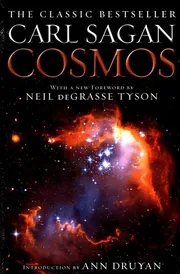
Cosmos
by Carl Sagan · 1980
Not to be confused with Alexander von Humboldt’s book of the same title (1845).
Suited to curious teens and adults, and accessible to anyone willing to follow clearly explained scientific ideas.
354 pages, about 5.5 to 8.5 hours.
Sagan's grand, humane tour of the universe and of us. 46% taste match
What it covers
Cosmos is a popular science book by astronomer Carl Sagan, first published in 1980. It was written as a companion to the PBS television series Cosmos: A Personal Voyage, and its 13 illustrated chapters each correspond to one episode of the series. The book runs to roughly 354 pages in its typical edition and has appeared in 74 editions.
The subject is science in its wider human setting, and how science and civilization developed side by side. Sagan follows the history of discovery through figures such as Democritus, Hypatia, Kepler, Newton, Huygens, Champollion, Lowell and Humason. Topics include missions to the planets of the solar system, the ancient Library of Alexandria, Egyptian hieroglyphics, the human brain, the origin of life, the death of the Sun, and the evolution of galaxies. The book also traces fifteen billion years of cosmic evolution, from matter to life and consciousness, and turns to the question of life elsewhere and how contact with other worlds might be made.
"The cosmos is all that is or ever was or ever will be."
Setting
Solar system
Themes
Ouvrages de vulgarisationAstronomieAstronomyPopular worksHistoryScienceCosmologyPlanetary science
- Want to read 546
- Reading now 41
- Read 38
- Stopped 2
Most people shelving it are saving it for later.
Of 627 readers who put it on a shelf, 87% want to read it, 7% are reading it now, 6% have finished it and 0% stopped before the end.
By the numbers
- The median edition runs 354 pages. Counting about 275 words a page and an adult reading pace of 250 words a minute, that is about 6.5 hours of reading.
- Open Library tracks 74 editions from 36 publishers, the earliest dated 1980 and the latest 2025, across 12 languages.
- On reader demand it ranks in the top 1% of the modern books in our catalog (15,152 of them).
- Libraries shelve it under Dewey 509 and Library of Congress class QB-0044.30000000.S34 2002.
 BookWard’s take
Sagan's grand, humane tour of the universe and of us
Cosmos is a popular science classic that treats astronomy as part of human history rather than a separate subject. Sagan moves from Democritus and Hypatia to Kepler and Newton, then out to planets, galaxies and the death of the Sun. It is firmly a book of ideas rather than plot, which runs against my usual preference, though the writing earns it. The authorial voice is its real strength: warm, wondering and unmistakably Sagan. He explains things outright rather than leaving them implied, and the pace is measured rather than quick. Where the book shines most is in how well it has lasted, since the questions he asks about life, origins and our place in the universe have not aged. Expect rigor delivered through story and metaphor rather than data tables.
At 354 pages across 13 chapters, it is substantial but organized into self-contained units, longer than BookWard's taste for short books.
Chapters move at a reflective, unhurried pace that favors wonder over speed, slower than BookWard prefers.
Linking the history of science with cosmic evolution was a fresh approach in 1980 and still feels distinctive.
The language is graceful and often poetic without turning ornate or showy.
There is no plot, but the book follows ideas and thinkers more than events, so this sits near the middle.
Sagan closes on a hopeful, humanist note about curiosity and our potential, despite warnings about fragility.
Thirteen chapters mirror a TV series, a conventional, orderly structure despite the ambitious subject.
The tone is earnest and reverent, with only occasional light touches of humor.
The tone is gentle overall, with occasional sober passages on cosmic mortality and human folly.
Awe and wonder run through it, giving an emotional pull alongside the learning.
See all 50 dialsEvery position, side by side with this book
Where it lines up
- Shock for effectBookWard 9 · book 9
- EndingBookWard 8 · book 7
- Authorial voiceBookWard 9 · book 10
Where it pulls apart
- LengthBookWard 1 · book 6
- ExpositionBookWard 2 · book 9
- OpeningBookWard 10 · book 6
At 354 pages across 13 chapters, it is substantial but organized into self-contained units, longer than BookWard's taste for short books.
Sagan opens by placing us in the vastness of the cosmos, an inviting start, though it builds more than it grabs.
It avoids stock science-writing formulas by weaving history, philosophy and astronomy into one personal vision.
Each argument follows carefully from evidence and earlier chapters, which suits BookWard's love of airtight reasoning.
Chapters move at a reflective, unhurried pace that favors wonder over speed, slower than BookWard prefers.
Linking the history of science with cosmic evolution was a fresh approach in 1980 and still feels distinctive.
The historical figures are sketched through their discoveries rather than drawn deeply, so people serve the ideas.
The book builds toward a clear closing vision about our place in the universe, and that resolution satisfies.
Sagan is openly moved by his subject, with real emotion but little sugary sentiment, a bit warmer than BookWard likes.
There is no manufactured darkness; the awe and the sobering facts about cosmic scale are earned honestly.
Claims rest on scientific knowledge, explained for general readers, rigorous in substance if narrative in delivery.
Sagan's voice is one of the most recognizable in popular science: lyrical, curious and personal.
The book is driven by concepts and discoveries rather than plot, far toward the idea end of the dial.
Sagan explains science and history directly to the reader, which is the whole method of the book.
Thirteen focused chapters keep energy up, though some stretches of historical background run a little longer.
The language is graceful and often poetic without turning ornate or showy.
There is no plot, but the book follows ideas and thinkers more than events, so this sits near the middle.
Sagan closes on a hopeful, humanist note about curiosity and our potential, despite warnings about fragility.
Thirteen chapters mirror a TV series, a conventional, orderly structure despite the ambitious subject.
The tone is earnest and reverent, with only occasional light touches of humor.
The ideas are big but explained for general readers, so effort is moderate and the reward high.
A single authorial perspective guides the whole book throughout.
The book ranges across antiquity to the far future, shifting between eras by theme rather than strict sequence.
Everything rests on real science and history, though speculation about alien life brings a little imagination.
Many historical figures and scientists appear across the chapters, though few linger for long.
It spans fifteen billion years of cosmic evolution, about as epic in scale as any book can get.
It balances outward exploration of planets and galaxies with inward reflection on consciousness and the brain.
As nonfiction exposition, the book contains essentially no scripted dialogue.
Romance plays no role in this science narrative.
Its subject is the universe itself, taking readers to places most will never see.
Written in 1980, it is a product of its time but speaks to present-day questions about science.
Its central wonder and big questions about origins have kept it relevant for decades.
Sagan speaks plainly in his own voice with no attempt to mislead.
The moral stance, favoring science, curiosity and peace, is stated plainly rather than left murky.
Sagan describes planets, stars and ancient cities with vivid, picture-rich language, aided by illustrations.
The book mixes storytelling with explanation, leaning slightly toward narrative.
A strong personal voice and first-person reflections make this a very personal take on science.
It is a standalone book, though it was written as a companion to the Cosmos TV series.
Discoveries surprise, but there are no plot twists in a book of this kind.
It asks readers to rethink humanity's place in the universe, a quietly challenging idea.
The tone is gentle overall, with occasional sober passages on cosmic mortality and human folly.
Awe and wonder run through it, giving an emotional pull alongside the learning.
Any wit is dry and understated.
There is little on-page violence beyond brief historical references.
The book contains essentially no sexual content.
Sagan touches on war, nuclear risk and the role of science in society, but politics is not the focus.
The prose is clear and accessible, with technical terms explained along the way.
Sagan speaks with conviction about science, skepticism and humanity's future, making his view plain.
Though rich in history, the book looks ahead to exploration and the future of our species.
It is deeply idealistic, believing in curiosity, reason and humanity's capacity to grow.
Review written by BookWard, dial version 1, November 2026.
Who is Cosmos right for?
Suited to curious teens and adults, and accessible to anyone willing to follow clearly explained scientific ideas. Some passages touch on historical violence and the fragility of civilization, but nothing is graphic.
The ideas are big but explained for general readers, so effort is moderate and the reward high.
The tone is gentle overall, with occasional sober passages on cosmic mortality and human folly.
Awe and wonder run through it, giving an emotional pull alongside the learning.
There is little on-page violence beyond brief historical references.
Book CompanionCosmos: ideas, characters, themes
Science and civilization grew up together, and understanding the cosmos reveals both how small we are and how remarkable it is that we can wonder about it.
- Science in its human context. Sagan presents discovery as a human story shaped by individuals, libraries and the forces of their times.
- Voices from the past. Figures such as Democritus, Hypatia, Kepler, Newton and Huygens show how ideas about the universe developed over centuries.
- The Library of Alexandria. The ancient library stands as a symbol of knowledge gathered, and a reminder of how fragile it can be.
- Cosmic evolution. The book follows fifteen billion years of change that turned matter into life and consciousness.
- Life elsewhere. Sagan considers what is known about life beyond Earth and how we might communicate with other worlds.
Characters
Carl Sagan
Author and guide
The astronomer narrates the journey in a personal, curious voice.
Hypatia
Scholar of Alexandria
An ancient thinker who connects the book to the Library of Alexandria.
Johannes Kepler
Astronomer
A key figure in the history of understanding the planets.
Isaac Newton
Physicist
One of the central figures in the growth of modern science.
Themes
The sense of awe that drives curiosity about the universe.
The long process by which matter became life and consciousness.
How knowledge and society develop together and shape each other.
What the scale of the cosmos suggests about humanity.
The possibility and meaning of reaching other intelligent life.
Discussion questions
- How does placing scientific discoveries in their human setting change how you see them?
- Why might Sagan have chosen the Library of Alexandria as such a central image?
- What does the idea of cosmic evolution add to your sense of what life is?
- How well has the book's hope about contact with other worlds held up?
- Does a sense of cosmic scale make human concerns feel smaller or more precious?
Personalize your Book Companion
This is the general edition. In BookWard, the Companion is written for you: your reading profile, your notes, and spoiler-safe to the page you are on.
Buy, listen or borrow Cosmos
Each link opens a search for this book on that store, in a new tab.
Read on a device
Borrow
Reviews and community
If you liked Cosmos
Sagan's long look at space, and why we must go
The botany of desireMichael PollanA plant's-eye view of us, one apple at a time
The Fountains of ParadiseArthur C. ClarkeA patient, idea-rich novel about building a tower into space
I Contain MultitudesEd YongA joyful tour of the microbes that make animals possible
Sources: Open Library.
Track Cosmos and find your next favorite
Add it to your shelf, rate what you have read, and BookWard will recommend what fits you.
Free to start. No credit card needed.