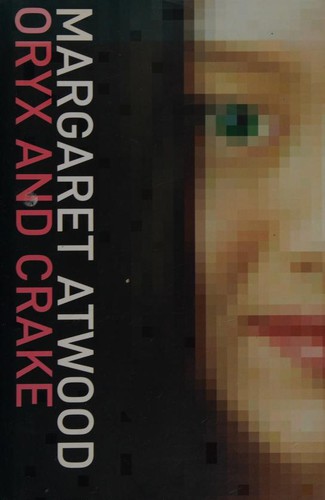
Oryx and Crake
by Margaret Atwood
★ Top 25 book of 2003 · #20 on Best Books of 2003
Snowman may be the last human after a plague, grieving his friend Crake and the elusive Oryx. With the green-eyed Children of Crake, he crosses wilderness that was once a city, ruined by corporate genetic engineering.
Best for: Fans of near-future dystopias mixing a love story with genetic engineering warnings
Oryx and Crake is #20 on BookWard's Best Books of 2003, out of 52 2003 books that cleared our data bar.
What Oryx and Crake is about
Snowman lives alone near a group of gentle, childlike people called the Crakers, in a world that has clearly ended. As he scavenges to survive, he remembers his earlier life as a boy named Jimmy, growing up in a society run by corporations, with the privileged sheltered inside walled compounds. There he befriends Glenn, a gifted science student who renames himself Crake, and the two grow up on very different paths, one writing ad copy, the other studying bioengineering.
Oryx, a woman who becomes entangled with both of them, adds to the tension between the friends. Margaret Atwood calls the book speculative fiction, and it asks what happens when science and commerce race ahead of any sense of responsibility. The tone is darkly satirical and bleak.
Oryx and Crake on the Best Books of 2003
Oryx and Crake came out in 2003. Of the 52 books first published in 2003 that met BookWard's data bar, it ranks #20 on our Best Books of 2003 list.
Why it made the list: 360 readers have shelved it on Open Library; readers rate it 4.2 out of 5 (48 ratings). The list ranks each year’s books on how many readers have picked them up, how highly readers rate them, and how many are reading them right now.
Nearby on the 2003 list
- Artemis Fowl and the Eternity Code Eoin Colfer, #18
- Quattro Topi Nella Giungla Nera Elisabetta Dami, #19
- When the Body Says No Gabor Maté, #21
- Can You Keep a Secret? Sophie Kinsella, #22
See all Best Books of 2003 Best books by year
More years: Best Books of 2002 Best Books of 2004.
The numbers behind it
- Readers: 275 want to read it, 10 are reading it now and 75 have read it, according to Open Library.
- Ratings: 4.2 out of 5 from 48 Open Library ratings.
| Signal | This book (0 to 100) | Weight |
|---|---|---|
| Reach | 62 | 55% |
| Reader love | 73 | 25% |
| Being read right now | 38 | 20% |
Questions about Oryx and Crake
When was Oryx and Crake published?
Oryx and Crake by Margaret Atwood was first published in 2003.
Was Oryx and Crake one of the best books of 2003?
Oryx and Crake is #20 on BookWard's Best Books of 2003, out of 52 2003 books that cleared our data bar. 360 readers have shelved it on Open Library; readers rate it 4.2 out of 5 (48 ratings).
Why is Oryx and Crake on the Best Books of 2003 list?
360 readers have shelved it on Open Library; readers rate it 4.2 out of 5 (48 ratings).
More of the best books of 2003
- Harry Potter and the Order of the Phoenix J. K. Rowling, #1
- Into the Wild Erin Hunter, #2
- The Kite Runner Khaled Hosseini, #3
- Don't Let the Pigeon Drive the Bus! Mo Willems, #4
- A Short History of Nearly Everything Bill Bryson, #5
- The Da Vinci Code Dan Brown, #6
See the full Best Books of 2003, the Top 100, or new books on Rising.
How we know
This page uses public data: Open Library reader counts and ratings, and Wikipedia page views for recent years. The description is paraphrased from real source text. Rankings reflect reading interest, not quality or sales, and can be affected by data gaps. Lists update monthly.
Best suited to adult readers and mature older teens comfortable with bleak themes.
Depends on the edition you pick.
A lone survivor, a ruined world, and the engineering behind it. 58% taste match
 BookWard’s take
A lone survivor, a ruined world, and the engineering behind it
Oryx and Crake opens on Snowman, possibly the last man alive, living beside the strange, gentle Crakers while the past unspools in flashbacks. The hook is immediate: a bleak present with a mystery buried inside it. It feels strikingly original, since Atwood builds corporate compounds, engineered animals and a world that sits uncomfortably close to our own. The internal logic is where it shines, because each invention follows plausibly from the last. The pace stays brisk through the foraging trip, though the book is more driven by ideas than I usually like, and it explains its world more than it shows it. The moral picture is deliberately murky, which suits a reader who enjoys being challenged. A sharp, unsettling start to the MaddAddam trilogy.
Brisk on the foraging trip and in the flashbacks, with some reflective stretches that slow it slightly below BookWard's pace.
The compounds, hybrid animals and Crakers feel freshly imagined rather than borrowed, matching BookWard's high bar.
Clear and controlled with flashes of wit, a little more polished than plain, close to BookWard's middle ground.
Plot and character share the load, with the mystery of the past slightly outweighing inner life.
The surviving world is bleak, and the book offers little comfort, darker than BookWard's mildly hopeful outlook.
Alternating present and flashback gives it more structural shape than a conventional straight telling.
Wry, satirical touches run through a mostly serious book, so it sits on the serious side.
Bleak throughout, with disturbing scenes in the flashbacks that push it toward the darker end.
Grief and loneliness run underneath, though Atwood keeps the surface controlled.
See all 50 dialsEvery position, side by side with this book
Where it lines up
- OriginalityBookWard 9 · book 9
- Authorial voiceBookWard 9 · book 9
- Internal logicBookWard 10 · book 9
Where it pulls apart
- LengthBookWard 1 · book 5
- EndingBookWard 8 · book 4
- Story or ideasBookWard 3 · book 7
It starts with Snowman alone in a ruined world, and the question of how he got there pulls you forward at once.
It avoids the usual apocalypse beats, building its own corporate-driven collapse, which fits BookWard's dislike of leaning on tropes.
Its genetic and corporate inventions follow from one another with a coherence that BookWard prizes.
Brisk on the foraging trip and in the flashbacks, with some reflective stretches that slow it slightly below BookWard's pace.
The compounds, hybrid animals and Crakers feel freshly imagined rather than borrowed, matching BookWard's high bar.
Snowman is well drawn, though some figures around him serve the ideas more than they live as people.
It leaves the central situation unresolved, which is more open than BookWard usually prefers.
Atwood keeps feeling cool and dry, avoiding easy emotion in a book full of loss, as BookWard prefers.
The darkness serves the argument about where this world came from, so it reads as earned rather than gratuitous.
Atwood's wry, precise voice is unmistakable and carries the book, a strong match for BookWard.
Big ideas about engineering and corporate power drive it, leaning further toward ideas than BookWard's story-first taste.
Much of the world is explained through Snowman's memory and narration, more than BookWard's show-it-in-scene preference.
The twin timelines keep tension up throughout, so the middle holds, as BookWard likes.
Clear and controlled with flashes of wit, a little more polished than plain, close to BookWard's middle ground.
Plot and character share the load, with the mystery of the past slightly outweighing inner life.
The surviving world is bleak, and the book offers little comfort, darker than BookWard's mildly hopeful outlook.
Alternating present and flashback gives it more structural shape than a conventional straight telling.
Wry, satirical touches run through a mostly serious book, so it sits on the serious side.
Accessible to read, though the ideas and layered chronology ask for some attention.
Everything comes through Snowman, so it is firmly a single-viewpoint novel.
Frequent returns to Jimmy's past make the timeline shift heavily, more than BookWard usually seeks.
Engineered creatures and the Crakers push past realism, though the science stays close to what feels possible.
A handful of key figures dominate, keeping the cast small despite the large world.
One man's story is set against the collapse of a civilization, giving it wide reach.
Snowman's reflections and his physical struggle to survive are balanced fairly evenly.
Scene and narration do most of the work, with dialogue present but not dominant.
A triangle of longing runs through the past, but the book's core is elsewhere.
A near-future world of compounds and engineered life is unfamiliar in a way BookWard enjoys.
Set in a speculative future grown from present-day trends, so it feels close to now.
Its concerns about science, commerce and survival keep it relevant years after publication.
Snowman's memories are filtered through grief and a made-up story for the Crakers, making him somewhat unreliable.
Blame and responsibility are tangled and uncomfortable, which BookWard values in a challenging book.
Ruined cities, lush wilderness and strange creatures are drawn in vivid, specific detail.
It opens the MaddAddam trilogy, so more story follows in later books.
The past reveals its secrets gradually, with several turns, though fewer than a thriller.
It confronts uncomfortable questions about science and society rather than soothing the reader.
Bleak throughout, with disturbing scenes in the flashbacks that push it toward the darker end.
Grief and loneliness run underneath, though Atwood keeps the surface controlled.
Humor is dry and satirical rather than broad.
There are scenes of danger and disturbing material, but it is not relentlessly violent.
Sexual content appears in some of the darker flashbacks and is part of the book's critique.
Corporate power and its social consequences are central, though presented through story.
The language is plain with a few invented words, so it reads easily.
The narration carries a distinct, sardonic point of view on the world it describes.
Though it begins after collapse, it is a warning about where today's choices lead.
A cynical view of human ambition and corporate power colors the whole book.
Review written by BookWard, dial version 1, November 2026.
Who is Oryx and Crake right for?
Best suited to adult readers and mature older teens comfortable with bleak themes. It includes disturbing material, among it references to child exploitation and graphic violence viewed online, so readers sensitive to that should take care.
Accessible to read, though the ideas and layered chronology ask for some attention.
Bleak throughout, with disturbing scenes in the flashbacks that push it toward the darker end.
Grief and loneliness run underneath, though Atwood keeps the surface controlled.
There are scenes of danger and disturbing material, but it is not relentlessly violent.
Book CompanionOryx and Crake: ideas, characters, themes
Through one survivor's memories, the novel traces how unchecked genetic engineering and corporate power could lead to the end of the world we know.
- A lone survivor. Snowman lives near the Crakers, human-like creatures who see him as a teacher, and he must scavenge to stay alive.
- Two timelines. The story moves between Snowman's bleak present and his past as a boy named Jimmy.
- Walled compounds. Corporations protect their employees in privileged compounds while the outside world decays.
- A key friendship. Jimmy's bond with the brilliant Glenn, later known as Crake, shapes everything that follows.
- Speculative fiction. Atwood calls it speculative fiction and adventure romance, since it deals with things not far beyond what we can already do.
Characters
Snowman
Narrator and survivor
Once called Jimmy, he is possibly the last man and is mourning his past while trying to survive.
Crake
Jimmy's brilliant friend
Born Glenn, he is a gifted science student whose work in genetics drives the story.
Oryx
Beloved figure from the past
A beautiful and elusive woman whom both Jimmy and Crake loved.
The Crakers
Children of Crake
Innocent, human-like creatures who regard Snowman as their teacher.
Themes
How companies shape society, science and who gets protected.
The promise and danger of remaking life itself.
How grief and recollection shape Snowman's sense of the past.
Who is to blame when a civilization collapses.
What a person does to endure when everything familiar is gone.
Discussion questions
- How does Snowman's account of his past shape what we believe about the collapse?
- Why does Atwood prefer the label speculative fiction to science fiction?
- What do the Crakers represent, and what does Snowman owe them?
- How does the split between the walled compounds and the outside world mirror today's divisions?
- Is the book a warning, a satire, or both?
Personalize your Book Companion
This is the general edition. In BookWard, the Companion is written for you: your reading profile, your notes, and spoiler-safe to the page you are on.
Buy, listen or borrow Oryx and Crake
Each link opens a search for this book on that store, in a new tab.
Read on a device
Borrow
Reviews and community
If you liked Oryx and Crake
Occult Yale, a scarred heroine, and privilege with teeth
AbsolutionJeff VanderMeerVanderMeer returns to Area X with a stranger, sharper, multi-part novel
The MagiciansLev GrossmanNarnia grown up, bruised, and a lot less comforting
WickedGregory MaguireOz retold as a political biography of its witch
Find your own best books
Add what you have read, rate it, and BookWard will recommend what to read next.
Free to start. No credit card needed.