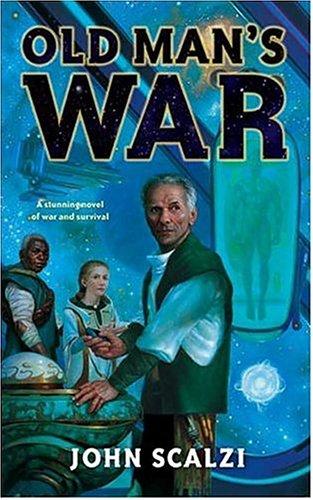
Old Man’s War
by John Scalzi
★ Top 25 book of 2005 · #17 on Best Books of 2005
On his 75th birthday, John Perry visits his wife's grave and then enlists in an interstellar army that restores old recruits in young, enhanced bodies. Humanity fights aliens for scarce habitable planets, with a wry tone reminiscent of Heinlein.
Best for: Fans of military science fiction with humor, in the spirit of Heinlein
Old Man’s War is #17 on BookWard's Best Books of 2005, out of 52 2005 books that cleared our data bar.
What Old Man’s War is about
John Perry spends his 75th birthday visiting his late wife's grave, then signs up for the army. In Scalzi's 2005 debut, Earth is a quiet backwater in a long interstellar war, and the Colonial Defense Forces take volunteers after retirement. The deal is startling: your mind moves into a young, improved body grown from your own DNA, and if you survive your term of service, you get a new body and a place on a colony. Livable planets are rare and aliens eager to fight for them are not. Sharp, funny, and quick, it carries a Heinlein-style spirit and suits readers who like military science fiction with a wry voice.
Old Man’s War on the Best Books of 2005
Old Man’s War came out in 2005. Of the 52 books first published in 2005 that met BookWard's data bar, it ranks #17 on our Best Books of 2005 list.
Why it made the list: 334 readers have shelved it on Open Library; readers rate it 4.2 out of 5 (112 ratings). The list ranks each year’s books on how many readers have picked them up, how highly readers rate them, and how many are reading them right now.
Nearby on the 2005 list
- The Game Neil Strauss, #15
- Death Note, Vol. 1 Tsugumi Ohba, #16
- Pretties Scott Westerfeld, #18
- Midnight Erin Hunter, #19
See all Best Books of 2005 Best books by year
More years: Best Books of 2004 Best Books of 2006.
The numbers behind it
- Readers: 185 want to read it, 5 are reading it now and 144 have read it, according to Open Library.
- Ratings: 4.2 out of 5 from 112 Open Library ratings.
| Signal | This book (0 to 100) | Weight |
|---|---|---|
| Reach | 67 | 55% |
| Reader love | 88 | 25% |
| Being read right now | 17 | 20% |
Questions about Old Man’s War
When was Old Man’s War published?
Old Man’s War by John Scalzi was first published in 2005.
Was Old Man’s War one of the best books of 2005?
Old Man’s War is #17 on BookWard's Best Books of 2005, out of 52 2005 books that cleared our data bar. 334 readers have shelved it on Open Library; readers rate it 4.2 out of 5 (112 ratings).
Why is Old Man’s War on the Best Books of 2005 list?
334 readers have shelved it on Open Library; readers rate it 4.2 out of 5 (112 ratings).
More of the best books of 2005
- The Lightning Thief Rick Riordan, #1
- Harry Potter and the Half-Blood Prince J. K. Rowling, #2
- The Glass Castle Jeannette Walls, #3
- Looking for Alaska John Green, #4
- Eldest Christopher Paolini, #5
- Freakonomics Steven D. Levitt, #6
See the full Best Books of 2005, the Top 100, or new books on Rising.
How we know
This page uses public data: Open Library reader counts and ratings, and Wikipedia page views for recent years. The description is paraphrased from real source text. Rankings reflect reading interest, not quality or sales, and can be affected by data gaps. Lists update monthly.
Best suited to adult and older teen readers who enjoy science fiction.
Depends on the edition you pick.
A fast, funny soldier's tale that starts at 75. 58% taste match
 BookWard’s take
A fast, funny soldier's tale that starts at 75
Old Man's War opens with a man visiting his wife's grave and then enlisting, and the hook never slips. John Scalzi's first novel is a quick, dialogue-heavy read, and it moves at a pace that makes it hard to put down. The voice is distinctive: wry, conversational, plainly Heinlein-flavored. The emotion is mostly restrained, with grief handled in a few well-judged beats instead of piled on. Where it loses some of its shine is in the familiar material. Military boot camp and alien-war scaffolding are well-worn ground, and the book cares more about telling a story than about chasing big ideas. Exposition is more explained than shown, which suits a book that wants you moving. It is a smart, brisk entry point to a series.
A lean, quick novel by genre standards, close to BookWard's preference for tight books, though not as short as it could be.
It moves briskly from the opening onward, matching BookWard's appetite for momentum.
Enlisting the elderly into young cloned bodies is a fresh premise on a familiar military-SF frame, a notch below BookWard's bar.
Clean, plain and quick, built for readability rather than ornament, close to BookWard's modest leaning.
Events and the military machine drive the story more than inner change, tilting plot-led against BookWard's lean.
Dark war is balanced by humor and a sense of fresh starts, leaving it a little more hopeful than bleak.
It follows a conventional recruit-train-fight arc with no formal experiments, matching BookWard's mild lean.
Wisecracks and a sarcastic narrator keep it light even in grim moments, matching BookWard's taste for humor.
War carries real casualties, but humor keeps the tone from sinking, so it lands at BookWard's midpoint.
Feeling runs under the jokes, with moments that land, a little below BookWard's mild intensity lean.
See all 50 dialsEvery position, side by side with this book
Where it lines up
- PaceBookWard 8 · book 8
- OpeningBookWard 10 · book 9
- SentimentBookWard 8 · book 7
Where it pulls apart
- Familiar tropesBookWard 10 · book 4
- Internal logicBookWard 10 · book 7
- ExpositionBookWard 2 · book 6
A lean, quick novel by genre standards, close to BookWard's preference for tight books, though not as short as it could be.
A man visits his wife's grave and then joins the army on his 75th birthday, which grabs at once, just as BookWard likes.
Boot camp and interstellar-war structure are familiar territory, so it leans on genre conventions more than BookWard would choose.
The body-transfer enlistment scheme is laid out clearly and holds together well enough, a little looser than BookWard's airtight ideal.
It moves briskly from the opening onward, matching BookWard's appetite for momentum.
Enlisting the elderly into young cloned bodies is a fresh premise on a familiar military-SF frame, a notch below BookWard's bar.
The narrator is vivid and likable, though the wider cast leans toward types, short of the depth BookWard prizes.
It reaches a reasonably resolved close while leaving room for the series to continue, slightly less closed than BookWard prefers.
Grief is acknowledged and then the book moves on, mostly restrained with some warmth showing, in line with BookWard.
The war is brutal, but the darkness serves the premise more than it is used for effect, which BookWard respects.
The wry, conversational Heinlein-style voice is unmistakable, which fits BookWard's love of a distinctive narrator.
The premise is clever, but the book is driven by what happens to its soldier, so it tilts story-led as BookWard does.
The book explains its world fairly directly in conversation, more than BookWard's show-in-scene preference.
The story keeps moving through its stages with few lulls, close to BookWard's wish for a sustained middle.
Clean, plain and quick, built for readability rather than ornament, close to BookWard's modest leaning.
Events and the military machine drive the story more than inner change, tilting plot-led against BookWard's lean.
Dark war is balanced by humor and a sense of fresh starts, leaving it a little more hopeful than bleak.
It follows a conventional recruit-train-fight arc with no formal experiments, matching BookWard's mild lean.
Wisecracks and a sarcastic narrator keep it light even in grim moments, matching BookWard's taste for humor.
It reads easily and asks little of the reader, a touch more accessible than BookWard's middle ground.
The story follows a single narrator throughout, narrower than BookWard's lean toward several viewpoints.
Events unfold in order without jumps, which fits BookWard's moderately linear preference.
Alien species, body transfer and interstellar travel make this fully science fiction, more fantastical than BookWard's middle.
A modest circle of recruits and officers surrounds the narrator, in range with BookWard's middling cast size.
An interstellar war across worlds gives it wide scope, more epic than BookWard's mid-range preference.
Combat and training dominate the page more than reflection, tilting outward from BookWard's balanced lean.
Banter carries much of the book, as BookWard likes, with conversation doing the heavy lifting.
Love appears mainly through the narrator's late wife, not as a central thread, a little under BookWard's mid-range.
Alien worlds, space travel and a changed society make the setting thoroughly unfamiliar, beyond BookWard's lean.
Set in a far future, it sits a little off from BookWard's present-day lean though its concerns feel current.
Heinlein-style military SF with a durable premise should age well, though it is rooted in a genre tradition.
The narrator tells his story straight, a reliable guide, well below BookWard's lean toward unreliable voices.
The ethics of the war and of recruiting the old are questioned, but the narrative leans toward clarity.
Description is functional and economical, with the focus on action and talk, close to BookWard's balance.
It launches a longer saga in the same universe, well above BookWard's standalone-leaning middle.
The plot springs several surprises about the nature of the war and the service, close to BookWard's liking.
It is an entertaining, accessible read more than a challenging one, a bit softer than BookWard's lean.
War carries real casualties, but humor keeps the tone from sinking, so it lands at BookWard's midpoint.
Feeling runs under the jokes, with moments that land, a little below BookWard's mild intensity lean.
The humor is sarcastic and conversational, between dry and broad, near BookWard's midpoint.
Combat is frequent and sometimes graphic, a little above BookWard's middle setting.
Sexual content appears in places but stays secondary, a touch below BookWard's midpoint.
Questions of military power and Earth's place come up as backdrop rather than the main thrust, near BookWard's midpoint.
The language is plain and quick, far easier than BookWard's middle setting.
The narrator has plenty of attitude and views, close to BookWard's lean toward an opinionated voice.
It looks to humanity's future in space, in line with BookWard's forward lean.
Cynicism about military and political institutions runs through it, below BookWard's mild idealistic lean.
Review written by BookWard, dial version 1, November 2026.
Who is Old Man’s War right for?
Best suited to adult and older teen readers who enjoy science fiction. It contains war violence and some adult language and situations.
It reads easily and asks little of the reader, a touch more accessible than BookWard's middle ground.
War carries real casualties, but humor keeps the tone from sinking, so it lands at BookWard's midpoint.
Feeling runs under the jokes, with moments that land, a little below BookWard's mild intensity lean.
Combat is frequent and sometimes graphic, a little above BookWard's middle setting.
Book CompanionOld Man’s War: ideas, characters, themes
Humanity recruits the elderly for an interstellar war, trading their aged bodies for young enhanced ones in exchange for years of dangerous service.
- The Colonial Defense Forces. Earth people reaching retirement age can enlist, then leave the planet for good.
- The deal. Recruits serve two years at the front, or longer if the war goes badly, in exchange for a fresh start.
- New bodies. Consciousness moves into a young, cloned, enhanced body built from the recruit's own DNA.
- A crowded galaxy. Habitable planets are scarce, and alien species willing to fight humans for them are common.
- A starting point. This is Scalzi's first novel and sets up a universe he returns to in later stories.
Characters
John Perry
Narrator and recruit
Visits his wife's grave on his 75th birthday and then enlists in the Colonial Defense Forces.
Themes
What it means to get a second chance at a young body.
The cost of fighting for humanity's place among the stars.
Carrying loss into a new life.
The scramble for scarce habitable planets.
How freely recruits really choose to serve.
Discussion questions
- Would you enlist for a young body at the price of never returning to Earth?
- How does the narrator's humor shape the way the war feels?
- Why does the military want old recruits rather than young ones?
- How does grief drive Perry's decision to enlist?
- What parallels does the book draw with classic military science fiction?
Personalize your Book Companion
This is the general edition. In BookWard, the Companion is written for you: your reading profile, your notes, and spoiler-safe to the page you are on.
Buy, listen or borrow Old Man’s War
Each link opens a search for this book on that store, in a new tab.
Read on a device
Borrow
Reviews and community
If you liked Old Man’s War
A dead software millionaire becomes a probe, and the fun begins
Storm FrontJim ButcherA wizard-for-hire in Chicago, broke and in over his head
Escaping PerilTui T. SutherlandA dragon built for killing learns what loyalty can mean
The Lightning ThiefRick RiordanA fast, funny Greek-myth quest that hooks in chapter one
Find your own best books
Add what you have read, rate it, and BookWard will recommend what to read next.
Free to start. No credit card needed.