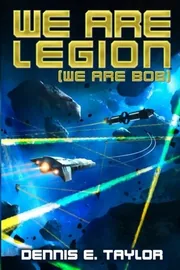
We Are Legion
by Dennis E. Taylor · 2016
Suits adult and older teen readers who enjoy science fiction with light humor and plenty of technical talk.
345 pages, about 5.5 to 8 hours.
A dead software millionaire becomes a probe, and the fun begins. 58% taste match
The story
We Are Legion is a science fiction novel by Dennis E. Taylor, first published in 2016 and running to roughly 345 pages. It is the first book in a series that continues with For We Are Many and All These Worlds. The author is a Canadian writer and former computer programmer whose work centers on artificial intelligence and the human condition.
The story follows Bob Johansson, a software entrepreneur who dies unexpectedly after selling his company. He comes back more than a century later as a digital mind, now treated as state property, and is assigned to guide an interstellar probe searching for planets people could settle. Declining means being shut down. Accepting means competing with rival nations racing to stake the first claims. The narrative moves through space flight and space warfare, from Earth and Saturn to star systems such as Epsilon Eridani, Alpha Centauri and Kappa Ceti, across the years 2133 to 2188, with the possible end of the human race in the background.
“So… You’ll cut my head off.”
Setting
EarthSaturnEpsilon EridaniOmicron Eridani82 Eridani
Period
20162133–2188
Themes
Artificial intelligenceColonizationExtinction of the human racePlanetsSpace flightSpace warfarevon Neumann probe
- Want to read 66
- Reading now 1
- Read 46
Readers are split between finishing it and saving it for later.
Of 113 readers who put it on a shelf, 58% want to read it, 1% are reading it now, 41% have finished it and 0% stopped before the end.
By the numbers
- The median edition runs 345 pages. Counting about 275 words a page and an adult reading pace of 250 words a minute, that is about 6.3 hours of reading.
- Open Library tracks 7 editions from 6 publishers, the earliest dated 2016 and the latest 2025, across 3 languages.
- On reader demand it ranks in the top 8% of the recent books in our catalog (6,647 of them).
 BookWard’s take
A dead software millionaire becomes a probe, and the fun begins
We Are Legion hands you a premise and starts running at once: Bob Johansson dies, wakes a century later as a digital mind, and is told to pilot an interstellar probe or be switched off. That opening hooks immediately, and the pace stays brisk across 345 pages, which suits a reader who likes tight books. Bob's wry, geeky voice does a lot of work, and the tone leans funny. The exposition is where I part company with it, since Bob often explains the engineering and the situation outright rather than letting scenes carry it. It is also more idea-led than story-led. Still, the internal logic of a mind running on hardware is carefully worked out, and the novel avoids bleakness while keeping real stakes in view.
At 345 pages it is compact for a space-faring epic, which fits BookWard's taste for tight books.
Events move briskly across decades and star systems, close to BookWard's preference for speed.
The concept of a copied mind spreading through space has precedent, so it is fresher in execution than in idea; BookWard wants more.
The writing is plain and conversational, a little simpler than BookWard's middle-ground taste.
It is mostly mission and problem driven, with Bob's personality as the flavor, more plot-led than BookWard's lean.
Despite the threat of extinction it keeps an optimistic, can-do tone, in line with BookWard.
A single narrator with time jumps gives it a mildly unconventional shape, slightly more than BookWard's usual.
Sarcasm and geek humor run throughout, sitting right in BookWard's funny territory.
Extinction and rivals hover in the background, but the tone stays light and mostly gentle.
Feeling is present but kept low-key behind jokes and engineering problems.
See all 50 dialsEvery position, side by side with this book
Where it lines up
- PaceBookWard 8 · book 8
- LengthBookWard 1 · book 2
- OpeningBookWard 10 · book 9
Where it pulls apart
- Familiar tropesBookWard 10 · book 5
- ExpositionBookWard 2 · book 7
- Story or ideasBookWard 3 · book 7
At 345 pages it is compact for a space-faring epic, which fits BookWard's taste for tight books.
A man's death and revival as a probe's controlling mind arrives almost immediately, matching BookWard's wish for an opening that grabs.
Uploaded minds, rival nations and space races are well-worn ground, so it only partly meets BookWard's wish to avoid familiar tropes.
The rules of Bob's digital existence and the probe's mission are worked through carefully, which BookWard values.
Events move briskly across decades and star systems, close to BookWard's preference for speed.
The concept of a copied mind spreading through space has precedent, so it is fresher in execution than in idea; BookWard wants more.
Bob is vivid and likable but more a voice than a deeply layered person, a step below BookWard's ideal.
It opens a series, so some threads are deliberately left for later books, short of BookWard's taste for full resolution.
Warm in places but dominated by dry wit and problem-solving rather than heavy feeling, reasonably close to BookWard's restraint.
Its high-stakes moments come out of the premise rather than gratuitous darkness, which BookWard respects.
This is fiction, so the dial does not apply.
Bob's wry, geeky narration gives it a distinct personality that BookWard enjoys.
Ideas about identity and technology drive much of it, leaning further toward concept than BookWard usually prefers.
Bob frequently explains engineering and circumstances outright, which runs against BookWard's liking for things shown in scene.
Momentum holds through most of the journey, though a story spread across decades can drift in stretches.
The writing is plain and conversational, a little simpler than BookWard's middle-ground taste.
It is mostly mission and problem driven, with Bob's personality as the flavor, more plot-led than BookWard's lean.
Despite the threat of extinction it keeps an optimistic, can-do tone, in line with BookWard.
A single narrator with time jumps gives it a mildly unconventional shape, slightly more than BookWard's usual.
Sarcasm and geek humor run throughout, sitting right in BookWard's funny territory.
The tech talk is approachable and the sentences easy, so it asks little of the reader.
Told through Bob's perspective, so it is closer to single-viewpoint than BookWard's many-voiced preference.
It moves forward with jumps across 2133 to 2188, mostly linear with some skipping.
Grounded hard-science speculation with some far-out elements, placing it near the middle.
The focus stays on Bob and a handful of others, keeping the cast small and manageable.
It spans star systems and decades with the human race's fate at stake, which is truly epic.
Bob's thoughts share the stage with probe missions and conflict, leaning slightly outward.
Conversation and banter carry a fair portion of the book, near BookWard's taste.
Romance plays essentially no role in the premise.
Space, probes and distant stars give it a strongly unfamiliar setting, which BookWard enjoys.
Set well over a century in the future, it is far from the present day.
Its ideas about minds and survival may age well, though the pop-culture humor is of its moment.
Bob narrates openly and honestly, which makes him reliable rather than shifty.
The choices are generally clear, with some gray over rights and ownership.
Descriptions serve the plot more than they dazzle, staying fairly lean.
This is fiction, so the dial does not apply.
This is fiction, so the dial does not apply.
It is the first of the Bobiverse, with sequels that continue the story.
The premise generates a steady run of developments and reversals, close to BookWard's liking.
It is an easygoing, entertaining read more than a demanding one, leaning comforting.
Extinction and rivals hover in the background, but the tone stays light and mostly gentle.
Feeling is present but kept low-key behind jokes and engineering problems.
The humor is wry and nerdy rather than slapstick, more dry than broad.
Space warfare is part of the story but the book does not dwell on gore.
Sexual content is essentially absent from the premise.
Nations race for claims and the state owns Bob, so politics is present without being the focus.
The language is plain and conversational with no heavy dialect.
Bob's strong opinions and asides color everything, making the narration quite opinionated.
It looks decisively forward, toward colonization and what humanity becomes.
A resourceful, hopeful streak runs through it, leaning idealistic over cynical.
Review written by BookWard, dial version 1, November 2026.
Who is We Are Legion right for?
Suits adult and older teen readers who enjoy science fiction with light humor and plenty of technical talk. It deals with death, the threat of human extinction and space warfare, though not in graphic or heavy-handed ways.
The tech talk is approachable and the sentences easy, so it asks little of the reader.
Extinction and rivals hover in the background, but the tone stays light and mostly gentle.
Feeling is present but kept low-key behind jokes and engineering problems.
Space warfare is part of the story but the book does not dwell on gore.
Book CompanionWe Are Legion: ideas, characters, themes
A man who dies and is revived as a digital mind must steer a probe through space while rival powers race for the same worlds.
- The setup. Bob Johansson sells his company, dies crossing the street, and wakes a century later to find he is state property.
- The choice. He can accept the role of controlling AI in an interstellar probe or be switched off and replaced.
- The race. At least three other countries are trying to launch their own probes first, and they do not play fair.
- The journey. The story travels from Earth and Saturn to star systems such as Epsilon Eridani, Alpha Centauri and Kappa Ceti.
- The stakes. Beyond rival nations, the universe holds threats, and the possible end of the human race lingers in the background.
Characters
Bob Johansson
Protagonist and narrator
A software entrepreneur who dies and is revived as the digital mind guiding an interstellar probe.
Themes
What it means to remain yourself after your body is gone and your mind runs on hardware.
Bob is declared property of the state, raising questions about who controls a person.
Nations race for the first claim to entire worlds, with ethics lagging behind ambition.
Humanity's possible extinction hangs behind the push to find new planets.
The drive to travel outward and claim what lies among the stars.
Discussion questions
- Would you accept Bob's offer or choose to be switched off, and why?
- How does Bob's humor shape the way you feel about the stakes?
- What does the book suggest about who should own the discovery of new worlds?
- Is a digital Bob still the same person as the man who died?
- How well does the story balance technical explanation with scenes that show events?
Personalize your Book Companion
This is the general edition. In BookWard, the Companion is written for you: your reading profile, your notes, and spoiler-safe to the page you are on.
Buy, listen or borrow We Are Legion
Each link opens a search for this book on that store, in a new tab.
Read on a device
Borrow
Reviews and community
If you liked We Are Legion
A fast, funny soldier's tale that starts at 75
Short FictionH. Beam PiperPiper's magazine-era science fiction, from galactic empire to parallel timelines
Life, the Universe and EverythingDouglas AdamsAdams's brisk third Hitchhiker book: cricket, doom, and a sofa
The Dangerous GiftTui T. SutherlandA young ice queen learns walls are not the same as safety
Sources: Open Library.
Track We Are Legion and find your next favorite
Add it to your shelf, rate what you have read, and BookWard will recommend what fits you.
Free to start. No credit card needed.