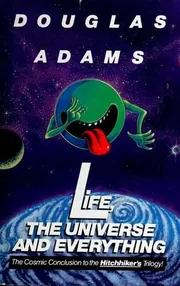
Life, the Universe and Everything
by Douglas Adams · 1982
Suits teens and adults who enjoy witty science fiction, and its content is mild.
210 pages, about 3.5 to 5 hours.
Adams's brisk third Hitchhiker book: cricket, doom, and a sofa. 56% taste match
The story
Life, the Universe and Everything is a science fiction comedy by British writer Douglas Adams, first published in 1982. It is the third installment in the Hitchhiker's Guide to the Galaxy series, which Adams famously described as a "trilogy" despite its larger number of volumes. The story belongs to the tradition of interplanetary voyage fiction, with a strong streak of fantasy, and runs to roughly 210 pages in its typical edition.
The cast brings together familiar figures from the series, including Arthur Dent, Ford Prefect, Zaphod Beeblebrox, Trillian, Slartibartfast, and Marvin the Paranoid Android. Also appearing are the Vogons, Agrajag, and Hactar. The settings range from Earth and Lord's Cricket Ground to Krikkit and Stavromula Beta, and the ship Heart of Gold and its Infinite Improbability Drive are part of the machinery of the tale. Among the subjects it touches are paradoxes, xenophobia, bird language, reverse engineering, and sofas, alongside the cricket world of The Ashes and a place called Wikkit Gate. The title points to the Answer to Life, the Universe, and Everything, a question that runs through the series as a whole. The book has appeared in around 65 editions and is also collected in several omnibus volumes of the Hitchhiker's books.
Characters
Ford PrefectArthur DentSlartibartfastTrillianZaphod BeeblebroxVogons
Setting
EarthLord's Cricket GroundKrikkitStavromula Beta
Themes
sofasxenophobiabird languageparadoxesInfinite Improbability DriveHeart of Goldreverse engineeringThe Ashes
- Want to read 159
- Reading now 10
- Read 211
Readers are split between finishing it and saving it for later.
Of 380 readers who put it on a shelf, 42% want to read it, 3% are reading it now, 56% have finished it and 0% stopped before the end.
By the numbers
- The median edition runs 210 pages. Counting about 275 words a page and an adult reading pace of 250 words a minute, that is about 3.9 hours of reading.
- Open Library tracks 65 editions from 49 publishers, the earliest dated 1982 and the latest 2021, across 7 languages.
- On reader demand it ranks in the top 2% of the modern books in our catalog (15,152 of them).
- Libraries shelve it under Dewey 823.914 and Library of Congress class PR-6051.00000000.D3352L5 1982.
 BookWard’s take
Adams's brisk third Hitchhiker book: cricket, doom, and a sofa
Life, the Universe and Everything is the third Hitchhiker's book, and at 210 pages it is lean. The comedy is the draw: Adams's voice is unmistakable, dry and deadpan, and the book is funny from start to finish. The pace is quick, and the familiar tropes are mostly turned inside out, though the originality is a notch below the first book's shock of the new. The characters are drawn lightly here, since the familiar crew work as comic types rather than deeply drawn people, and it is plainly part of a series, so start earlier. The ending resolves cleanly enough. If you want idea-led absurdity delivered at speed, it delivers.
At 210 pages it is short and quick to finish, which suits BookWard's love of tight books.
Short scenes and constant incident keep it moving, close to BookWard's fast preference.
Adams's comic invention still feels fresh, if a step less startling than the first book.
The prose is plain and clean, with wit in the phrasing rather than ornament.
Events and gags lead, so it sits well toward plot, unlike BookWard's lean to character.
The tone is cheerfully fatalistic: doom looms but never crushes, landing mildly toward hope.
A straightforward adventure told in order, with only the odd narrator digression bending the form.
Comedy is the whole point, running at full strength, well above BookWard's already high mark.
Despite cosmic doom, the tone stays light and gentle.
Feeling is kept at arm's length by the jokes, so it is more restrained than intense.
See all 50 dialsEvery position, side by side with this book
Where it lines up
- PaceBookWard 8 · book 8
- SentimentBookWard 8 · book 8
- Shock for effectBookWard 9 · book 9
Where it pulls apart
- Familiar tropesBookWard 10 · book 6
- Internal logicBookWard 10 · book 6
- OpeningBookWard 10 · book 7
At 210 pages it is short and quick to finish, which suits BookWard's love of tight books.
It drops you into the series' absurd universe quickly, though less abruptly than BookWard's top marks for instant hooks.
It spoofs science fiction conventions rather than leaning on them, though some series habits repeat by the third book.
The jokes run on their own consistent absurd logic, looser than the airtight plotting BookWard prizes.
Short scenes and constant incident keep it moving, close to BookWard's fast preference.
Adams's comic invention still feels fresh, if a step less startling than the first book.
The crew are comic archetypes, drawn lightly, a little below BookWard's taste for deeply drawn people.
The central problem is resolved, which BookWard likes, even if the tone stays flippant.
Adams undercuts feeling with a joke almost every time, which BookWard enjoys as restraint.
Its destruction and doom are played for laughs, not for shock, so any darkness is earned by the comedy.
Not applicable to a comic novel.
Adams's dry, digressive narration is among the most recognisable in science fiction, a big plus for BookWard.
Comic ideas drive much of the fun, though a quest plot still carries it, leaning slightly toward story.
Asides and explanatory digressions are a signature, so it explains more than BookWard's show-in-scene preference.
Short and episodic, it mostly sustains, though a few stretches coast on the jokes.
The prose is plain and clean, with wit in the phrasing rather than ornament.
Events and gags lead, so it sits well toward plot, unlike BookWard's lean to character.
The tone is cheerfully fatalistic: doom looms but never crushes, landing mildly toward hope.
A straightforward adventure told in order, with only the odd narrator digression bending the form.
Comedy is the whole point, running at full strength, well above BookWard's already high mark.
Light, quick and easy to read, easier than BookWard's usual middle ground.
It cuts between the travellers and different locations, giving a handful of viewpoints.
The story moves forward in order, with little jumping around in time.
Spaceships, aliens and absurd physics make it thoroughly fantastical, beyond BookWard's mid-range taste.
The core crew plus a parade of recurring and one-off characters make the cast fairly sizeable.
The stakes cover the galaxy and the universe, an epic canvas treated with a shrug.
Action and incident dominate over private thought, tilting toward the outer.
Sharp, quotable banter carries much of the humor and the plot.
Alien planets and cosmic oddities make the settings highly unfamiliar, with an Earth cricket ground for contrast.
It is an early-1980s book with a timeless comic bent, so it reads as a past-era work.
Its jokes about bureaucracy and absurdity have aged well and still land for new readers.
The narrator is a reliable guide, even when the commentary is cheeky.
Description appears as funny asides, so it is moderate rather than lush.
Part of a larger multi-book series and best read after the first two.
There are reveals and reversals, but the pleasure is the jokes more than the surprises.
A comforting, light-hearted read that does not push the reader.
Despite cosmic doom, the tone stays light and gentle.
Feeling is kept at arm's length by the jokes, so it is more restrained than intense.
Dry, deadpan wit sits toward the dry end of the scale, with some broader slapstick moments.
Sexual content is essentially nil.
Satire of bureaucracy and xenophobia is present but not the focus.
The language is plain and accessible, with only invented names to trip over.
The narrator editorialises constantly, which gives the book much of its flavor.
It is a comic present-tense adventure, with only a modest look to the future.
Cosmic indifference leans cynical, softened by the characters' warmth.
Review written by BookWard, dial version 1, November 2026.
Who is Life, the Universe and Everything right for?
Suits teens and adults who enjoy witty science fiction, and its content is mild. There is cartoonish peril and some talk of planetary destruction, but little that is graphic.
Light, quick and easy to read, easier than BookWard's usual middle ground.
Despite cosmic doom, the tone stays light and gentle.
Feeling is kept at arm's length by the jokes, so it is more restrained than intense.
Book CompanionLife, the Universe and Everything: ideas, characters, themes
The galaxy is vast, absurd and indifferent, and the funniest response is to keep going with a towel and a sense of humor.
- A cricket-shaped crisis. The story ties Earth's cricket world and the Ashes into a galactic problem, mixing the homely with the cosmic.
- The series' third outing. It continues the Hitchhiker's saga, reuniting Arthur, Ford, Zaphod, Trillian and others.
- Place-hopping adventure. The plot ranges from Earth and Lord's Cricket Ground to Krikkit and Stavromula Beta.
- Tech as comic engine. The Heart of Gold and its Infinite Improbability Drive power the book's silliest turns.
- Digression as style. Asides on topics like sofas, bird language and paradoxes give the book its trademark flavor.
Characters
Arthur Dent
The bewildered Earthman
A hapless everyman who keeps being dragged along by events.
Ford Prefect
Arthur's resourceful alien friend
A seasoned traveller who treats chaos casually.
Zaphod Beeblebrox
Flamboyant ship-hopping adventurer
A showy, reckless presence in the crew.
Trillian
Fellow traveller
A capable companion in the group.
Marvin the Paranoid Android
Gloomy robot
A perpetually depressed machine who supplies much of the dry humor.
Themes
The universe runs on logic that makes sense only as a joke.
Fear and suspicion of outsiders, satirised through alien conflicts.
Contradictions that the story plays with for laughs.
Officialdom as a source of cosmic comic trouble.
A mismatched group sticks together through chaos.
Discussion questions
- Why does Adams keep undercutting big stakes with jokes, and does it work?
- What does the book say about fear of outsiders?
- How does the cricket thread change the way you see the larger plot?
- Which character carries the book's humor best, and why?
- Does it help or hurt to read this one after the first two books?
Personalize your Book Companion
This is the general edition. In BookWard, the Companion is written for you: your reading profile, your notes, and spoiler-safe to the page you are on.
Buy, listen or borrow Life, the Universe and Everything
Each link opens a search for this book on that store, in a new tab.
Read on a device
Borrow
Reviews and community
If you liked Life, the Universe and Everything
A short, ferociously funny galaxy tour that never slows down
The Last HeroTerry PratchettCohen's last ride, in Pratchett's most lavishly illustrated Discworld
Thief of TimeTerry PratchettPratchett turns clockwork and the nature of time into a comic chase
Witches AbroadTerry PratchettThree witches, one wand, and a fairy tale with teeth
Sources: Open Library.
Track Life, the Universe and Everything and find your next favorite
Add it to your shelf, rate what you have read, and BookWard will recommend what fits you.
Free to start. No credit card needed.