Suits teens and adults who enjoy witty fantasy, and it works as a stand-alone entry in the series.
384 pages, about 6 to 9 hours.
Pratchett turns clockwork and the nature of time into a comic chase. 63% taste match
The story
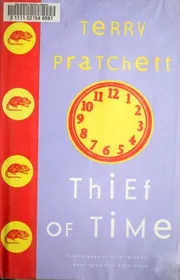
Thief of Time is a humorous fantasy novel by Terry Pratchett, first published in 2001. It is the 26th book in the Discworld series and the last in that series to carry a cover by Josh Kirby. The story is set on the Discworld, with scenes in Ankh-Morpork and the Ramtops.
On this world, time is looked after by the Monks of History. A young horologist sets out to build the first truly accurate clock, and if it starts ticking, time as it is known will come to an end. The History Monk Lobsang Ludd and his teacher must race to stop the clock before it begins. Death, Nanny Ogg, Jeremy Clockson and Myria LeJean also appear among its characters. The book is a standalone adventure within the longer Discworld sequence and deals with clocks, watches and the nature of time. It runs to about 384 pages and has appeared in 32 editions.
According to the First Scroll of Wen the Eternally Surprised, Wen Stepped out of the cave where he had received enlightenment and into the dawning light of the first day of the rest of his life.
Setting
Ankh-MorporkThe RamtopsDiscworld
Themes
Discworld (Imaginary place)Discworld (Imaginary placeFantasyTimeClocks and watchesEnglish literatureTempsRomans, nouvelles
- Want to read 82
- Reading now 3
- Read 72
Readers are split between finishing it and saving it for later.
Of 157 readers who put it on a shelf, 52% want to read it, 2% are reading it now, 46% have finished it and 0% stopped before the end.
By the numbers
- The median edition runs 384 pages. Counting about 275 words a page and an adult reading pace of 250 words a minute, that is about 7.0 hours of reading.
- Open Library tracks 32 editions from 22 publishers, the earliest dated 2001 and the latest 2022, across 6 languages.
- On reader demand it ranks in the top 6% of the modern books in our catalog (15,152 of them).
- Libraries shelve it under Dewey 813 and Library of Congress class PR-6066.00000000.R34.
 BookWard’s take
Pratchett turns clockwork and the nature of time into a comic chase
Thief of Time is Terry Pratchett's 26th Discworld novel, and it shows an author at ease with big ideas and small jokes. A young horologist builds the world's first truly accurate clock, and the Monks of History have to stop it before it starts. It is a funny book, with the wit worked into the plot itself rather than sprinkled on top, which is a pleasure to read. The premise of time as a managed resource feels fresh even this deep into a long series. The voice is the real signature here: unmistakable and distinctive, and a joy to settle into. It leans harder into ideas than I usually like, and the series is the main caveat, since it belongs to a long sequence, though the story stands alone well enough. At 384 pages it moves briskly without feeling thin.
At 384 pages it is mid-length for a novel and moves briskly, which is close enough to BookWard's love of tight books.
The race to stop the clock keeps things moving, a little lighter on momentum than BookWard's fast ideal.
Time managed by monks and threatened by a clock is a fresh angle, very much in BookWard's territory.
The prose is clever and playful with lots of wit, a touch more ornamented than BookWard's plain-leaning taste.
The race against the clock drives events more than inner change, tilting plot-driven against BookWard's character lean.
Despite apocalyptic stakes, the tone stays warm and optimistic, close to BookWard's mildly hopeful outlook.
The telling is mostly conventional storytelling, with the clock premise adding some playfulness.
Comedy is central to the book and runs through nearly every page, matching BookWard's fondness for humor.
The end of time is the threat, but the tone stays light, gentler than BookWard's middle.
Feeling is present but tempered by humor, a little below BookWard's moderate setting.
See all 50 dialsEvery position, side by side with this book
Where it lines up
- OriginalityBookWard 9 · book 9
- EndingBookWard 8 · book 8
- Shock for effectBookWard 9 · book 9
Where it pulls apart
- LengthBookWard 1 · book 4
- OpeningBookWard 10 · book 7
- Story or ideasBookWard 3 · book 7
At 384 pages it is mid-length for a novel and moves briskly, which is close enough to BookWard's love of tight books.
The premise of a perfect clock that could end time gives the story a strong early pull, matching what BookWard wants from an opening.
It plays with fantasy conventions rather than leaning on them, which BookWard rewards.
Its odd rules about time hold together inside the Discworld, and the comedy never breaks them, which BookWard values.
The race to stop the clock keeps things moving, a little lighter on momentum than BookWard's fast ideal.
Time managed by monks and threatened by a clock is a fresh angle, very much in BookWard's territory.
Lobsang and Lu-Tze are drawn with warmth and quirk, though comedy keeps some characters closer to types than BookWard prefers.
The central threat is settled by the close, which suits BookWard's liking for resolution.
Warmth runs through the book but it undercuts feeling with humor, landing somewhat short of BookWard's restraint.
The stakes are high but the book never reaches for cheap darkness, in line with BookWard's taste.
Pratchett's voice is unmistakable, dry, digressive and confident, exactly the distinctive voice BookWard prizes.
Ideas about time drive the plot, though a chase and a cast of characters keep it story-led enough, more idea-heavy than BookWard's lean.
Pratchett explains plenty through narrator asides, more openly than BookWard's preference for showing in scene.
The chase structure keeps the middle moving, which BookWard appreciates.
The prose is clever and playful with lots of wit, a touch more ornamented than BookWard's plain-leaning taste.
The race against the clock drives events more than inner change, tilting plot-driven against BookWard's character lean.
Despite apocalyptic stakes, the tone stays warm and optimistic, close to BookWard's mildly hopeful outlook.
The telling is mostly conventional storytelling, with the clock premise adding some playfulness.
Comedy is central to the book and runs through nearly every page, matching BookWard's fondness for humor.
The prose reads easily, though the time concepts ask for some attention, a bit easier than BookWard's moderate demand.
The story moves among several characters and groups, giving it a wide cast of perspectives that suits BookWard.
Time itself is the subject, but the narrative runs mostly forward, a touch more linear than BookWard's mix.
Discworld is fully fantastical, a flat world with its own gods and rules, well beyond BookWard's midpoint.
Death, Nanny Ogg, monks and more crowd the pages, a larger cast than BookWard's middle setting.
The fate of time itself is at stake, which is epic in scope despite the comic tone.
It balances action with reflection, sitting near BookWard's slightly inward lean.
Banter carries much of the comedy, so dialogue is heavy, matching BookWard's liking for talk.
Romance stays in the background, below BookWard's moderate middle.
Discworld is an unfamiliar invented place full of its own customs, which suits BookWard's love of new settings.
It is an invented fantasy world with no present-day setting, much further from now than BookWard's usual lean.
Humor about time and human nature has lasting appeal, slightly above BookWard's own staying-power setting.
The narration is a trustworthy, amused guide, far from the unreliable end BookWard likes.
Right and wrong are fairly clear here, though Pratchett enjoys complicating them a little, less ambiguous than BookWard's lean.
Discworld is vividly imagined but description serves the jokes, landing near BookWard's middle.
It is the 26th Discworld novel, well into a long sequence, though it works as a self-contained adventure.
Reversals and clever turns keep coming, close to BookWard's taste for surprise.
It entertains first and is gently comforting, easier going than BookWard's lean toward challenge.
The end of time is the threat, but the tone stays light, gentler than BookWard's middle.
Feeling is present but tempered by humor, a little below BookWard's moderate setting.
The humor is witty and observational with some broad moments, balanced right where BookWard sits.
Violence is mild and cartoonish, lighter than BookWard's middle setting.
Sexual content is essentially absent, much lower than BookWard's moderate mark.
Satire touches society now and then but politics is not the point, below BookWard's middle.
The language is playful but accessible, plainer than BookWard's middle.
Pratchett's narrator editorializes constantly with wry commentary, more opinionated than BookWard's lean.
It reflects on time and tradition while pushing toward resolution, close to BookWard's slight forward lean.
Underneath the jokes is a kind and idealistic view of people, near BookWard's idealistic lean.
Review written by BookWard, dial version 1, November 2026.
Who is Thief of Time right for?
Suits teens and adults who enjoy witty fantasy, and it works as a stand-alone entry in the series. Content is mild, with light fantasy peril and nothing graphic.
The prose reads easily, though the time concepts ask for some attention, a bit easier than BookWard's moderate demand.
The end of time is the threat, but the tone stays light, gentler than BookWard's middle.
Feeling is present but tempered by humor, a little below BookWard's moderate setting.
Violence is mild and cartoonish, lighter than BookWard's middle setting.
Book CompanionThief of Time: ideas, characters, themes
A perfect clock threatens to stop time, and two History Monks must race to stop it before it starts.
- Time as a resource. On Discworld, time is managed by the Monks of History, treated as something to be looked after.
- The perfect clock. A young horologist sets out to build the first truly accurate clock, which could end time as it is known.
- A race against the clock. Lobsang Ludd and his teacher have to act quickly to stop the timepiece before it begins.
- Familiar faces. Death and Nanny Ogg appear among the characters, alongside Jeremy Clockson and Myria LeJean.
- Place in the series. It is the 26th Discworld novel and the last with a cover by Josh Kirby.
Characters
Lobsang Ludd
History Monk
A young monk of history who must help stop the clock.
Lu-Tze
History Monk
The esteemed monk who teaches Lobsang and races to stop the clock.
Jeremy Clockson
Horologist
The young horologist who sets out to build the first truly accurate clock.
Death
Recurring Discworld figure
A fixture of the series who appears in the story.
Themes
What it is, who looks after it, and what would be lost if it stopped.
The danger of chasing a perfectly accurate clock.
The monks' responsibility to protect something everyone depends on.
How comedy carries real ideas about people and the world.
Discussion questions
- Why might a perfectly accurate clock be dangerous rather than useful?
- How does treating time as a managed resource change how you think about it?
- What does the book gain from its comic tone when the stakes are so high?
- How do Lu-Tze and Lobsang work as a teacher and student pairing?
- Does it help or hurt to come to this as the 26th book in a series?
Personalize your Book Companion
This is the general edition. In BookWard, the Companion is written for you: your reading profile, your notes, and spoiler-safe to the page you are on.
Buy, listen or borrow Thief of Time
Each link opens a search for this book on that store, in a new tab.
Read on a device
Borrow
Reviews and community
If you liked Thief of Time
A cosmic comic detective novel where everything turns out connected
HogfatherTerry PratchettDeath plays Father Christmas, and belief itself is at stake
Reaper ManTerry PratchettDeath takes early retirement and Discworld gets funnier and wiser
Witches AbroadTerry PratchettThree witches, one wand, and a fairy tale with teeth
Sources: Open Library.
Track Thief of Time and find your next favorite
Add it to your shelf, rate what you have read, and BookWard will recommend what fits you.
Free to start. No credit card needed.