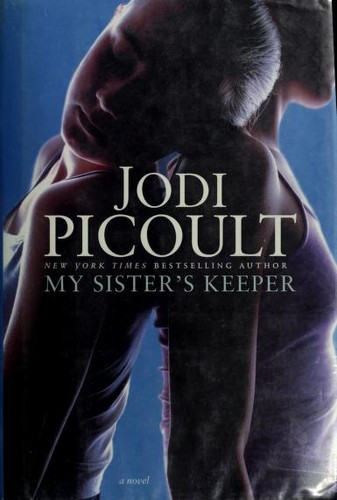
My Sister's Keeper
by Jodi Picoult
★ Top 25 book of 2004 · #12 on Best Books of 2004
Anna was conceived to be a bone marrow match for her leukemia-stricken sister, and she has endured countless medical procedures. Now she makes a choice that threatens her family, raising hard questions about parenthood and morality.
Best for: Readers who enjoy emotional family dramas built around difficult moral dilemmas
My Sister's Keeper is #12 on BookWard's Best Books of 2004, out of 48 2004 books that cleared our data bar.
What My Sister's Keeper is about
Anna Fitzgerald was conceived to help save her older sister Kate, who has leukemia, and she has given what her sister needed since birth. At thirteen she is told she must give a kidney, and she decides to say no. With the help of a lawyer named Campbell Alexander, she petitions for control over her own body, setting her against her mother Sara, who argues the case herself.
Jodi Picoult tells the story through several voices, including a court-appointed guardian trying to decide what is best for Anna, and a brother whose troubles have gone unnoticed in the family's crisis. There is no easy villain here, only people who love each other and want different things. Readers who enjoy emotional, morally tangled family drama will find plenty to argue over.
My Sister's Keeper on the Best Books of 2004
My Sister's Keeper came out in 2004. Of the 48 books first published in 2004 that met BookWard's data bar, it ranks #12 on our Best Books of 2004 list.
Why it made the list: 439 readers have shelved it on Open Library; readers rate it 3.7 out of 5 (35 ratings). The list ranks each year’s books on how many readers have picked them up, how highly readers rate them, and how many are reading them right now.
Nearby on the 2004 list
- The Pigeon Finds a Hot Dog! Mo Willems, #10
- The Last Kingdom Bernard Cornwell, #11
- The Definitive Book of Body Language Allan Pease, #13
- The Darkest Hour Erin Hunter, #14
See all Best Books of 2004 Best books by year
More years: Best Books of 2003 Best Books of 2005.
The numbers behind it
- Readers: 344 want to read it, 19 are reading it now and 76 have read it, according to Open Library.
- Ratings: 3.7 out of 5 from 35 Open Library ratings.
| Signal | This book (0 to 100) | Weight |
|---|---|---|
| Reach | 85 | 55% |
| Reader love | 17 | 25% |
| Being read right now | 85 | 20% |
Questions about My Sister's Keeper
When was My Sister's Keeper published?
My Sister's Keeper by Jodi Picoult was first published in 2004.
Was My Sister's Keeper one of the best books of 2004?
My Sister's Keeper is #12 on BookWard's Best Books of 2004, out of 48 2004 books that cleared our data bar. 439 readers have shelved it on Open Library; readers rate it 3.7 out of 5 (35 ratings).
Why is My Sister's Keeper on the Best Books of 2004 list?
439 readers have shelved it on Open Library; readers rate it 3.7 out of 5 (35 ratings).
More of the best books of 2004
- Darkly Dreaming Dexter Jeffry P. Lindsay, #1
- Rich Dad, Poor Dad for Teens Robert T. Kiyosaki, #2
- The Ruins of Gorlan John Flanagan, #3
- Blink Malcolm Gladwell, #4
- Alexander Hamilton Ron Chernow, #5
- She Comes First Ian Kerner, #6
See the full Best Books of 2004, the Top 100, or new books on Rising.
How we know
This page uses public data: Open Library reader counts and ratings, and Wikipedia page views for recent years. The description is paraphrased from real source text. Rankings reflect reading interest, not quality or sales, and can be affected by data gaps. Lists update monthly.
Best suited to mature teens and adults.
Depends on the edition you pick.
A thirteen-year-old sues her parents over her own body. 53% taste match
 BookWard’s take
A thirteen-year-old sues her parents over her own body
Jodi Picoult builds her 2004 novel on a single, hard question: Anna Fitzgerald was conceived as a donor match for her sister Kate, and at thirteen she petitions for medical emancipation rather than give up a kidney. That premise hooks at once, and the courtroom frame keeps the pace brisk. The book is told from multiple viewpoints, so the family, the lawyer and the guardian ad litem each get a say, which suits its moral ambiguity: no one is simply wrong. Two things may give some readers pause. A story about a dying child runs warm, and it can tip into sentiment. And the family-in-crisis drama is well-worn ground, so the book leans on familiar tropes. Still, the premise is sharp and the logic of the case holds together.
A full-length family drama with several narrators, longer than BookWard's taste for tight books.
The court case gives steady forward motion, though family backstory slows it in places.
The savior-sister premise is a fresh hook within a familiar genre, a mixed fit for BookWard.
Clean, direct writing that serves the story and avoids ornament.
The legal case drives events, but the weight comes from how each family member responds.
Illness and family strain dominate, with limited comfort on offer.
Rotating narrators add some variety to an otherwise conventional frame.
A serious book with little room for humor.
Serious illness and family strain give the book a heavy tone without graphic detail.
Built to move the reader, with grief and love at the center.
See all 50 dialsEvery position, side by side with this book
Where it lines up
- EndingBookWard 8 · book 8
- OpeningBookWard 10 · book 9
- PaceBookWard 8 · book 7
Where it pulls apart
- Familiar tropesBookWard 10 · book 4
- LengthBookWard 1 · book 6
- SentimentBookWard 8 · book 3
A full-length family drama with several narrators, longer than BookWard's taste for tight books.
The central dilemma, a girl suing her parents over a kidney, is clear from the start, which BookWard rewards.
Terminal illness and courtroom drama are familiar ground, though the savior-sister premise gives it a distinct angle.
The legal and medical stakes follow clearly from the setup, and the case moves in a coherent way.
The court case gives steady forward motion, though family backstory slows it in places.
The savior-sister premise is a fresh hook within a familiar genre, a mixed fit for BookWard.
Each narrator gets a distinct inner life, which matches BookWard's liking for deeply drawn people.
The case reaches a firm answer, which BookWard prefers to an ambiguous close.
A story about a sick child leans emotional, which sits against BookWard's preference for restraint.
The darkness comes from the central dilemma rather than gratuitous events, which BookWard respects.
The multi-narrator approach gives each viewpoint its own tone, though the overall style is accessible rather than singular.
Driven by a moral question, but carried through characters and a courtroom plot.
Most of the situation emerges through the characters' own accounts, close to BookWard's taste for scenes over explanation.
The trial structure sustains tension, though backstory chapters can interrupt the momentum.
Clean, direct writing that serves the story and avoids ornament.
The legal case drives events, but the weight comes from how each family member responds.
Illness and family strain dominate, with limited comfort on offer.
Rotating narrators add some variety to an otherwise conventional frame.
A serious book with little room for humor.
Easy to follow, with emotional rather than intellectual difficulty.
Told from multiple points of view, including the lawyer and the guardian ad litem.
Mostly linear around the trial, with backstory woven in.
Entirely grounded in medicine, law and family life.
A core family plus a lawyer, a judge and a guardian ad litem keep the cast manageable.
The stakes sit inside one family and one courtroom.
The balance is split between the inner turmoil of each narrator and the outer legal action.
Courtroom exchanges and family arguments make talk a prominent part of the book.
A past romance between the lawyer and the guardian ad litem is a subplot, not the center.
A contemporary American town and its courthouse, familiar territory for most readers.
Set in 2004 and close enough to the present to feel contemporary.
The ethical questions outlast the date, though the medical details belong to their moment.
The narrators are plain about what they feel and want.
The book refuses to cast anyone as simply wrong, which suits BookWard's taste for moral complexity.
Description serves the scenes and does not linger.
A standalone novel.
The plot holds back some developments, though the core situation is stated early.
The ethical dilemma is genuinely difficult to settle, whatever side a reader takes.
Serious illness and family strain give the book a heavy tone without graphic detail.
Built to move the reader, with grief and love at the center.
Very little humor, mostly dry when it appears.
The harm is medical and emotional rather than physical violence.
Little sexual content beyond the backstory of a past romance.
Bioethics and the law are central to the premise, but the book does not preach.
Plain, accessible language throughout.
Each narrator gives a personal view, but the book itself stays even-handed.
Rooted in present dilemmas and recent family history.
It cares about doing right while acknowledging how hard that is.
Review written by BookWard, dial version 1, November 2026.
Who is My Sister's Keeper right for?
Best suited to mature teens and adults. It deals with serious childhood illness, medical procedures and family conflict, which some readers may find upsetting.
Easy to follow, with emotional rather than intellectual difficulty.
Serious illness and family strain give the book a heavy tone without graphic detail.
Built to move the reader, with grief and love at the center.
The harm is medical and emotional rather than physical violence.
Book CompanionMy Sister's Keeper: ideas, characters, themes
What do we owe our family, and who decides when one person's body is used to save another's life?
- The savior sibling. Anna was conceived so that her cord blood could help treat Kate's leukemia, and that origin defines her role in the family.
- A decision at thirteen. When Anna is told she must donate a kidney, she petitions for medical emancipation with the help of lawyer Campbell Alexander.
- Parent versus child. Sara, a former civil attorney, chooses to represent herself against her own daughter's case.
- Many narrators. Telling the story from several viewpoints lets each person's reasons be heard, including those of the judge and the guardian ad litem.
- A contested question. The book weighs saving one child against protecting another's rights without handing the reader an easy answer.
Characters
Anna Fitzgerald
The thirteen-year-old who sues for medical emancipation
Defined all her life in terms of her sister, she begins to ask who she is apart from that role.
Kate Fitzgerald
Anna's older sister, who has leukemia
Her illness shapes every decision the family makes.
Sara Fitzgerald
Their mother and a former civil attorney
She represents herself in court, putting her parenting and her profession in direct conflict.
Campbell Alexander
Anna's lawyer
He takes her case and has a past with the court-appointed guardian ad litem.
Julia Romano
The guardian ad litem
Appointed to decide what is best for Anna, she is tied to Campbell by their shared history.
Themes
A person's right to decide what happens to their own body, even against family wishes.
Anna's struggle to be seen as herself rather than as her sister's donor.
How far a parent should go to save one child when it costs another.
What science makes possible versus what we are right to do with it.
Devotion between sisters that complicates every choice.
Discussion questions
- Is Anna right to refuse, and does your answer change if the outcome could be fatal for Kate?
- Was it fair of Sara to represent herself, or did it blur her roles as mother and advocate?
- How does hearing from several narrators change your sympathy for each person?
- Should the law ever allow a child to make a decision of this size without her parents?
- What does the book suggest it means to be a good parent when your children's needs conflict?
Personalize your Book Companion
This is the general edition. In BookWard, the Companion is written for you: your reading profile, your notes, and spoiler-safe to the page you are on.
Buy, listen or borrow My Sister's Keeper
Each link opens a search for this book on that store, in a new tab.
Read on a device
Borrow
Reviews and community
If you liked My Sister's Keeper
A school shooting told through the town left behind
Then She Was GoneLisa JewellA missing-girl mystery that hooks fast and grips to the end
The Three Lives of Cate KayKate FaganA famous anonymous novelist decides to tell the world who she is
Mina vännerFredrik BackmanA lonely teenager chases the story behind a famous painting
Find your own best books
Add what you have read, rate it, and BookWard will recommend what to read next.
Free to start. No credit card needed.