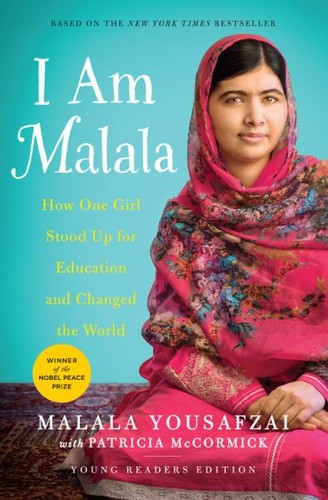
I Am Malala
by Malala Yousafzai
★ Top 10 book of 2013 · #10 on Best Books of 2013
When the Taliban took over Pakistan's Swat Valley, Malala Yousafzai spoke up for girls' education and was shot in the head at fifteen. Her recovery led her to the United Nations and made her a global symbol of peaceful protest.
Best for: Readers drawn to true stories of courage, family, and the fight for education
I Am Malala is #10 on BookWard's Best Books of 2013, out of 46 2013 books that cleared our data bar.
What I Am Malala is about
Malala Yousafzai grew up in Pakistan's Swat Valley, where her father, Ziauddin, opened a school and offered free places to poor children. As the Taliban's influence spread, music was condemned and women were told to stay at home. Malala began writing a blog for the BBC under a pseudonym, even as threats against her grew.
Written with Christina Lamb, her memoir tells the story of her family, her village, and the day in October 2012 when she was shot on her school bus at age fifteen. It is also the account of what she chose to do next. Earnest and hopeful, the book shows how one young voice can carry a long way. It will move readers who care about education, family, and courage, and it is accessible to teenagers and adults alike.
I Am Malala on the Best Books of 2013
I Am Malala came out in 2013. Of the 46 books first published in 2013 that met BookWard's data bar, it ranks #10 on our Best Books of 2013 list.
Why it made the list: 512 readers have shelved it on Open Library; readers rate it 4.3 out of 5 (38 ratings); 37 are reading it right now. The list ranks each year’s books on how many readers have picked them up, how highly readers rate them, and how many are reading them right now.
Nearby on the 2013 list
- Losing Hope Colleen Hoover, #8
- The Elite (the Selection #2) Kiera Cass, #9
- Doctor Sleep Stephen King, #11
- Crazy Rich Asians Kevin Kwan, #12
See all Best Books of 2013 Best books by year
More years: Best Books of 2012 Best Books of 2014.
The numbers behind it
- Readers: 417 want to read it, 37 are reading it now and 58 have read it, according to Open Library.
- Ratings: 4.3 out of 5 from 38 Open Library ratings.
| Signal | This book (0 to 100) | Weight |
|---|---|---|
| Reach | 72 | 55% |
| Reader love | 80 | 25% |
| Being read right now | 85 | 20% |
Questions about I Am Malala
When was I Am Malala published?
I Am Malala by Malala Yousafzai was first published in 2013.
Was I Am Malala one of the best books of 2013?
I Am Malala is #10 on BookWard's Best Books of 2013, out of 46 2013 books that cleared our data bar. 512 readers have shelved it on Open Library; readers rate it 4.3 out of 5 (38 ratings); 37 are reading it right now.
Why is I Am Malala on the Best Books of 2013 list?
512 readers have shelved it on Open Library; readers rate it 4.3 out of 5 (38 ratings); 37 are reading it right now.
More of the best books of 2013
- House of Hades Rick Riordan, #1
- Hard Luck Jeff Kinney, #2
- Crown of Midnight Sarah J. Maas, #3
- The Screaming Staircase Jonathan Stroud, #4
- Unravel Me Tahereh Mafi, #5
- The Goldfinch Donna Tartt, #6
See the full Best Books of 2013, the Top 100, or new books on Rising.
How we know
This page uses public data: Open Library reader counts and ratings, and Wikipedia page views for recent years. The description is paraphrased from real source text. Rankings reflect reading interest, not quality or sales, and can be affected by data gaps. Lists update monthly.
Suits teens and adults, and is widely read in schools, though it has been banned in many schools in Pakistan.
Depends on the edition you pick.
A girl's memoir of Swat, the Taliban, and a school bus. 56% taste match
 BookWard’s take
A girl's memoir of Swat, the Taliban, and a school bus
I Am Malala is Malala Yousafzai's account of growing up in the Swat Valley, co-written with Christina Lamb, and it is as much a portrait of a family and a place as it is the story of one day in October 2012. The shooting is the famous event, but the book earns its weight by showing the years before it: her father's schools, the rise of Fazlullah's radio broadcasts, the closing of her own school. The title and subtitle do the work of hooking you, and after that the book settles into a steadier, more explanatory build. It stops to explain Pakistani politics outright rather than leaving the reader to piece them together from scenes. It ends on a hopeful note, and it keeps the violence restrained, never reaching for shock. The result is plain-spoken and moving.
Brisk once the Taliban arrive, slower where it explains history and politics, so moderate overall.
A familiar memoir form, but a rare first-person view of this valley and this fight, told by someone who lived it.
Plain and accessible, built for clarity rather than ornament.
Driven by events, but anchored in who these people are, leaning a little toward character.
Despite the attack and the loss of her home, it ends firmly on resilience and belief in change.
Three parts running in chronological order, with a conventional structure.
Serious in subject, with only small moments of lightness in family life.
Covers terrorism and an attempted killing, but handled with restraint and a hopeful frame.
Moving in its portrayal of family love and her recovery, without pushing for tears.
See all 50 dialsEvery position, side by side with this book
Where it lines up
- EndingBookWard 8 · book 8
- Shock for effectBookWard 9 · book 9
- Story or ideasBookWard 3 · book 3
Where it pulls apart
- LengthBookWard 1 · book 5
- Familiar tropesBookWard 10 · book 6
- ExpositionBookWard 2 · book 7
The shooting frames the book from the start, but the early chapters settle into childhood and family before the tension builds.
The memoir and activist-hero shape is familiar, though the Swat setting and a teenage narrator give it a fresh angle.
A clear, well-ordered account of events that holds together, which suits BookWard's liking for airtight books.
Brisk once the Taliban arrive, slower where it explains history and politics, so moderate overall.
A familiar memoir form, but a rare first-person view of this valley and this fight, told by someone who lived it.
Her father Ziauddin, her mother Toor Pekai and Malala herself are drawn with real warmth and specifics, matching BookWard's taste for depth.
The account follows her recovery and her path to the United Nations, closing on resolution and purpose rather than ambiguity.
Heartfelt and sometimes tender about family, yet kept steady by plain reporting, so slightly more sentimental than BookWard prefers.
The violence is part of the story and not played for effect, which fits BookWard's wish for darkness that is earned.
A personal memoir backed by historical and political context, though not a formal, sourced study.
Direct, earnest and unmistakably hers, with a young person's clarity and conviction.
Led by story and lived experience, with ideas about education arriving through events rather than argument.
Pauses to explain Pakistani politics and history outright, more than BookWard's love of showing in scene would choose.
Mostly sustained, with some stretches of background history that slow the middle slightly.
Plain and accessible, built for clarity rather than ornament.
Driven by events, but anchored in who these people are, leaning a little toward character.
Despite the attack and the loss of her home, it ends firmly on resilience and belief in change.
Three parts running in chronological order, with a conventional structure.
Serious in subject, with only small moments of lightness in family life.
Easy to read, with only the political background asking for some attention.
A single first-person narrator throughout.
Follows her life in order, with the shooting held up as the shaping event.
Entirely grounded in real events and places.
Family, teachers, friends and political figures make a moderately large cast, though few get much space.
A personal story set against national and global events, balancing the intimate and the wide.
Balances her reflections with the external events of the Taliban's rise and the family's choices.
Mostly narration and summary, with scenes of talk used sparingly.
Not a feature of the story.
A valley in northern Pakistan, unfamiliar to many readers but made clear through close detail.
Covers recent history, from her childhood to a book published in 2013.
Tied to specific events but carrying a lasting message about education and courage.
A candid first-person account, with no sign of unreliability.
Clear about right and wrong, with the Taliban's actions and her cause stated plainly.
Vivid about the valley, her home and her school, though not lavish.
A story told through narrative rather than analysis.
Deeply personal, told by the person at the center of events.
A standalone memoir.
A true-life account, so few surprises beyond events themselves.
Gently challenging, asking readers to face what girls' education can cost.
Covers terrorism and an attempted killing, but handled with restraint and a hopeful frame.
Moving in its portrayal of family love and her recovery, without pushing for tears.
Mild, family-based humor in small doses.
The shooting and the Taliban's killings are reported, though rarely lingered over.
No sexual content.
Politics is central, covering Taliban rule, Pakistani governments and the fight over girls' schooling.
Clear English with some Pashto and Urdu terms explained as they come up.
Openly takes a side, arguing for education and against the Taliban.
Rooted in the past but pointed toward a future of girls in school.
Strongly idealistic, built on faith that one voice can change things.
Review written by BookWard, dial version 1, November 2026.
Who is I Am Malala right for?
Suits teens and adults, and is widely read in schools, though it has been banned in many schools in Pakistan. It covers terrorism, killings and the shooting of a child, handled seriously and without graphic detail.
Easy to read, with only the political background asking for some attention.
Covers terrorism and an attempted killing, but handled with restraint and a hopeful frame.
Moving in its portrayal of family love and her recovery, without pushing for tears.
The shooting and the Taliban's killings are reported, though rarely lingered over.
Book CompanionI Am Malala: ideas, characters, themes
A teenage girl's insistence on going to school turns a family's quiet commitment to education into a global story of courage.
- Home in Swat. Malala describes the valley, her family and her father's schools, giving the story its roots before the Taliban arrive.
- Her father's example. Ziauddin Yousafzai runs schools, offers free places to poor children and speaks out, shaping her own convictions.
- The Taliban's rise. Fazlullah's radio broadcasts begin with religious advice and move toward condemning music and keeping women at home.
- A blog under a pseudonym. During the First Battle of Swat, she begins writing a BBC Urdu blog as 'Gul Mukai'.
- The attack and its aftermath. On 9 October 2012, at fifteen, she is shot while returning from school, and the book follows what comes after.
Characters
Malala Yousafzai
Narrator and activist
A girl from the Swat Valley who speaks out for girls' education despite the danger.
Ziauddin Yousafzai
Her father
A school owner and outspoken activist who encourages his daughter's education and voice.
Toor Pekai
Her mother
Brings children in need into the family home and supports her husband and daughter.
Fazlullah
Taliban leader
Rises through his 'Radio Mullah' broadcasts, pushing restrictions on music, dancing and women.
Themes
Schooling is shown as a right worth risking everything for.
Speaking out is portrayed as a choice made again and again under threat.
Her parents' love and example support her through danger and displacement.
The book traces how a movement takes hold of a community step by step.
A single person's words, from a blog to a speech, can carry across the world.
Discussion questions
- How did Ziauddin's example shape Malala's choices?
- What did the Taliban's early radio broadcasts do to win people over?
- Why might her blog under a pseudonym have mattered?
- How does the book balance personal story with political history?
- What does the title suggest about identity and speaking for oneself?
Personalize your Book Companion
This is the general edition. In BookWard, the Companion is written for you: your reading profile, your notes, and spoiler-safe to the page you are on.
Buy, listen or borrow I Am Malala
Each link opens a search for this book on that store, in a new tab.
Read on a device
Borrow
Reviews and community
If you liked I Am Malala
A Malawian teenager builds a windmill from scrap and stubbornness
MarshaTourmalineA full-color biography of Marsha P. Johnson, by Tourmaline
Permanent RecordEdward SnowdenA whistleblower's memoir that explains the machine he helped build
Et la joie de vivreGisèle PelicotA woman who made shame change sides, in her own words
Find your own best books
Add what you have read, rate it, and BookWard will recommend what to read next.
Free to start. No credit card needed.