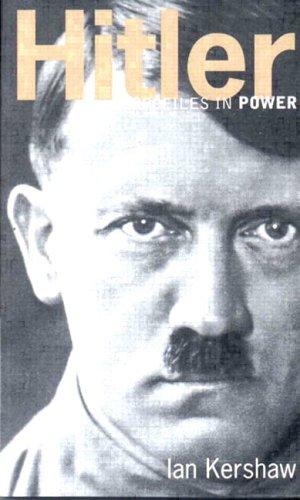
Hitler (Profiles in Power)
by Ian Kershaw
★ Top 25 book of 1998 · #20 on Best Books of 1998
This life of the German dictator follows him from a modest birth in an Austrian village to his death in a Berlin bunker. It draws on newly used sources to explain the settings and conditions that enabled his rise to power.
Best for: History readers seeking a serious, thorough account of Hitler's life and rise
Hitler (Profiles in Power) is #20 on BookWard's Best Books of 1998, out of 36 1998 books that cleared our data bar.
What Hitler (Profiles in Power) is about
Ian Kershaw traces the life of Adolf Hitler from a modest birth in a small Austrian village to his death in a Berlin bunker. Along the way he rebuilds the worlds that shaped the story: antisemitic Vienna before the First World War, the war itself, the nationalism of 1920s Bavaria, and a Weimar Republic pulled apart by extremists on both sides. Kershaw treats Hitler as a dull man with no private life to speak of, and he resists the habit of explaining history through one person. Social, cultural and economic conditions mattered more, he argues, and ambitious subordinates often drove radical acts by guessing what their leader wanted. Hitler is still held to account. Readers of modern history will find a clear, carefully reasoned guide.
Hitler (Profiles in Power) on the Best Books of 1998
Hitler (Profiles in Power) came out in 1998. Of the 36 books first published in 1998 that met BookWard's data bar, it ranks #20 on our Best Books of 1998 list.
Why it made the list: 216 readers have shelved it on Open Library. The list ranks each year’s books on how many readers have picked them up, how highly readers rate them, and how many are reading them right now.
Nearby on the 1998 list
- Shipwreck at the Bottom of the World Jennifer L. Armstrong, #18
- The Price of a Bride Michelle Reid, #19
See all Best Books of 1998 Best books by year
More years: Best Books of 1997 Best Books of 1999.
The numbers behind it
- Readers: 195 want to read it, 13 are reading it now and 8 have read it, according to Open Library.
| Signal | This book (0 to 100) | Weight |
|---|---|---|
| Reach | 42 | 55% |
| Reader love | 14 | 25% |
| Being read right now | 50 | 20% |
Questions about Hitler (Profiles in Power)
When was Hitler (Profiles in Power) published?
Hitler (Profiles in Power) by Ian Kershaw was first published in 1998.
Was Hitler (Profiles in Power) one of the best books of 1998?
Hitler (Profiles in Power) is #20 on BookWard's Best Books of 1998, out of 36 1998 books that cleared our data bar. 216 readers have shelved it on Open Library.
Why is Hitler (Profiles in Power) on the Best Books of 1998 list?
216 readers have shelved it on Open Library.
More of the best books of 1998
- Harry Potter and the Chamber of Secrets J. K. Rowling, #1
- Holes Louis Sachar, #2
- A Clash of Kings George R. R. Martin, #3
- Among the Hidden Margaret Peterson Haddix, #4
- Who Moved My Cheese? Spencer Johnson, #5
- No, David! David Shannon, #6
See the full Best Books of 1998, the Top 100, or new books on Rising.
How we know
This page uses public data: Open Library reader counts and ratings, and Wikipedia page views for recent years. The description is paraphrased from real source text. Rankings reflect reading interest, not quality or sales, and can be affected by data gaps. Lists update monthly.
Best suited to mature, committed readers, such as older teens and adults with an interest in history.
Depends on the edition you pick.
Kershaw's Hitler: a rigorous study of power, not a portrait of a monster. 49% taste match
 BookWard’s take
Kershaw's Hitler: a rigorous study of power, not a portrait of a monster
Kershaw makes a deliberate choice: he treats Hitler as an empty figure in private life and asks why so much power gathered around him. That gives the book real rigor, and it is driven more by ideas than by storytelling, even as the life unfolds in order. His 'Working towards the Führer' argument is the spine, and it makes the logic hold together: ambitious subordinates reading the leader's wishes and racing to act on them. The prose is plain and the narration restrained, with sentiment kept firmly out of it. The subject is dark, and the book earns that darkness through evidence rather than shock. It is long, so the opening is measured, and the pace rewards steady reading rather than racing.
A two-volume biography of a life and regime, built to be exhaustive; that sits against BookWard's love of tight books.
It follows a life from birth to death in order, steady and thorough rather than fast.
Its central idea, that subordinates drove radicalisation by anticipating Hitler's wishes, was a fresh angle on a heavily covered subject.
The writing is plain and functional, serving the argument rather than ornamenting it.
Events and structures drive the account more than inner life, since Hitler's private self is described as a void.
The subject matter leaves little room for optimism, ending in ruin and atrocity.
A chronological biography from birth to death, conventional in shape.
There is essentially no humor in the subject or the treatment.
It deals directly with genocide, war and dictatorship.
The emotional force is held back, arising from the facts rather than from heightened writing.
See all 50 dialsEvery position, side by side with this book
Where it lines up
- EndingBookWard 8 · book 8
- Shock for effectBookWard 9 · book 9
- Familiar tropesBookWard 10 · book 9
Where it pulls apart
- LengthBookWard 1 · book 9
- OpeningBookWard 10 · book 5
- ExpositionBookWard 2 · book 7
A two-volume biography of a life and regime, built to be exhaustive; that sits against BookWard's love of tight books.
Kershaw sidesteps the 'evil genius' myth and frames Hitler through social and political conditions, which BookWard values.
The 'Working towards the Führer' thesis ties the regime's radicalisation into one coherent explanation, which suits BookWard well.
It follows a life from birth to death in order, steady and thorough rather than fast.
Its central idea, that subordinates drove radicalisation by anticipating Hitler's wishes, was a fresh angle on a heavily covered subject.
Hitler himself is drawn as a void outside politics, so depth lies in the system and its people, not the man.
A life story has a settled endpoint in his death, giving a firm resolution that BookWard likes.
The tone stays analytical and restrained, with no sentimental cushioning of its subject.
The darkness comes from documented events, explained in context rather than used for effect.
Built on many previously untapped sources and a clear scholarly argument, this is about as rigorous as popular history gets.
Kershaw writes in a clear historian's register with a strong thesis, authoritative if not flashy.
It follows a life in sequence, but the pull comes from the argument about power and how it worked.
Kershaw explains causes and context outright, which is the point of a work of analytical history.
Over a very long span some stretches lean on dense political detail, though the argument keeps pulling forward.
The writing is plain and functional, serving the argument rather than ornamenting it.
Events and structures drive the account more than inner life, since Hitler's private self is described as a void.
The subject matter leaves little room for optimism, ending in ruin and atrocity.
A chronological biography from birth to death, conventional in shape.
There is essentially no humor in the subject or the treatment.
The scale of material and political detail asks for sustained attention, though the prose is clear.
The lens stays on Hitler and his circle, with some range across the people around him.
It runs strictly in order from birth in Austria through to his death.
This is documented history with no fantastical element.
A broad field of political figures, subordinates and rivals populates the account.
It spans a regime and a world war, from small beginnings to continental catastrophe.
It centers on public events and the machinery of power over Hitler's inner life.
As a work of history it rests on narrative and analysis, not reproduced conversation.
Personal relationships are marginal to an account focused on political power.
The events belong to the early and mid twentieth century.
Its questions about how power and charisma take hold keep it relevant well beyond the period.
The historian's voice is straightforward and evidence-led, not a narrator to second-guess.
The moral weight is clear: the scale of evil is stated plainly, though Kershaw examines how responsibility was shared.
Settings such as prewar Vienna and 1920s Bavaria are drawn with care but in service of the argument.
It blends a chronological life narrative with a thesis-driven analysis, leaning toward the analytical.
Kershaw keeps a scholarly distance and is explicitly wary of personalizing history.
Originally two volumes, Hubris and Nemesis, later abridged into one edition.
The history is well known, so surprise comes from interpretation rather than plot turns.
The material is disturbing and intellectually demanding, offering no comfort.
It deals directly with genocide, war and dictatorship.
The emotional force is held back, arising from the facts rather than from heightened writing.
Humor does not feature in the treatment.
Atrocities and brutality are discussed, but mostly through analysis rather than lingering depiction.
Sexual content is essentially absent.
Politics is the entire subject, from party struggle to the machinery of dictatorship.
The language is plain and accessible, with no dialect or dense stylization.
Kershaw advances a clear thesis but keeps judgments grounded in evidence.
The book looks backward to explain how a past catastrophe came about.
Its view of power and human behavior is sober and unsentimental.
Review written by BookWard, dial version 1, November 2026.
Who is Hitler (Profiles in Power) right for?
Best suited to mature, committed readers, such as older teens and adults with an interest in history. It deals directly with genocide, war and antisemitism.
The scale of material and political detail asks for sustained attention, though the prose is clear.
It deals directly with genocide, war and dictatorship.
The emotional force is held back, arising from the facts rather than from heightened writing.
Atrocities and brutality are discussed, but mostly through analysis rather than lingering depiction.
Book CompanionHitler (Profiles in Power): ideas, characters, themes
Hitler's power came less from his personal qualities than from a system in which others radicalised policy by working towards his broad wishes.
- A life as a void. Kershaw describes Hitler as an 'unperson' whose life outside politics was empty, shifting the question to how he gained such power.
- Working towards the Führer. Subordinates competing for advancement acted on his broadly outlined wishes, driving radicalisation and atrocity.
- Against personalizing history. Social, cultural and economic conditions mattered more than any one man, though Hitler still bears culpability.
- Rise from obscurity. The account follows a thirty-year climb from a Viennese shelter for the indigent to rule over Germany.
- The settings that enabled him. Prewar Vienna's antisemitism, the First World War, Bavarian nationalism and a weakened Weimar Republic all shaped his rise.
Characters
Adolf Hitler
Subject
The dictator whose rise and rule the biography traces, treated as remarkable for the power and reverence he gained rather than for personal depth.
Themes
How authority forms around a figure through belief and reverence.
How competition among subordinates pushed policy toward ever greater extremes.
The balance between conditions and a single person's role in history.
The hatred that shaped Hitler's milieu and, ultimately, state policy.
The failure of the Weimar Republic and the conditions that undermined it.
Discussion questions
- Does Kershaw's 'Working towards the Führer' idea shift how you think about responsibility?
- Why might a biographer call his subject an 'unperson' and still write thousands of pages?
- How far do social and economic conditions explain Hitler's rise compared with his own actions?
- What does the book suggest about how democracies can be undermined?
- Is it possible to study such a figure closely without personalizing history?
Personalize your Book Companion
This is the general edition. In BookWard, the Companion is written for you: your reading profile, your notes, and spoiler-safe to the page you are on.
Buy, listen or borrow Hitler (Profiles in Power)
Each link opens a search for this book on that store, in a new tab.
Read on a device
Borrow
Reviews and community
If you liked Hitler (Profiles in Power)
Bullock's landmark life of Hitler, built on a chronological sweep
Creating Black AmericansNell Irvin PainterA sweeping, art-filled history of African Americans from Africa to hip-hop
The Guns of AugustBarbara TuchmanThirty days in 1914, told as high drama with real authority
The Last Days of HitlerH. R. Trevor-RoperA ten-day bunker investigation that reads like a thriller
Find your own best books
Add what you have read, rate it, and BookWard will recommend what to read next.
Free to start. No credit card needed.