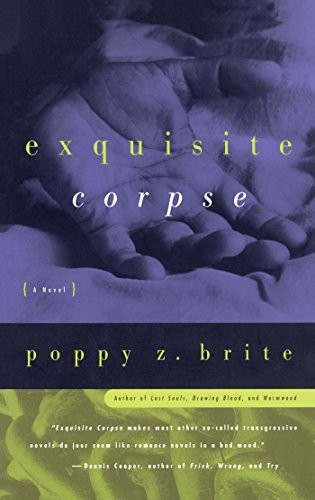
Exquisite Corpse
by Poppy Z. Brite
★ Top 25 book of 1996 · #21 on Best Books of 1996
A serial killer escapes prison and travels from London to the United States, where he teams up with a fellow murderer. Together they stalk a young runaway, while a dying radio host plans chaos of his own.
Best for: Adult readers who can handle dark, graphic horror about murder and obsession
Exquisite Corpse is #21 on BookWard's Best Books of 1996, out of 39 1996 books that cleared our data bar.
What Exquisite Corpse is about
Andrew Compton is an English serial killer and cannibal who escapes his prison in a self-induced cataleptic trance and makes his way to the French Quarter of New Orleans. There he meets Jay Byrne, a wealthy recluse with the same appetites, and the two begin an affair built on sex and murder. Compton is based on Dennis Nilsen and Byrne on Jeffrey Dahmer.
The novel alternates between four points of view. Lucas Ransom, a writer, learns he is HIV-positive, pushes away his friends and ends things with his teenage lover Tran. At night he hosts a pirate radio show as Lush Rimbaud, raging at a society that denies gay men and the AIDS epidemic. Tran, a Vietnamese-American runaway, is driven from home and takes refuge with Jay, while Andrew grows obsessed with killing him. It is an explicit horror novel that the author called a love story, and it deals with victimhood, illness, and love tangled up with death. Readers should expect disturbing material.
Exquisite Corpse on the Best Books of 1996
Exquisite Corpse came out in 1996. Of the 39 books first published in 1996 that met BookWard's data bar, it ranks #21 on our Best Books of 1996 list.
Why it made the list: 228 readers have shelved it on Open Library. The list ranks each year’s books on how many readers have picked them up, how highly readers rate them, and how many are reading them right now.
Nearby on the 1996 list
- The Color of Water James McBride, #19
- Frindle Andrew Clements, #20
- Hogfather Terry Pratchett, #22
See all Best Books of 1996 Best books by year
More years: Best Books of 1995 Best Books of 1997.
The numbers behind it
- Readers: 195 want to read it, 17 are reading it now and 16 have read it, according to Open Library.
| Signal | This book (0 to 100) | Weight |
|---|---|---|
| Reach | 38 | 55% |
| Reader love | 36 | 25% |
| Being read right now | 64 | 20% |
Questions about Exquisite Corpse
When was Exquisite Corpse published?
Exquisite Corpse by Poppy Z. Brite was first published in 1996.
Was Exquisite Corpse one of the best books of 1996?
Exquisite Corpse is #21 on BookWard's Best Books of 1996, out of 39 1996 books that cleared our data bar. 228 readers have shelved it on Open Library.
Why is Exquisite Corpse on the Best Books of 1996 list?
228 readers have shelved it on Open Library.
More of the best books of 1996
- A Game of Thrones George R. R. Martin, #1
- The Green Mile Stephen King, #2
- Forbidden Knowledge Roger Shattuck, #3
- Fight Club Chuck Palahniuk, #4
- Push Sapphire, #5
- Neverwhere Neil Gaiman, #6
See the full Best Books of 1996, the Top 100, or new books on Rising.
How we know
This page uses public data: Open Library reader counts and ratings, and Wikipedia page views for recent years. The description is paraphrased from real source text. Rankings reflect reading interest, not quality or sales, and can be affected by data gaps. Lists update monthly.
Suited to adult readers comfortable with extreme horror.
Depends on the edition you pick.
A transgressive horror love story that wants you uncomfortable on purpose. 52% taste match
 BookWard’s take
A transgressive horror love story that wants you uncomfortable on purpose
Exquisite Corpse announces its intent on page one and never apologizes. Brite alternates between four points of view, and the structure keeps the book moving: an escaped killer in New Orleans, a wealthy recluse with matching appetites, a dying radio host, and the runaway teenager all of them circle. The shock here leans on transgression more than it earns, and that part didn't work for me. Where it does work is in the restraint of the prose, which is easy to move through and refuses to wallow. The Lush Rimbaud radio rants give the voice a sharp, angry edge, and the rotation between viewpoints keeps the middle from stalling. It is extreme, deliberate, and not for everyone.
Alternating chapters and a converging cast keep it moving at a brisk clip that BookWard enjoys.
The killer love story framing and the AIDS-era radio thread give it a distinct angle, if not a wholly new one.
Lush, sensory and deliberately beautiful against ugly subject matter, richer than BookWard's usual preference.
Plot and character carry roughly equal weight, since the obsessions of the leads are the plot.
Nearly everything here is about death, disease and appetite, with little light offered.
Four alternating viewpoints converge, but the arrangement is fairly conventional beyond that.
Gallows humor surfaces now and then, but the book is overwhelmingly grim.
This is about as dark as mainstream fiction gets, built around murder, cannibalism and necrophilia.
Grief, desire and rage run hot throughout, especially in Lucas's thread.
See all 50 dialsEvery position, side by side with this book
Where it lines up
- EndingBookWard 8 · book 8
- PaceBookWard 8 · book 7
- Authorial voiceBookWard 9 · book 8
Where it pulls apart
- Familiar tropesBookWard 10 · book 5
- Internal logicBookWard 10 · book 6
- Shock for effectBookWard 9 · book 3
Serial killers and gothic New Orleans are well-trodden ground, though the pairing of its leads is less standard.
The events follow from the characters' compulsions and choices, though it prizes mood over tight mechanics.
Alternating chapters and a converging cast keep it moving at a brisk clip that BookWard enjoys.
The killer love story framing and the AIDS-era radio thread give it a distinct angle, if not a wholly new one.
The four leads are given real interiority and obsessions, though some lean toward archetype.
All four storylines converge on one night and are brought to a definite close, which BookWard appreciates.
It treats love and illness with a cold eye in places, but still indulges some romantic excess.
Its transgressions are central to its identity and often feel designed to provoke, which sits at odds with BookWard.
This is a novel, so the nonfiction rigor dial does not apply.
Brite's style and the Lush Rimbaud rants are unmistakable and strongly personal, which BookWard values.
It is driven by plot and character, but the politics of victimhood and disease give it a thematic spine.
Backstory is woven in through scenes and perspectives, with occasional direct explanation of the characters' pasts.
The rotating viewpoints keep momentum up through the middle, with only minor lulls.
Lush, sensory and deliberately beautiful against ugly subject matter, richer than BookWard's usual preference.
Plot and character carry roughly equal weight, since the obsessions of the leads are the plot.
Nearly everything here is about death, disease and appetite, with little light offered.
Four alternating viewpoints converge, but the arrangement is fairly conventional beyond that.
Gallows humor surfaces now and then, but the book is overwhelmingly grim.
The prose is accessible, but the content makes it emotionally and morally heavy going.
Four main characters take turns narrating, which is more than most thrillers but not sprawling.
The story moves forward in a mostly linear way across its alternating chapters.
It is firmly realistic horror, with human monsters and no supernatural machinery.
The story centers on four principals, with a small circle around them.
It is a close, claustrophobic story about a handful of people in two cities.
It mixes graphic action with the obsessive inner lives of its characters in fairly even measure.
Conversations and radio monologues carry a fair share of the book without dominating it.
The central relationships, however twisted, drive much of the story, so romance is front and center.
The French Quarter and its underground feel vivid and unfamiliar to most readers.
It is set in the AIDS-era 1990s, recognizable but not present day.
Its specific moment is strong, but the obsessions it explores keep it from feeling purely period.
The narration is straightforward, though the killers' self-justifications color how events are framed.
It refuses to hand readers a clear verdict, and its victims and villains blur together.
The settings and bodies are rendered in rich, lingering detail.
It stands alone as a single novel.
The convergence has some surprises, but the direction of the story is largely telegraphed.
It is built to unsettle and provoke rather than soothe, which BookWard respects.
This is about as dark as mainstream fiction gets, built around murder, cannibalism and necrophilia.
Grief, desire and rage run hot throughout, especially in Lucas's thread.
Any humor is bitter and sardonic rather than broad.
Graphic killing and mutilation are central to the book and shown in explicit detail.
Sex and death are intertwined and depicted explicitly throughout.
The AIDS epidemic and the treatment of gay men are woven in and voiced directly.
The language is plain and readable, with no heavy dialect.
Lucas's broadcasts and the book's own stance on victimhood give it an openly angry voice.
It dwells on endings, decay and the damage of the past more than any future.
It takes a bleak, unsentimental view of human nature.
Review written by BookWard, dial version 1, November 2026.
Who is Exquisite Corpse right for?
Suited to adult readers comfortable with extreme horror. It contains graphic violence, explicit sex, cannibalism, necrophilia and sexual content involving a teenager.
The prose is accessible, but the content makes it emotionally and morally heavy going.
This is about as dark as mainstream fiction gets, built around murder, cannibalism and necrophilia.
Grief, desire and rage run hot throughout, especially in Lucas's thread.
Graphic killing and mutilation are central to the book and shown in explicit detail.
Book CompanionExquisite Corpse: ideas, characters, themes
A killer love story set against the AIDS crisis, asking who counts as a victim and who as a monster.
- The escape. Andrew Compton gets out of an English prison by feigning death and heads for New Orleans.
- Two killers meet. In the French Quarter he crosses paths with Jay Byrne, whose appetites match his own.
- The voice on the radio. Lucas Ransom, newly HIV-positive, turns his anger into pirate radio broadcasts as Lush Rimbaud.
- The runaway. Tran, Lucas's former lover, is driven from his home and drifts into Jay's orbit.
- Four lives converge. The alternating threads head toward a single night that changes all of them.
Characters
Andrew Compton
Escaped serial killer
An English convicted killer who fakes his own death and relocates to New Orleans.
Jay Byrne
Wealthy recluse
A rich New Orleans loner with his own murderous compulsions.
Lucas Ransom
Radio host
A writer facing HIV who broadcasts angry commentary as Lush Rimbaud.
Tran
Runaway
Lucas's teenage ex-lover, cast out by his family and adrift in the Quarter.
Themes
Who is allowed to claim it, and who gets overlooked.
The AIDS epidemic and society's reaction to gay men.
Love and violence tangled so tightly they cannot be separated.
The killers treat murder as a creative act.
Each lead is cut off from family, friends or society.
Discussion questions
- Does the book want you to sympathize with its killers, or just understand them?
- How does Lucas's thread change the meaning of the killer story around it?
- Is the shock here earned, or does it get in the way of the ideas?
- What does the New Orleans setting add to the mood?
- How does the book use the real-life cases behind its killers?
Personalize your Book Companion
This is the general edition. In BookWard, the Companion is written for you: your reading profile, your notes, and spoiler-safe to the page you are on.
Buy, listen or borrow Exquisite Corpse
Each link opens a search for this book on that store, in a new tab.
Read on a device
Borrow
Reviews and community
If you liked Exquisite Corpse
Shakespeare's villainess gets a voice, a past, and real magic
Bat EaterKylie Lee BakerA Chinatown crime scene cleaner, a murdered sister, and hungry ghosts
The Starving SaintsCaitlin StarlingA besieged castle, a feast of dark origin, three women
Blood on Her TongueJohanna van VeenA twin, a corpse, and a hunger that may not be madness
Find your own best books
Add what you have read, rate it, and BookWard will recommend what to read next.
Free to start. No credit card needed.