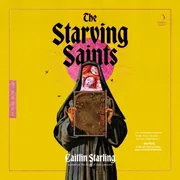
The Starving Saints
by Caitlin Starling · 2025
Suited to adult readers of gothic horror and dark fantasy.
352 pages, about 5.5 to 8 hours.
A besieged castle, a feast of dark origin, three women. 65% taste match
The story
The Starving Saints, published in 2025, is a gothic horror novel with fantasy and historical fiction elements and queer characters at its center. Caitlin Starling sets it inside Aymar Castle, which has endured a siege for six months while its stores dwindle and no help arrives.
When food runs short, the castle's supplies are suddenly restored and the ill recover. The Constant Lady and her Saints, figures of divine standing, appear within the barricaded walls and ask for devotion in return for their gifts. Feasts of dark origin follow, and the garrison gives itself over to them. Three women stand apart from the rest: Ser Voyne, a war hero who pledges herself to the Constant Lady; Phosyne, a paranoid former nun turned sorceress who works to learn who the newcomers are and whether her experiments are to blame; and Treila, a serving girl in the lower reaches of the castle who nurses a private grudge against Voyne while looking for a way out. Around them, the army waiting beyond the gates is forgotten as indulgence takes hold. The book runs about 352 pages.
Themes
HorrorFantasyQueerLGBTLesbianHistoricalGothicLGBTQ+
By the numbers
- The median edition runs 352 pages. Counting about 275 words a page and an adult reading pace of 250 words a minute, that is about 6.5 hours of reading.
- Open Library tracks 4 editions.
- On reader demand it ranks in the top 20% of the recent releases books in our catalog (1,627 of them).
- Libraries shelve it under Dewey 813.6 and Library of Congress class PS-3619.00000000.T3747.
 BookWard’s take
A besieged castle, a feast of dark origin, three women
Caitlin Starling shuts a garrison inside a six-month siege, then lets divine visitors restore the stores and heal the sick. The premise hooks at once, and it holds because the castle is a sealed room with a rotting bargain at its center. Three women, Ser Voyne, Phosyne and Treila, anchor the story, so the book leans toward people over spectacle. At 352 pages it is lean, and a single claustrophobic setting keeps the pace brisk and the middle sustained. The fantastical runs strong here, and the content is dark and unsettling. I'd read it for the opening, the tight length and the originality, and I'd want the darkness to feel earned rather than lurid.
At 352 pages it stays compact, close to BookWard's taste for short, tight books.
One confined setting and mounting dread keep things moving, close to BookWard's quick preference.
Saints who arrive inside barricaded gates and trade healing for adoration is a distinctive hook, in step with BookWard.
Gothic atmosphere asks for lush, sensory writing, a bit more ornate than BookWard's middle ground.
The siege drives events, but the grudges and alliances between the women steer them, matching BookWard.
A castle sliding into hedonistic madness under a siege is grim, far from BookWard's mild optimism.
Three intertwined perspectives give it some shape, but nothing suggests radical experiment.
This is horror and dread, with little room for jokes, well below BookWard's taste for wit.
Horror with feasts of terrible origin and a castle in madness is dark, past BookWard's middle.
Vengeance, dread and desperation run hot beneath the surface, a touch more intense than BookWard's lean.
See all 50 dialsEvery position, side by side with this book
Where it lines up
- Character depthBookWard 8 · book 8
- SentimentBookWard 8 · book 8
- OpeningBookWard 10 · book 9
Where it pulls apart
- Familiar tropesBookWard 10 · book 7
- Internal logicBookWard 10 · book 7
- LengthBookWard 1 · book 3
At 352 pages it stays compact, close to BookWard's taste for short, tight books.
A six-month siege followed by a sudden miraculous restoration gives the book a strong pull from the start, matching BookWard.
Gothic horror and siege fiction are well-worn ground, though the divine-feast twist keeps it fresher than most; BookWard would still want more distance.
A sealed castle gives the rules a clear frame, and the mystery of the visitors invites a coherent explanation.
One confined setting and mounting dread keep things moving, close to BookWard's quick preference.
Saints who arrive inside barricaded gates and trade healing for adoration is a distinctive hook, in step with BookWard.
Three women with entangled pasts, grudges and private motives carry the story, which suits BookWard's appetite for depth.
The tone is menacing rather than tender, so it stays restrained, in line with BookWard.
Feasts of terrible origin could tip into excess, but the dread is built into the premise, so the darkness reads as purposeful.
Fiction, so this dial does not apply.
Starling's gothic horror work has a recognizable stamp, though the premise matters more than any single flourish.
The ideas about hunger and devotion matter, but the story and its three women lead.
A mystery built on unraveling the visitors favors discovery in scene over lectures, near BookWard's preference.
One tight location and escalating madness leave little room for slack, which BookWard values.
Gothic atmosphere asks for lush, sensory writing, a bit more ornate than BookWard's middle ground.
The siege drives events, but the grudges and alliances between the women steer them, matching BookWard.
A castle sliding into hedonistic madness under a siege is grim, far from BookWard's mild optimism.
Three intertwined perspectives give it some shape, but nothing suggests radical experiment.
This is horror and dread, with little room for jokes, well below BookWard's taste for wit.
Layered alliances and a sinister puzzle need attention, but the story is approachable.
Three women share the spotlight, a moderate spread that BookWard would find satisfying.
The tale unfolds in a single siege, with past entanglements surfacing, so it reads mostly linear.
Divine figures, sorcery and impossible feasts push it well into the fantastical, past BookWard's middle.
Three leads and a garrison keep the focus tight, close to BookWard's range.
Everything happens within one castle's walls, so it is intimate despite the army outside.
Paranoia and private vengeance sit alongside violence and crisis, a roughly even mix.
Confrontations and shifting alliances suggest a fair share of talk, near BookWard's lean.
Queer relationships and entangled pasts matter to the plot without being the only engine.
A besieged castle shaped by sorcery and strange saints is an unfamiliar place, matching BookWard.
A historical siege setting places it firmly in the past, far from BookWard's present-day lean.
Hunger, devotion and temptation are durable themes, which should wear well.
The Constant Lady's offer and the women's compromised choices leave the ethics murky, in step with BookWard.
Feasts, rot and a stricken castle call for rich sensory detail, above BookWard's middle.
Fiction, so this dial does not apply.
Fiction, so this dial does not apply.
It is presented as a single, complete novel.
A mystery about who the visitors are and where the food comes from invites several turns, close to BookWard.
Dark, unsettling material with no easy comfort suits BookWard's appetite for challenge.
Horror with feasts of terrible origin and a castle in madness is dark, past BookWard's middle.
Vengeance, dread and desperation run hot beneath the surface, a touch more intense than BookWard's lean.
Any humor is likely dry and incidental amid the horror.
Violence rises to the surface as alliances break, so expect a fair amount on the page.
Hedonistic ecstasy and queer relationships suggest some sexual content without it dominating.
Power, loyalty and wartime allegiance play a part, but politics is not the headline.
The horror speaks for itself rather than through a commentating narrator.
Set in a besieged past, it looks backward more than forward.
A castle that gives itself over to indulgence and a bleak bargain reads cynical, below BookWard's lean.
Review written by BookWard, dial version 1, November 2026.
Who is The Starving Saints right for?
Suited to adult readers of gothic horror and dark fantasy. Expect disturbing feasts, violence, hedonistic content and a bleak, menacing atmosphere.
Layered alliances and a sinister puzzle need attention, but the story is approachable.
Horror with feasts of terrible origin and a castle in madness is dark, past BookWard's middle.
Vengeance, dread and desperation run hot beneath the surface, a touch more intense than BookWard's lean.
Violence rises to the surface as alliances break, so expect a fair amount on the page.
Book CompanionThe Starving Saints: ideas, characters, themes
When a starving castle is offered miraculous plenty by divine visitors, three women must decide what salvation costs and who they are willing to become.
- The siege. Aymar Castle has been surrounded for six months, with food running low and no sign of rescue.
- The arrival. The castle stores are restored and the sick are healed once the Constant Lady and her Saints appear.
- The bargain. The divine figures offer succor in return for adoration, and the garrison surrenders to intoxicating feasts.
- The three women. Ser Voyne, Phosyne and Treila each see the situation for what it is, but all are tempted.
- The forgotten army. Indulgence leads the castle to neglect the massed army waiting beyond its walls.
Characters
Ser Voyne
War hero
A celebrated soldier who gives her allegiance to the Constant Lady.
Phosyne
Nun-turned-sorceress
A disorganized, paranoid sorceress racing to unravel the mystery of the visitors and clear her experiments.
Treila
Serving girl
A servant in the castle's depths who nurses a secret vengeance against Voyne while trying to escape.
The Constant Lady
Divine visitor
A divine figure who arrives with her Saints and demands adoration in return for plenty.
Themes
How scarcity and desperation shape what people will accept.
What adoration costs when it is given in exchange for survival.
The pull of comfort and ecstasy even for those who see the danger.
How private grudges persist and complicate shared survival.
Shifting alliances between people with entangled pasts.
Discussion questions
- Would you have accepted the Constant Lady's offer in Aymar's position, and why?
- What does the book suggest about faith when it is traded for survival?
- How do Voyne, Phosyne and Treila differ in how they resist or yield to temptation?
- What does it mean that the castle forgets the army outside?
- How does a single, sealed setting shape the horror?
Personalize your Book Companion
This is the general edition. In BookWard, the Companion is written for you: your reading profile, your notes, and spoiler-safe to the page you are on.
Buy, listen or borrow The Starving Saints
Each link opens a search for this book on that store, in a new tab.
Read on a device
Borrow
Reviews and community
If you liked The Starving Saints
A short, haunted Appalachian novella with a queer nurse at its center
Lady MacbethAva ReidShakespeare's villainess gets a voice, a past, and real magic
Blood on Her TongueJohanna van VeenA twin, a corpse, and a hunger that may not be madness
The HoundingXenobe PurvisA village turns on four odd sisters, told through five voices
Sources: Open Library.
Track The Starving Saints and find your next favorite
Add it to your shelf, rate what you have read, and BookWard will recommend what fits you.
Free to start. No credit card needed.