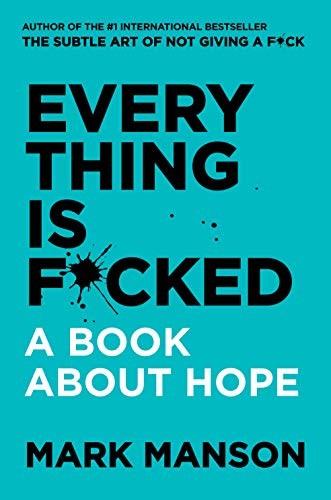
Everything Is F*cked
by Mark Manson
★ Top 25 book of 2019 · #19 on Best Books of 2019
Mark Manson asks why, despite living freer, healthier and wealthier lives than ever, so many people feel hopeless about the world. Following his earlier bestseller, he sets out to name this modern malaise and offer a way through.
Best for: Readers who like blunt, humorous takes on modern anxiety and finding meaning
Everything Is F*cked is #19 on BookWard's Best Books of 2019, out of 83 2019 books that cleared our data bar.
What Everything Is F*cked is about
Manson starts from an odd observation: by almost any material measure, we are freer, healthier and wealthier than people have ever been, and yet a lot of us feel that everything is beyond repair. He looks at the usual suspects, from a warming planet and shaky governments to wobbling economies and the constant offense on Twitter, and asks what is feeding that deep sense of hopelessness when we have so much technology, education and communication at hand.
It follows his 2016 book The Subtle Art of Not Giving A F*ck, which argued that technology makes it easy to care about the wrong things, that culture teaches us the world owes us something, and that chasing happiness can leave us unhappier. Readers who liked that book's blunt, challenge-yourself tone will feel at home here, as will anyone who has felt worn down by the news and wants a frank look at why.
Everything Is F*cked on the Best Books of 2019
Everything Is F*cked came out in 2019. Of the 83 books first published in 2019 that met BookWard's data bar, it ranks #19 on our Best Books of 2019 list.
Why it made the list: 627 readers have shelved it on Open Library; readers rate it 3.8 out of 5 (24 ratings); 22 are reading it right now. The list ranks each year’s books on how many readers have picked them up, how highly readers rate them, and how many are reading them right now.
Nearby on the 2019 list
- On Earth We're Briefly Gorgeous Ocean Vuong, #17
- The Tyrant's Tomb Rick Riordan, #18
- Invisible Women Caroline Criado Perez, #20
- This Is How You Lose the Time War Amal El-Mohtar, #21
See all Best Books of 2019 Best books by year
More years: Best Books of 2018 Best Books of 2020.
The numbers behind it
- Readers: 570 want to read it, 22 are reading it now and 35 have read it, according to Open Library.
- Ratings: 3.8 out of 5 from 24 Open Library ratings.
| Signal | This book (0 to 100) | Weight |
|---|---|---|
| Reach | 87 | 55% |
| Reader love | 23 | 25% |
| Being read right now | 83 | 20% |
Questions about Everything Is F*cked
When was Everything Is F*cked published?
Everything Is F*cked by Mark Manson was first published in 2019.
Was Everything Is F*cked one of the best books of 2019?
Everything Is F*cked is #19 on BookWard's Best Books of 2019, out of 83 2019 books that cleared our data bar. 627 readers have shelved it on Open Library; readers rate it 3.8 out of 5 (24 ratings); 22 are reading it right now.
Why is Everything Is F*cked on the Best Books of 2019 list?
627 readers have shelved it on Open Library; readers rate it 3.8 out of 5 (24 ratings); 22 are reading it right now.
More of the best books of 2019
- Red, White & Royal Blue Casey McQuiston, #1
- A Good Girl's Guide to Murder Holly Jackson, #2
- Heartstopper, Volume 2 Alice Oseman, #3
- Guts Raina Telgemeier, #4
- The Silent Patient Alex Michaelides, #5
- Into the Pit (Five Nights at Freddy’s Scott Cawthon, #6
See the full Best Books of 2019, the Top 100, or new books on Rising.
How we know
This page uses public data: Open Library reader counts and ratings, and Wikipedia page views for recent years. The description is paraphrased from real source text. Rankings reflect reading interest, not quality or sales, and can be affected by data gaps. Lists update monthly.
It suits adult readers and mature teens who enjoy opinionated, humorous nonfiction.
Depends on the edition you pick.
Manson's sweary, sprawling follow-up on hope, values and why everything feels broken. 38% taste match
 BookWard’s take
Manson's sweary, sprawling follow-up on hope, values and why everything feels broken
Mark Manson's 2019 follow-up to The Subtle Art of Not Giving a F*ck trades the personal for the civilizational, asking why life has never been materially better and yet hopelessness feels everywhere. The voice is the draw: irreverent, conversational and unmistakable. This is a book driven by ideas far more than by story, and it is openly opinionated, which sits uneasily with a reader who wants more rigor. Manson argues with confidence and humor, but he borrows from philosophy and psychology more than he proves. The pace is brisk and the tone is funny, so it reads easily, though the ideas are explained outright when they might have been shown. The outlook is more hopeful than the title suggests. A lively, provocative read, best taken as an argument to wrestle with rather than a settled account.
It remixes familiar philosophy and psychology in a fresh tone, but the ideas themselves are largely borrowed.
Plain, casual and direct, with no ornament, a little plainer than BookWard's taste.
Despite the title, it argues toward hope and meaning, which lines up with BookWard.
A conventional run of chapters built around a central thesis, not experimental.
Jokes and profanity run throughout, which BookWard enjoys.
It discusses hopelessness and societal collapse but keeps a light, wry touch.
Warm and sometimes affecting, but mostly cerebral and wry.
See all 50 dialsEvery position, side by side with this book
Where it lines up
- Authorial voiceBookWard 9 · book 9
- PaceBookWard 8 · book 7
- OpeningBookWard 10 · book 8
Where it pulls apart
- Familiar tropesBookWard 10 · book 4
- Internal logicBookWard 10 · book 5
- ExpositionBookWard 2 · book 9
Its blunt, provocative premise about everything being broken pulls you in quickly, which BookWard values.
Self-help framing and familiar pop-philosophy moves recur, so it only partly avoids the well-worn.
The argument links big ideas with confident leaps rather than tight proof, looser than BookWard's airtight ideal.
It remixes familiar philosophy and psychology in a fresh tone, but the ideas themselves are largely borrowed.
As an argument-driven book it has no characters to draw, so people appear only as illustrations.
Manson is irreverent, but he does lean toward uplift, so it is not fully restrained.
Swearing and provocation are mostly tone, not shock used to carry the book.
It leans on anecdote and sweeping claims more than careful evidence, short of BookWard's rigor.
Manson's profane, conversational voice is instantly recognizable, a strong match for BookWard.
This is an argument and a set of frameworks, not a story, at the far idea-led end.
Ideas are explained outright and at length, the opposite of BookWard's preference for showing in scene.
A long argument with a few repeated beats, though the humor keeps it mostly sustained.
Plain, casual and direct, with no ornament, a little plainer than BookWard's taste.
Despite the title, it argues toward hope and meaning, which lines up with BookWard.
A conventional run of chapters built around a central thesis, not experimental.
Jokes and profanity run throughout, which BookWard enjoys.
Accessible and breezy, though it handles big ideas, so it asks little effort of the reader.
Told from Manson's single viewpoint throughout, with other thinkers brought in as support.
The argument moves mostly forward, with some historical detours but a clear line.
Entirely grounded in real history, philosophy and current events.
It tackles civilization, politics and meaning on a very large canvas.
It is mostly about thought, belief and values, not action.
Nearly all exposition and argument, with almost no dialogue.
Romance is not part of the book.
It covers a familiar, modern-day world that most readers already know.
Squarely about the present moment and the anxieties of the late 2010s.
Tied to the mood and online culture of its moment, so it may date.
Manson speaks plainly in his own voice, with no unreliable narrator.
It argues for clear values and takes firm positions, though it admits some complexity.
Little scene-setting or sensory detail, since it is about ideas.
It mixes stories and anecdotes with analysis, leaning slightly analytical.
Manson frequently draws on his own life and opinions, a notably personal perspective.
It follows The Subtle Art of Not Giving a F*ck but stands alone.
An argument built for clarity, with few surprises in the structure.
It pushes readers to question their beliefs, though gently and with humor.
It discusses hopelessness and societal collapse but keeps a light, wry touch.
Warm and sometimes affecting, but mostly cerebral and wry.
Broad, sweary and jokey rather than dry.
Touches on historical atrocities in passing but is not graphic.
There is little sexual content beyond the odd crude joke.
Politics and culture war run through the argument but are not its sole focus.
Plain, conversational English with no dense or dialect-heavy language.
Manson's opinions and attitude drive nearly every page.
It looks ahead, asking how people might find hope and meaning going forward.
It sits between cynicism and idealism, diagnosing the problems before offering a hopeful answer.
Review written by BookWard, dial version 1, November 2026.
Who is Everything Is F*cked right for?
It suits adult readers and mature teens who enjoy opinionated, humorous nonfiction. It contains frequent strong profanity and discussion of hopelessness and societal problems.
Accessible and breezy, though it handles big ideas, so it asks little effort of the reader.
It discusses hopelessness and societal collapse but keeps a light, wry touch.
Warm and sometimes affecting, but mostly cerebral and wry.
Touches on historical atrocities in passing but is not graphic.
Book CompanionEverything Is F*cked: ideas, characters, themes
Hope is the foundation of a meaningful life, and the trouble we face comes from how we chase it, and what we place it in.
- The problem of hope. Despite unprecedented material comfort, many people feel hopeless, which the book treats as the central puzzle.
- A sweary, conversational frame. Manson uses humor and blunt language to make big philosophical ideas feel approachable.
- Values as the root of meaning. The book argues that what we value shapes how we experience life, so values matter more than circumstances.
- Building on his earlier book. It extends The Subtle Art of Not Giving a F*ck from the individual to society and civilization.
- From personal to collective. It turns its attention from personal flaws to the wider forces that make the world feel broken.
Themes
The belief that things can improve, which the book treats as essential to a meaningful life.
What we choose to care about and how that shapes our experience.
The anxiety and sense of futility that persist despite material progress.
The search for purpose in a world that often seems broken.
How modern tools and online life shape our mood and beliefs.
Discussion questions
- Why do you think people feel hopeless when life is materially better than ever?
- Does Manson's irreverent tone help or hurt his argument?
- Which of his claims would you want to see more evidence for?
- How do your own values shape what you find meaningful?
- Is the book more useful as a diagnosis of the problem or as a guide to fixing it?
Personalize your Book Companion
This is the general edition. In BookWard, the Companion is written for you: your reading profile, your notes, and spoiler-safe to the page you are on.
Buy, listen or borrow Everything Is F*cked
Each link opens a search for this book on that store, in a new tab.
Read on a device
Borrow
Reviews and community
If you liked Everything Is F*cked
A cheerful, idea-led case for doubting yourself on purpose
Age of Magical OverthinkingAmanda MontellA funny, personal tour of the biases that run our heads
The Anxious GenerationJonathan HaidtA data-driven case against smartphone childhood, and what to do
End of WomanCarrie GressA polemic arguing feminism erased the very category of woman
Find your own best books
Add what you have read, rate it, and BookWard will recommend what to read next.
Free to start. No credit card needed.