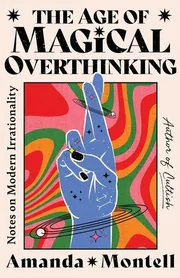
Age of Magical Overthinking
by Amanda Montell · 2024
Best suited to adult and older teen readers curious about psychology and culture.
257 pages, about 4 to 6 hours.
A funny, personal tour of the biases that run our heads. 46% taste match
What it covers
The Age of Magical Overthinking is a 2024 nonfiction book by Amanda Montell that blends essay, memoir, and psychology. It sits in the self-help, health, and psychology category and draws on sociology and philosophy as well. The edition runs about 257 pages, and the book has appeared in five editions.
Montell, who previously wrote Wordslut and Cultish, turns her attention here to the human mind and the biases that shape how people think. The central subject is magical thinking, the belief that private thoughts can influence events that have no connection to them. She examines how this habit shows up in modern life, from trying to manifest a way out of poverty to expecting positive vibes to ward off illness, and she argues that the pressures of the information age have strained the mental shortcuts people rely on to feel in control. The chapters work through specific cognitive biases, including the halo effect and its role in how people idolize or despise famous figures, along with the sunk cost fallacy. Her own experiences run through the discussion, giving the psychological material a personal footing.
Themes
New York Times bestsellerPsychologySelf HelpEssaysMental HealthMemoirSociologyPhilosophy
By the numbers
- The median edition runs 257 pages. Counting about 275 words a page and an adult reading pace of 250 words a minute, that is about 4.7 hours of reading.
- Open Library tracks 5 editions from 3 publishers.
- On reader demand it ranks in the top 21% of the recent releases books in our catalog (1,627 of them).
- Libraries shelve it under Dewey 153 and Library of Congress class BF-0442.00000000.M66.
 BookWard’s take
A funny, personal tour of the biases that run our heads
Montell pairs psychology with memoir, and the pairing is the point. Each chapter takes a cognitive bias, such as the halo effect or the sunk cost fallacy, and runs it through her own life. The voice is the book's great strength, with humor and candor that are unmistakable. The structure is idea-led, concept first and anecdote second. It is lighter on rigor than I tend to prefer. This is essayistic and personal rather than a tight evidentiary argument, so the claims lean on illustration more than data. The outlook is hopeful, ending on empathy and forgiveness for anxious minds. At 257 pages it is a quick, brisk read. Come for the voice and the self-recognition, not for a deep research dive.
At about 257 pages it is compact, which suits BookWard's preference for tight books.
The material is well-trodden pop psychology, freshened by Montell's angle and voice rather than a new thesis.
The writing is conversational and polished rather than ornate, a touch more stylish than plain.
The book is driven by Montell's own experience and inner life more than any plot.
Its stated message is hope, empathy and forgiveness for anxious people, a good match for BookWard.
A series of essay chapters, each built around one bias, is a familiar, lightly varied form.
Wit runs through the chapters, so it reads as funny even while tackling anxiety.
Anxiety and unhealthy relationships come up, but the tone stays warm and light.
Vulnerable and heartfelt in places, balanced by humor.
See all 50 dialsEvery position, side by side with this book
Where it lines up
- Authorial voiceBookWard 9 · book 9
- PaceBookWard 8 · book 7
- LengthBookWard 1 · book 3
Where it pulls apart
- Familiar tropesBookWard 10 · book 5
- Internal logicBookWard 10 · book 6
- Rigor (nonfiction)BookWard 9 · book 4
At about 257 pages it is compact, which suits BookWard's preference for tight books.
Self-help and pop-psychology framings are familiar, though the personal essays and cultural references keep it from feeling stock.
Each bias is explained clearly, but the links between anecdote and argument are looser than BookWard's airtight ideal.
The material is well-trodden pop psychology, freshened by Montell's angle and voice rather than a new thesis.
Montell herself is the main character, drawn candidly, which fits BookWard's appetite for depth.
It closes on forgiveness and hope rather than a neat solution, resolving emotionally more than analytically.
Warmth and empathy are central, so it sits mid-range, more open-hearted than BookWard's restrained taste.
It is not shock-driven; the vulnerable moments feel in service of the ideas.
Concepts are real and named, but the approach is essayistic and anecdotal, below BookWard's high bar.
Montell's wit and candor are unmistakable, matching BookWard's love of distinctive voices.
Chapters are organized by concept, with personal stories illustrating them, so ideas lead.
Biases are explained outright to the reader, more than BookWard's show-in-scene preference.
The writing is conversational and polished rather than ornate, a touch more stylish than plain.
The book is driven by Montell's own experience and inner life more than any plot.
Its stated message is hope, empathy and forgiveness for anxious people, a good match for BookWard.
A series of essay chapters, each built around one bias, is a familiar, lightly varied form.
Wit runs through the chapters, so it reads as funny even while tackling anxiety.
Accessible and conversational, it asks little of the reader.
It stays with Montell's single perspective throughout.
Essays move between present reflection and past episodes but stay easy to follow.
Entirely grounded in real minds and everyday modern life.
It is intimate, centered on one person's mind, though it gestures at wider culture.
Focus falls on thoughts and mental habits, not external action.
Relationships appear as examples, such as sunk costs, but romance is not the subject.
The setting is ordinary contemporary life, familiar to most readers.
It addresses the modern information age directly, so it is firmly present day.
Its tie to current internet culture makes it more of its moment, though the biases themselves endure.
Montell speaks plainly in her own voice and invites trust.
It aims at understanding and self-forgiveness rather than judgment, which keeps the morals fairly clear.
Prose leans on ideas and anecdote rather than lush scene-setting.
Personal storytelling carries most of the book, more narrative than analytical.
Memoir runs through the book, making it intimate rather than detached.
A standalone book.
It is idea-led, so there are few plot surprises to speak of.
It is gently provocative about our habits but ultimately reassuring.
Anxiety and unhealthy relationships come up, but the tone stays warm and light.
Vulnerable and heartfelt in places, balanced by humor.
The wit is wry and self-aware, with some broader pop-culture jokes.
There is no violence on the page.
Relationships feature, but sexual content is minimal.
Social and cultural currents appear, but politics is not the focus.
Plain, conversational language throughout.
Montell's views and personality are front and center.
It takes stock of the present with an eye toward coping going forward.
It chooses empathy and hope over cynicism about human reasoning.
Review written by BookWard, dial version 1, November 2026.
Who is Age of Magical Overthinking right for?
Best suited to adult and older teen readers curious about psychology and culture. It touches on anxiety, mental health and unhealthy relationships, handled with humor and warmth.
Accessible and conversational, it asks little of the reader.
Anxiety and unhealthy relationships come up, but the tone stays warm and light.
Vulnerable and heartfelt in places, balanced by humor.
There is no violence on the page.
Book CompanionAge of Magical Overthinking: ideas, characters, themes
In an overloaded information age, our urge to feel in control breeds magical thinking, and understanding our biases is a route to compassion for ourselves.
- What magical thinking is. The belief that private thoughts can affect unrelated events, from manifesting wealth to using positivity against illness.
- Why it spikes now. Montell argues the information age has overloaded the mind's coping mechanisms and amplified irrationality.
- The halo effect. A bias that fuels both worship and hatred of larger-than-life celebrities.
- The sunk cost fallacy. The pull that keeps people in relationships that no longer serve them.
- Memoir as method. Her own experiences ground the psychology, making abstract biases concrete.
Themes
Magical thinking as an attempt to restore agency when life feels uncertain.
The predictable mental shortcuts that distort judgment.
Meeting our own irrationality with empathy instead of shame.
How constant input strains the mind's ability to reason.
How we project meaning onto public figures.
Discussion questions
- Which of your own habits looks like magical thinking once you name it?
- Why might the information age intensify irrational thinking?
- How does Montell's personal storytelling change the way the psychology lands?
- Where did a bias like the sunk cost fallacy show up in your own choices?
- Is forgiveness an adequate response to our biases, or does something more need to change?
Personalize your Book Companion
This is the general edition. In BookWard, the Companion is written for you: your reading profile, your notes, and spoiler-safe to the page you are on.
Buy, listen or borrow Age of Magical Overthinking
Each link opens a search for this book on that store, in a new tab.
Read on a device
Borrow
Reviews and community
If you liked Age of Magical Overthinking
Gilbert's warm, anecdotal pep talk on living a creative life
LocalAlastair HumphreysAn adventurer swaps the globe for one map near home
101 Essays That Will Change The Way You ThinkBrianna WiestShort, quotable self-help essays you can read one idea at a time
Everything I Know About LoveDolly AldertonA funny, warm memoir of friendship, bad dates and growing up
Sources: Open Library.
Track Age of Magical Overthinking and find your next favorite
Add it to your shelf, rate what you have read, and BookWard will recommend what fits you.
Free to start. No credit card needed.