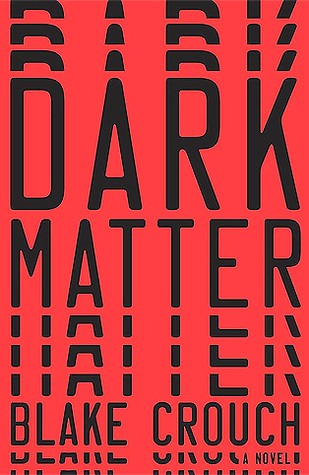
Dark Matter
by Blake Crouch
★ Top 25 book of 2016 · #17 on Best Books of 2016
Chicago physics professor Jason Dessen is abducted, drugged, and wakes in a life that is not his own, with a different wife and no son. He must fight to return to his family while facing a fearsome enemy.
Best for: Readers who like fast, mind-bending thrillers about alternate realities and family
Dark Matter is #17 on BookWard's Best Books of 2016, out of 70 2016 books that cleared our data bar.
What Dark Matter is about
Jason Dessen is a physics professor in Chicago with a loving wife, Daniela, and a son, Charlie. One evening a masked man forces him at gunpoint to an abandoned industrial site and injects him with a powerful drug. Jason wakes in a laboratory, in a Chicago that is almost his own, except that fifteen years ago he chose his physics career over marrying Daniela.
In this other life he is a celebrated genius who has built a cube that allows people to step between the worlds created by every possible outcome of every choice. Blake Crouch draws on the many-worlds idea from quantum mechanics and turns it into a tense, fast-moving thriller about identity, regret and what we would risk for the people we love.
It works well for readers who like science fiction with a human heart and a puzzle at its centre. A television adaptation premiered on Apple TV+ in 2024.
Dark Matter on the Best Books of 2016
Dark Matter came out in 2016. Of the 70 books first published in 2016 that met BookWard's data bar, it ranks #17 on our Best Books of 2016 list.
Why it made the list: 837 readers have shelved it on Open Library; readers rate it 4 out of 5 (93 ratings); 34 are reading it right now. The list ranks each year’s books on how many readers have picked them up, how highly readers rate them, and how many are reading them right now.
Nearby on the 2016 list
- Culpa Tuya Mercedes Ron, #15
- A Gentleman in Moscow Amor Towles, #16
- A Thousand Boy Kisses Tillie Cole, #18
- It Didn't Start with You Mark Wolynn, #19
See all Best Books of 2016 Best books by year
More years: Best Books of 2015 Best Books of 2017.
The numbers behind it
- Readers: 656 want to read it, 34 are reading it now and 147 have read it, according to Open Library.
- Ratings: 4 out of 5 from 93 Open Library ratings.
| Signal | This book (0 to 100) | Weight |
|---|---|---|
| Reach | 77 | 55% |
| Reader love | 54 | 25% |
| Being read right now | 69 | 20% |
Questions about Dark Matter
When was Dark Matter published?
Dark Matter by Blake Crouch was first published in 2016.
Was Dark Matter one of the best books of 2016?
Dark Matter is #17 on BookWard's Best Books of 2016, out of 70 2016 books that cleared our data bar. 837 readers have shelved it on Open Library; readers rate it 4 out of 5 (93 ratings); 34 are reading it right now.
Why is Dark Matter on the Best Books of 2016 list?
837 readers have shelved it on Open Library; readers rate it 4 out of 5 (93 ratings); 34 are reading it right now.
More of the best books of 2016
- It Ends with Us Colleen Hoover, #1
- Dog Man Dav Pilkey, #2
- The Subtle Art of Not Giving a F*ck Mark Manson, #3
- Never Split the Difference Chris Voss, #4
- The Hidden Oracle Rick Riordan, #5
- Born a Crime Trevor Noah, #6
See the full Best Books of 2016, the Top 100, or new books on Rising.
How we know
This page uses public data: Open Library reader counts and ratings, and Wikipedia page views for recent years. The description is paraphrased from real source text. Rankings reflect reading interest, not quality or sales, and can be affected by data gaps. Lists update monthly.
Best suited to adult and older teen readers who enjoy thrillers and science fiction.
Depends on the edition you pick.
A fast, high-concept thriller about one choice and endless versions of a life. 60% taste match
 BookWard’s take
A fast, high-concept thriller about one choice and endless versions of a life
Dark Matter opens with a kidnapping on an ordinary Chicago night and never really lets up, which suits BookWard's love of a hook and a quick pace. Its core idea is the many-worlds interpretation of quantum mechanics, and the book commits to it with a clean internal logic that holds together. It leans more toward story than ideas, and the tropes of the genre are used with some freshness. Characters are drawn with enough depth to make the stakes personal, though the prose stays plain and efficient rather than ornate. The ending resolves its central conflict. If you want a propulsive thriller that turns a single decision into a gripping premise, this delivers.
A lean thriller built around a single sustained chase, not a sprawling epic; it sits near the short end, which BookWard favors.
Short chapters and a constant sense of pursuit keep it moving quickly, close to BookWard's own preference.
The premise of one life diverging at a single choice is well worn in fiction, but the execution feels distinct.
The sentences are plain and functional, built to move the story and not to draw attention to themselves.
The plot engine dominates, even though Jason's love for his family gives the story its emotional core.
Even through darkness, the story is oriented toward getting home and keeping a family together.
It follows a conventional thriller shape with a clear beginning, escalation, and climax.
This is a tense, serious book with little room for comedy.
There is real menace and loss, balanced by a hopeful drive toward reunion.
Fear of losing a family keeps the feeling running high throughout.
See all 50 dialsEvery position, side by side with this book
Where it lines up
- OpeningBookWard 10 · book 10
- EndingBookWard 8 · book 8
- PaceBookWard 8 · book 9
Where it pulls apart
- Familiar tropesBookWard 10 · book 6
- Rigor (nonfiction)BookWard 9 · book 5
- LengthBookWard 1 · book 3
A lean thriller built around a single sustained chase, not a sprawling epic; it sits near the short end, which BookWard favors.
A masked abduction on an ordinary evening throws the reader straight into the story, exactly the immediate opening BookWard prizes.
It uses familiar thriller and sci-fi machinery, though the parallel-life premise gives it a fresher angle than most.
Its many-worlds rules are set up and followed with care, which sits well with BookWard's demand for airtight internal logic.
Short chapters and a constant sense of pursuit keep it moving quickly, close to BookWard's own preference.
The premise of one life diverging at a single choice is well worn in fiction, but the execution feels distinct.
Jason's motivations are clear and emotionally grounded, though the supporting cast is drawn more lightly than BookWard would like.
The central conflict is settled and the characters land somewhere definite, in line with BookWard's taste for resolution.
The pull of a family and a marriage carries real feeling, and the book leans warm rather than staying fully restrained.
The darkness grows out of the premise and its consequences, though some turns exist mainly to jolt.
Real physics ideas underpin the story, but they serve the plot and are not examined in depth.
The writing is clean and capable with a clear thriller register, more efficient than strikingly individual.
The science concept drives the setup, but the book is mostly told as a character-centered chase.
The science is explained to the reader at times, though much of it is carried through action and scene.
The momentum holds from abduction through the final stretch with few lulls, matching BookWard's wish for a sustained middle.
The sentences are plain and functional, built to move the story and not to draw attention to themselves.
The plot engine dominates, even though Jason's love for his family gives the story its emotional core.
Even through darkness, the story is oriented toward getting home and keeping a family together.
It follows a conventional thriller shape with a clear beginning, escalation, and climax.
This is a tense, serious book with little room for comedy.
Short chapters and plain language make it an easy, quick read despite the big scientific idea.
The story stays tightly anchored to one perspective, which keeps it focused.
The story moves forward in a largely linear way even as the setting shifts between worlds.
Its central device is a speculative invention, but the surrounding world is recognizably real.
A small circle of key characters carries the story, centered on one family and a few others.
The idea is vast, but the human story stays close and personal.
It favors action and external pressure, with Jason's thoughts serving to track the stakes.
Conversations carry much of the explanation and tension, giving dialogue a solid presence.
Jason's bond with his wife is the emotional heart that motivates everything he does.
Most of the book plays out in a version of a familiar city, with the strange parts coming from the parallel worlds.
It is set in a contemporary world of modern science and technology.
The premise of a life-altering choice is lasting, though the book is rooted in its thriller moment.
The narration is straightforward and trustworthy, following the protagonist closely.
The ethics of the choices people make are real questions, though the story still points toward clear heroes and villains.
Description is functional and economical, there to ground scenes and keep the pace up.
It is a self-contained novel with a complete story.
Revelations about identity and the nature of the other worlds arrive steadily and drive the plot.
It is gripping and thought-provoking without being especially difficult or heavy.
There is real menace and loss, balanced by a hopeful drive toward reunion.
Fear of losing a family keeps the feeling running high throughout.
Violence appears as part of the pursuit and confrontation but is not the focus.
Intimacy is present in the marriage but kept low-key and not explicit.
The story is about personal choices and has essentially no political agenda.
The language is plain and accessible, with no dense or dialect-heavy passages.
The narration stays close to events and does not editorialize much.
It looks toward scientific possibility and a future for the family, though regret over the past is central.
Despite danger and betrayal, the story ultimately believes in love and the effort to get back to it.
Review written by BookWard, dial version 1, November 2026.
Who is Dark Matter right for?
Best suited to adult and older teen readers who enjoy thrillers and science fiction. It contains tension, threats and some violence, along with themes of loss and the stress of a family in danger.
Short chapters and plain language make it an easy, quick read despite the big scientific idea.
There is real menace and loss, balanced by a hopeful drive toward reunion.
Fear of losing a family keeps the feeling running high throughout.
Violence appears as part of the pursuit and confrontation but is not the focus.
Book CompanionDark Matter: ideas, characters, themes
A physicist is pulled out of his own life and into another version of it, and must fight to return to the family he chose.
- A sudden abduction. Jason Dessen is kidnapped at gunpoint and drugged, and wakes in a life that is not his own.
- The road not taken. In the new world, a decision he made fifteen years earlier went the other way, giving him a very different life.
- The cube. A device built in that other world lets people move between countless parallel worlds.
- A rival in his own skin. Another version of Jason is at the center of the conflict, which raises questions of identity.
- The fight to get home. Jason's drive to return to his wife and son powers the chase across worlds.
Characters
Jason Dessen
Protagonist
A college physics professor in Chicago who wants nothing more than to get back to his family.
Daniela
Jason's wife
The woman whose life with Jason is the emotional anchor of the story.
Charlie
Jason's son
The child Jason is fighting to return to.
Amanda
Therapist in the alternate world
Someone who helps Jason navigate and escape from the other world.
Themes
How a single decision can shape an entire life, and what we wonder about the paths we did not take.
What makes a person who they are when other versions of them exist.
The pull of the people we love as a reason to keep fighting.
The tension between pursuing a career and building a life with others.
The idea that every possible outcome creates its own parallel universe.
Discussion questions
- Would you want to see the life you might have had if you made a different choice?
- What does the book suggest makes one version of a person more 'real' than another?
- How does the pace of the story affect the way the science is presented?
- Is Jason's fight to return to his family fully sympathetic, and why?
- Which character's choices stayed with you the most, and why?
Personalize your Book Companion
This is the general edition. In BookWard, the Companion is written for you: your reading profile, your notes, and spoiler-safe to the page you are on.
Buy, listen or borrow Dark Matter
Each link opens a search for this book on that store, in a new tab.
Read on a device
Borrow
Reviews and community
If you liked Dark Matter
A ticking-clock fantasy set in the hidden magic of Los Angeles
The HusbandDean KoontzA kidnapping thriller that never lets go of its hook
TitheHolly BlackSuburban faerie dark fantasy with a punk edge and real teeth
The Eyes of DarknessDean KoontzA grieving mother, a chalkboard message, and a race north
Find your own best books
Add what you have read, rate it, and BookWard will recommend what to read next.
Free to start. No credit card needed.