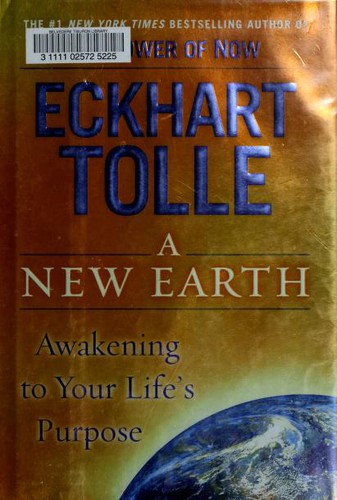
A New Earth
by Eckhart Tolle
★ Top 25 book of 2005 · #13 on Best Books of 2005
Tolle builds on his earlier bestseller to argue that moving beyond the ego is the route to personal happiness and an end to conflict. He traces anger, jealousy, and unhappiness to ego attachment and guides readers toward a new state of consciousness.
Best for: Spiritual seekers wanting an accessible guide to loosening the ego and finding fulfillment
A New Earth is #13 on BookWard's Best Books of 2005, out of 52 2005 books that cleared our data bar.
What A New Earth is about
Eckhart Tolle's 2005 follow-up to The Power of Now makes one central claim: much of our unhappiness comes from living inside the ego, and stepping out of it is the route to peace. He says clinging to that false self breeds anger, jealousy, and misery, and that waking to a different state of consciousness could ease conflict well beyond the individual. Where the earlier book answered questions in a handbook style, this one flows as a continuous narrative, mixing stories with reflection. It will appeal to readers drawn to spiritual self-examination who want a calm, thoughtful guide to living with more presence.
A New Earth on the Best Books of 2005
A New Earth came out in 2005. Of the 52 books first published in 2005 that met BookWard's data bar, it ranks #13 on our Best Books of 2005 list.
Why it made the list: 482 readers have shelved it on Open Library; readers rate it 3.8 out of 5 (26 ratings); 31 are reading it right now. The list ranks each year’s books on how many readers have picked them up, how highly readers rate them, and how many are reading them right now.
Nearby on the 2005 list
- Llama Llama Red Pajama Anna Dewdney, #11
- Uglies Scott Westerfeld, #12
- American Prometheus Kai Bird, #14
- The Game Neil Strauss, #15
See all Best Books of 2005 Best books by year
More years: Best Books of 2004 Best Books of 2006.
The numbers behind it
- Readers: 411 want to read it, 31 are reading it now and 40 have read it, according to Open Library.
- Ratings: 3.8 out of 5 from 26 Open Library ratings.
| Signal | This book (0 to 100) | Weight |
|---|---|---|
| Reach | 79 | 55% |
| Reader love | 27 | 25% |
| Being read right now | 83 | 20% |
Questions about A New Earth
When was A New Earth published?
A New Earth by Eckhart Tolle was first published in 2005.
Was A New Earth one of the best books of 2005?
A New Earth is #13 on BookWard's Best Books of 2005, out of 52 2005 books that cleared our data bar. 482 readers have shelved it on Open Library; readers rate it 3.8 out of 5 (26 ratings); 31 are reading it right now.
Why is A New Earth on the Best Books of 2005 list?
482 readers have shelved it on Open Library; readers rate it 3.8 out of 5 (26 ratings); 31 are reading it right now.
More of the best books of 2005
- The Lightning Thief Rick Riordan, #1
- Harry Potter and the Half-Blood Prince J. K. Rowling, #2
- The Glass Castle Jeannette Walls, #3
- Looking for Alaska John Green, #4
- Eldest Christopher Paolini, #5
- Freakonomics Steven D. Levitt, #6
See the full Best Books of 2005, the Top 100, or new books on Rising.
How we know
This page uses public data: Open Library reader counts and ratings, and Wikipedia page views for recent years. The description is paraphrased from real source text. Rankings reflect reading interest, not quality or sales, and can be affected by data gaps. Lists update monthly.
Suited to adult readers and mature teens interested in spirituality, mindfulness or self-reflection.
Depends on the edition you pick.
Tolle's case for dissolving the ego, argued with calm conviction. 30% taste match
 BookWard’s take
Tolle's case for dissolving the ego, argued with calm conviction
A New Earth is a spiritual manifesto rather than a story, and it asks to be judged on its ideas. Tolle argues that the ego drives anger, jealousy and unhappiness, and that waking from it is the route to a better world. The book is idea-led from start to finish, with little interest in plot or character. Its exposition is outright explanation, and the anecdotes serve as illustration rather than scene. Rigor is where it struggles: the case rests on assertion and spiritual teaching, not evidence, which sits uneasily with a reader who wants an argument to be airtight. Where it earns real credit is its voice, which is quiet, unhurried and unmistakably Tolle. The outlook is hopeful throughout, and the book reads as a sustained, repetitive meditation rather than a fast one.
Reflective and repetitive by design, it moves slowly and invites pausing, well below BookWard's brisk pace.
Tolle draws on long-standing spiritual traditions, so the core ideas feel familiar even as his framing is his own.
Plain, clear sentences with little ornament, close to BookWard's slightly plain leaning.
Its whole premise is that awakening can end suffering and change the world, a decidedly hopeful outlook that matches BookWard's lean.
Earnest and serious throughout, with little attempt at humor, though BookWard enjoys a lighter touch.
The subject is suffering, but the treatment is calm and consoling rather than dark.
The tone is soothing and moderately affecting rather than intense.
See all 50 dialsEvery position, side by side with this book
Where it lines up
- Authorial voiceBookWard 9 · book 8
- SentimentBookWard 8 · book 6
- Sagging middleBookWard 8 · book 5
Where it pulls apart
- Familiar tropesBookWard 10 · book 3
- OpeningBookWard 10 · book 4
- Internal logicBookWard 10 · book 4
Self-help and spiritual-awakening language is well worn, and the book leans on familiar phrasing even while pushing its own framework.
Claims about ego and consciousness are asserted and restated rather than demonstrated, so the argument holds together loosely compared with BookWard's airtight preference.
Reflective and repetitive by design, it moves slowly and invites pausing, well below BookWard's brisk pace.
Tolle draws on long-standing spiritual traditions, so the core ideas feel familiar even as his framing is his own.
Warm and uplifting in intent, it is more earnest than restrained, sitting a little on the sentimental side of BookWard's taste.
Its authority comes from spiritual teaching and anecdote, not evidence or citation, which is far from the rigor BookWard values.
Tolle's patient, gentle, instructive voice is immediately recognizable and consistent, which BookWard rewards.
It is almost entirely about ideas, with no plot to carry them, the opposite of BookWard's story-led lean.
Concepts are explained outright and then re-explained, the reverse of BookWard's preference for showing in scene.
Plain, clear sentences with little ornament, close to BookWard's slightly plain leaning.
Its whole premise is that awakening can end suffering and change the world, a decidedly hopeful outlook that matches BookWard's lean.
Earnest and serious throughout, with little attempt at humor, though BookWard enjoys a lighter touch.
The language is simple, but the ideas ask for patient, inward attention, making it moderately demanding.
A single teacher addresses the reader throughout, far from BookWard's many-voiced preference.
It proceeds in a straight teaching order with no time shifts.
Grounded in everyday experience, though it ventures into spiritual and metaphysical claims.
There is essentially no cast; anecdotes appear only briefly in service of the teaching.
It frames personal awakening as the key to ending conflict across the world, giving it broad ambition.
Attention stays on inner consciousness and thought, nearly the opposite of outer action.
It is exposition and reflection, with almost no dialogue.
Romance is not a concern here beyond passing mentions of relationships and the ego.
The setting is ordinary daily life, which is entirely familiar territory.
Published in 2005 and aimed at contemporary readers, it speaks to present-day concerns.
It draws on perennial spiritual themes, but its packaging is rooted in the 2000s self-help moment.
Tolle speaks as a direct, sincere teacher, with no sign of unreliability.
It offers a clear, one-directional view of ego as the problem and awareness as the answer, leaving little ambiguity.
Lean on scene-setting, it relies on abstract explanation instead of vivid description.
Part anecdote and part teaching, it leans more narrative-reflective than analytical, though less story-shaped than it claims.
It follows The Power of Now and expands its ideas, though it reads as a separate book.
It builds in a steady line with no surprises in structure.
It asks readers to question their sense of self, which is challenging even in a gentle tone.
The subject is suffering, but the treatment is calm and consoling rather than dark.
The tone is soothing and moderately affecting rather than intense.
Sexual content is essentially absent.
It speaks of global conflict and collective dysfunction but stays spiritual rather than partisan.
Written in clear, plain English that any reader can follow.
Tolle's convictions run through every page, so the narration is strongly opinionated.
Its central promise is a coming shift in human consciousness, so it looks ahead.
It holds a deeply idealistic belief that transformed awareness can end human suffering.
Review written by BookWard, dial version 1, November 2026.
Who is A New Earth right for?
Suited to adult readers and mature teens interested in spirituality, mindfulness or self-reflection. It touches on suffering and conflict in general terms but contains no graphic content.
The language is simple, but the ideas ask for patient, inward attention, making it moderately demanding.
The subject is suffering, but the treatment is calm and consoling rather than dark.
The tone is soothing and moderately affecting rather than intense.
Book CompanionA New Earth: ideas, characters, themes
Tolle argues that identifying with the ego's thoughts and stories is the root of personal and collective suffering, and that awakening to present-moment awareness is the way out.
- The ego as the source of dysfunction. Tolle says our attachment to a mental sense of self creates anger, jealousy and unhappiness.
- Awakening a new consciousness. He presents a shift beyond ego-based thinking as both a personal path and a human necessity.
- From personal peace to world change. The book links individual transformation to ending conflict and suffering more widely.
- A narrative follow-up to The Power of Now. Where the earlier book used question and answer, this one is written as a traditional narrative with anecdotes and philosophy.
- Accessible spiritual teaching. It aims to make its ideas open to any reader, in plain and encouraging language.
Themes
The mind's constructed sense of self, which Tolle treats as the cause of suffering.
A state of awareness he says can move beyond ego-driven thought.
The unhappiness and strife he traces back to ego attachment.
Personal awakening as the route to a better world.
Living in the now rather than in thought and story.
Discussion questions
- Does the idea that ego causes most suffering match your experience, or does it oversimplify?
- Tolle ties personal awakening to world change; how convincing is that link?
- How did the book's mix of anecdote and teaching work for you compared with a more evidence-based approach?
- Where did the repetition help you absorb an idea, and where did it wear thin?
- What would you need to see to trust the book's claims about consciousness?
Personalize your Book Companion
This is the general edition. In BookWard, the Companion is written for you: your reading profile, your notes, and spoiler-safe to the page you are on.
Buy, listen or borrow A New Earth
Each link opens a search for this book on that store, in a new tab.
Read on a device
Borrow
Reviews and community
If you liked A New Earth
Chopra's case that aging bends to belief, argued with conviction
The Law of SuccessNapoleon HillHill's lesson-by-lesson course on success, earnest and influential, but short on proof
Becoming SupernaturalJoe DispenzaA meditation manual dressed as science, big on promise
The 7 Habits of Highly Effective PeopleStephen R. CoveySeven habits, laid out plainly, with ideas ahead of story
Find your own best books
Add what you have read, rate it, and BookWard will recommend what to read next.
Free to start. No credit card needed.