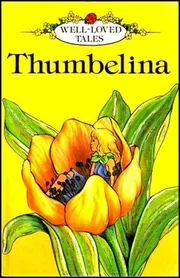
Thumbelina
by Hans Christian Andersen, Elsa Beskow · 1835
It suits young readers and listeners, and works well as a read-aloud.
32 pages, about 0.5 to 0.5 hours.
A tiny girl, a crowd of suitors, and a clear path home. 47% taste match
The story
Thumbelina is a Danish fairy tale by Hans Christian Andersen, first issued in 1835. It belongs to the fantasy category and has long been treated as a story for young readers. The tale opens with a woman who longs for a child and cannot say how to come by one, and it follows the miniature girl who results as she travels through a world of animals. Along the way she meets toads, moles and cockchafers, several of whom hope to marry her, and she finds her own way around their plans. Her journey ends when she falls for a prince from the flower-fairy realm, who is exactly her size.
The story first appeared in Copenhagen on 16 December 1835, published by C. A. Reitzel in the second installment of Andersen's Fairy Tales Told for Children, alongside "The Naughty Boy" and "The Travelling Companion." Its roots in Denmark and in folklore have carried it across many languages, with translations into English, Russian and Spanish. Roughly 79 editions exist, many of them short picture-book volumes of around 32 pages, and the tale has also appeared in miniature book formats and in collections of children's stories.
Once upon a time, there lived a woman who wished very much to have a child but did not know how to get one.
Setting
Denmark
Themes
Spanish language materialsFairy talesCuentos de hadasLiteratura juvenilCuentos infantilesChildren's stories, DanishMiniature booksSpecimens
- Want to read 90
- Reading now 4
- Read 26
Most people shelving it are saving it for later.
Of 120 readers who put it on a shelf, 75% want to read it, 3% are reading it now, 22% have finished it and 0% stopped before the end.
By the numbers
- The median edition runs 32 pages. Counting about 275 words a page and an adult reading pace of 250 words a minute, that is about 35 minutes of reading.
- Open Library tracks 79 editions from 68 publishers, the earliest dated 1911 and the latest 2020, across 8 languages.
- On reader demand it ranks in the top 10% of the classic books in our catalog (8,749 of them).
- Libraries shelve it under Dewey 839.8136 and Library of Congress class PZ-0008.00000000.A542 Th 1980.
 BookWard’s take
A tiny girl, a crowd of suitors, and a clear path home
Thumbelina is Andersen's 1835 fairy tale about a girl no bigger than a thumb, and it moves quickly from its very first sentence, where a woman longs for a child and has no idea where to find one. It hooks at once, and that kind of immediate pull is what I look for in a story. It is as tight as a story can be, and there is no middle to sag, since each new creature brings a fresh scheme. Where it loses me a little is in the familiar shapes it relies on: the animal suitors and the fairy prince are now well-worn figures, even if Andersen helped set them. The ending is fully resolved and gently sentimental, and the outlook is hopeful. It is a short, clear, well-made tale rather than a surprising one.
At around 32 pages in its common editions, it is as short as BookWard likes its stories, and sits at the very tight end.
Thumbelina moves from one creature and one proposal to the next without lingering, close to BookWard's fast preference.
Its tiny heroine was fresh in 1835, but a tale this widely retold now reads as familiar to modern eyes.
The language is simple and clean, built for young readers and read-aloud, a bit plainer than BookWard's middle ground.
Events and encounters drive everything, as Thumbelina is carried from one situation to the next.
Kindness and a happy union end the tale, giving it a clearly hopeful outlook, a little warmer than BookWard's usual.
It is a straightforward sequence of episodes told start to finish, more conventional than BookWard's mild appetite for structure.
Gentle whimsy runs through the animal characters, but the tale is more tender than funny and leans serious.
Her trials stay mild enough for children, with only a faint shadow beneath the fairy-tale surface.
Feelings run gentle and sincere, with moments of longing and relief, but nothing overwhelming.
See all 50 dialsEvery position, side by side with this book
Where it lines up
- LengthBookWard 1 · book 1
- PaceBookWard 8 · book 8
- OpeningBookWard 10 · book 9
Where it pulls apart
- Familiar tropesBookWard 10 · book 3
- Internal logicBookWard 10 · book 4
- Character depthBookWard 8 · book 3
At around 32 pages in its common editions, it is as short as BookWard likes its stories, and sits at the very tight end.
The first sentence sets up a woman's longing for a child at once, matching BookWard's love of an immediate opening.
Marrying-minded animals and a fairy prince are now familiar fairy-tale shapes, so it leans on convention more than BookWard prefers.
Fairy-tale rules govern events, and things happen because the story needs them to, which is looser than BookWard's airtight taste.
Thumbelina moves from one creature and one proposal to the next without lingering, close to BookWard's fast preference.
Its tiny heroine was fresh in 1835, but a tale this widely retold now reads as familiar to modern eyes.
Thumbelina and her suitors are drawn in a few clear strokes, so they read as types, short of BookWard's deeper portraits.
The story closes with her settled and happy among beings her own size, giving the full resolution BookWard values.
The tale leans warm and tender, especially in its happy close, which is softer than BookWard's restrained taste.
Her troubles come from the story's own plot rather than gratuitous darkness, which suits BookWard's preference for earned stakes.
This is a fairy tale, so a rigor dial does not apply.
Andersen's storytelling carries a recognizable gentle, confiding tone, though adaptations often smooth it flat.
This is firmly story-led, a sequence of adventures with only a light moral shape, well away from BookWard's idea-led pull.
The narrator states situations and feelings plainly in a fable manner, though scenes still carry most of the action.
With so little length and a new threat in each stretch, there is no sagging middle to speak of.
The language is simple and clean, built for young readers and read-aloud, a bit plainer than BookWard's middle ground.
Events and encounters drive everything, as Thumbelina is carried from one situation to the next.
Kindness and a happy union end the tale, giving it a clearly hopeful outlook, a little warmer than BookWard's usual.
It is a straightforward sequence of episodes told start to finish, more conventional than BookWard's mild appetite for structure.
Gentle whimsy runs through the animal characters, but the tale is more tender than funny and leans serious.
It reads easily for young readers and needs no effort, lighter than BookWard's comfortable level.
We follow Thumbelina alone from start to finish, a single viewpoint where BookWard enjoys more voices.
Events unfold in plain chronological order, which is more linear than BookWard's slight taste for shifting time.
A girl born tiny, talking animals and a flower-fairy realm make this thoroughly fantastical, beyond BookWard's middle position.
Thumbelina meets a handful of animals and one prince, a modest cast in line with BookWard's slightly smaller preference.
The story stays close to one small girl and her immediate surroundings, far more intimate than epic.
The tale is built from what happens to her and what she does, tilting toward outer action over inner thought.
Characters speak and propose but the narration carries most of the story, so dialogue is moderate.
Her path ends in love with a prince her own size, and the suitor plots give marriage a real place in the tale.
A world of toads, moles and flower fairies is unfamiliar territory, which suits BookWard's liking for fresh settings.
This is a nineteenth-century tale set in a timeless long-ago, so it belongs to the past rather than the present.
Told in many languages and editions since 1835, it has lasted far beyond its moment.
A plain, trustworthy storyteller guides us and gives no reason to doubt his account.
Good and bad are clear in this tale, with unkind suitors set against a kind heroine, far from ambiguous.
Tiny-scale details give some richness, though brief editions keep the scenery light, near the middle.
It stands alone as a single tale, though it first appeared in an installment of Andersen's fairy tales.
Each new suitor or setback is a turn, but the shape of the tale is fairly predictable overall.
This is an easy, comforting story for young readers, with little to unsettle or argue with.
Her trials stay mild enough for children, with only a faint shadow beneath the fairy-tale surface.
Feelings run gentle and sincere, with moments of longing and relief, but nothing overwhelming.
Any lightness is mild and whimsical, closer to dry charm than broad comedy.
The threats she faces are the pressure of unwanted marriages and unkind creatures rather than brutal acts.
There is no sexual content, only the fairy-tale notion of marriage and a sweet closing romance.
The tale holds no political agenda and stays within its small fairy-tale world.
The language is plain and easy, well below BookWard's middle on difficulty.
The narrator guides our sympathies toward Thumbelina and against her suitors, giving the telling a mild opinion.
The story is told as a long-ago tale and leans backward rather than ahead.
Kindness is rewarded and the heroine finds her place, an idealistic stance a little warmer than BookWard's norm.
Review written by BookWard, dial version 1, November 2026.
Who is Thumbelina right for?
It suits young readers and listeners, and works well as a read-aloud. Some moments of unwanted marriage proposals and a sense of danger may need a word for the very youngest.
It reads easily for young readers and needs no effort, lighter than BookWard's comfortable level.
Her trials stay mild enough for children, with only a faint shadow beneath the fairy-tale surface.
Feelings run gentle and sincere, with moments of longing and relief, but nothing overwhelming.
The threats she faces are the pressure of unwanted marriages and unkind creatures rather than brutal acts.
Book CompanionThumbelina: ideas, characters, themes
A tiny girl moves past marriage plans pressed on her by creatures of the wrong size and finds a partner who truly matches her.
- A longing for a child. The tale opens with a woman who wants a tiny child and has no idea how to get one, setting up Thumbelina's strange start.
- A small girl in a large world. Thumbelina's tiny size shapes every encounter, turning ordinary animals into serious obstacles.
- Marriage-minded suitors. Toads, moles and cockchafers each hope to marry her, and she works her way around their plans.
- Finding her own way. Rather than accepting what others arrange, she finds a path that fits her.
- A match of her own size. The tale ends with her falling in love with a flower-fairy prince exactly her size.
Characters
Thumbelina
Heroine
A girl no bigger than a thumb who travels among animals and avoids the marriages they propose.
The flower-fairy prince
Love interest
A prince from the flower-fairy realm, the same size as Thumbelina.
The suitors
Obstacles
Toads, moles and cockchafers who hope to marry her.
Themes
Thumbelina avoids the matches others plan for her and finds her own way.
She is happiest among beings of her own size and kind.
The suitors want her for their own ends, while the tale rewards gentleness.
Her tiny size makes the world dangerous, yet she keeps going.
The ending suggests that the right partner is one who fits you.
Discussion questions
- Why does Thumbelina seem to meet so many unsuitable suitors, and what does each one want?
- What does her tiny size let Andersen say about being powerless?
- Is the ending a reward for something Thumbelina does, or simple good luck?
- How does this tale compare with other fairy tales you know?
- Why might a story like this still be retold in so many languages?
Personalize your Book Companion
This is the general edition. In BookWard, the Companion is written for you: your reading profile, your notes, and spoiler-safe to the page you are on.
Buy, listen or borrow Thumbelina
Each link opens a search for this book on that store, in a new tab.
Read on a device
Borrow
Reviews and community
If you liked Thumbelina
A short fairy tale about an unloved duckling who becomes a swan
A House for Hermit CrabEric CarleA gentle, tidy picture book about outgrowing your home
The Wonderful Wizard of OzL. Frank BaumA short, odd, restless road-trip fairy tale that earned its classic status
The reluctant dragonKenneth GrahameA gentle dragon, a kind boy, and one very polite compromise
Sources: Open Library.
Track Thumbelina and find your next favorite
Add it to your shelf, rate what you have read, and BookWard will recommend what fits you.
Free to start. No credit card needed.