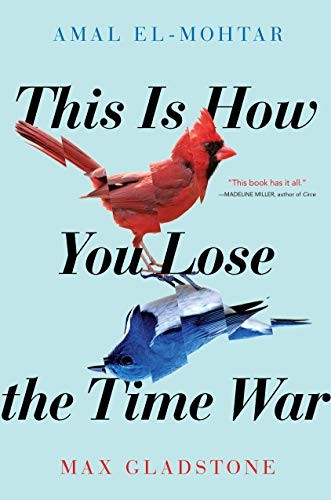
This Is How You Lose the Time War
by Amal El-Mohtar
★ Top 25 book of 2019 · #21 on Best Books of 2019
Red and Blue, rival agents fighting a war across time, begin trading letters that grow from boasts into something deeper. Their worlds could not be more opposed, yet the correspondence turns into a dangerous game and a romance.
Best for: Fans of inventive, romantic science fiction told through letters between rivals
This Is How You Lose the Time War is #21 on BookWard's Best Books of 2019, out of 83 2019 books that cleared our data bar.
What This Is How You Lose the Time War is about
Red and Blue are agents for two rival powers, each trying to tilt history in its own favor by slipping through time. Red serves the Agency, a cold, technological future. Blue belongs to Garden, a single living mind spread through all organic matter. Their empires cannot both exist, yet one day Red finds a letter from Blue, marked to be burned after reading. What follows is a secret correspondence that starts as mockery, turns to flirtation and slowly becomes something deeper.
The book is told almost entirely through those letters, in rich, poetic language. Their growing closeness is risky. Written by two authors, it won the 2019 BSFA Award for Best Shorter Fiction, 2019 Nebula Award for Best Novella, 2020 Locus Award for Best Novella, 2020 Hugo Award for Best Novella, and 2020 Ignyte Award for Best Novella, and tells of two time-traveling agents from warring futures who begin exchanging letters and fall in love.
This Is How You Lose the Time War on the Best Books of 2019
This Is How You Lose the Time War came out in 2019. Of the 83 books first published in 2019 that met BookWard's data bar, it ranks #21 on our Best Books of 2019 list.
Why it made the list: 482 readers have shelved it on Open Library; readers rate it 4.1 out of 5 (29 ratings). The list ranks each year’s books on how many readers have picked them up, how highly readers rate them, and how many are reading them right now.
Nearby on the 2019 list
- Everything Is F*cked Mark Manson, #19
- Invisible Women Caroline Criado Perez, #20
- Anxious People Fredrik Backman, #22
- The House in the Cerulean Sea T. J. Klune, #23
See all Best Books of 2019 Best books by year
More years: Best Books of 2018 Best Books of 2020.
The numbers behind it
- Readers: 409 want to read it, 12 are reading it now and 61 have read it, according to Open Library.
- Ratings: 4.1 out of 5 from 29 Open Library ratings.
| Signal | This book (0 to 100) | Weight |
|---|---|---|
| Reach | 77 | 55% |
| Reader love | 57 | 25% |
| Being read right now | 61 | 20% |
Questions about This Is How You Lose the Time War
When was This Is How You Lose the Time War published?
This Is How You Lose the Time War by Amal El-Mohtar was first published in 2019.
Was This Is How You Lose the Time War one of the best books of 2019?
This Is How You Lose the Time War is #21 on BookWard's Best Books of 2019, out of 83 2019 books that cleared our data bar. 482 readers have shelved it on Open Library; readers rate it 4.1 out of 5 (29 ratings).
Why is This Is How You Lose the Time War on the Best Books of 2019 list?
482 readers have shelved it on Open Library; readers rate it 4.1 out of 5 (29 ratings).
More of the best books of 2019
- Red, White & Royal Blue Casey McQuiston, #1
- A Good Girl's Guide to Murder Holly Jackson, #2
- Heartstopper, Volume 2 Alice Oseman, #3
- Guts Raina Telgemeier, #4
- The Silent Patient Alex Michaelides, #5
- Into the Pit (Five Nights at Freddy’s Scott Cawthon, #6
See the full Best Books of 2019, the Top 100, or new books on Rising.
How we know
This page uses public data: Open Library reader counts and ratings, and Wikipedia page views for recent years. The description is paraphrased from real source text. Rankings reflect reading interest, not quality or sales, and can be affected by data gaps. Lists update monthly.
Best suited to older teens and adults comfortable with lyrical, non-linear storytelling.
Depends on the edition you pick.
Two enemy agents, one letter, and a war across time. 62% taste match
 BookWard’s take
Two enemy agents, one letter, and a war across time
A short, strange, fast-moving novella told almost entirely in letters between Red and Blue, rival agents from empires whose futures cannot both exist. It hooks at once: a note reading 'Burn before reading' turns a battlefield boast into something far more dangerous. The idea feels fresh, and the tropes are handled with care, since enemies-to-lovers is rarely done through correspondence across time like this. It's brief, which suits a story this tightly wound, and the pace stays brisk. The prose is more ornate than I usually go for, rich and lyrical, and it asks more of the reader than the page count suggests. It's character-driven and intimate rather than epic in feel, despite the scope. If you want romance carried by voice and wordplay, this delivers.
A novella that never overstays; it is as tight as BookWard likes its books.
Short letters and quick jumps through time keep things moving at close to BookWard's preferred speed.
Epistolary romance between rival time agents is an unusual conceit, executed with real invention.
Lush, lyrical, and metaphor-heavy, richer than BookWard's usual middle ground.
The relationship between Red and Blue drives everything; the war is the backdrop to it.
Despite the war and its cost, the story reaches toward connection and hope.
Told in letters and interleaved scenes, it departs from conventional narration while staying readable.
There is teasing wit between the correspondents, but the tone stays largely serious and romantic.
War and betrayal give it weight, but it is tempered by tenderness.
The longing between Red and Blue comes through strongly.
See all 50 dialsEvery position, side by side with this book
Where it lines up
- LengthBookWard 1 · book 1
- OriginalityBookWard 9 · book 9
- EndingBookWard 8 · book 8
Where it pulls apart
- Internal logicBookWard 10 · book 6
- SentimentBookWard 8 · book 4
- Familiar tropesBookWard 10 · book 8
A novella that never overstays; it is as tight as BookWard likes its books.
A letter marked 'Burn before reading' opens the story, pulling you in almost immediately, which suits BookWard well.
Enemies falling in love is a known shape, but telling it through letters across time feels fresh.
Time travel between mutually exclusive futures works on its own dreamlike rules rather than airtight mechanics, a little looser than BookWard prefers.
Short letters and quick jumps through time keep things moving at close to BookWard's preferred speed.
Epistolary romance between rival time agents is an unusual conceit, executed with real invention.
Red and Blue come alive through how they write to each other, giving them real depth despite the brevity.
The central story reaches a clear, satisfying resolution, in line with BookWard's taste for closure.
The emotion is real but expressed through wit and metaphor, so it reads as heartfelt without turning syrupy.
Its darker moments come out of the war and the stakes the lovers face, not out of gratuitous effect.
This is fiction, so rigor does not apply.
The letters carry two distinct, unmistakable voices, and that voice is the book's greatest strength.
It is led by its love story and its characters more than by abstract ideas, though the premise is rich.
Backstory and worldbuilding arrive through glimpses in the letters rather than being explained outright.
At novella length it holds its energy from the first letter to the last.
Lush, lyrical, and metaphor-heavy, richer than BookWard's usual middle ground.
The relationship between Red and Blue drives everything; the war is the backdrop to it.
Despite the war and its cost, the story reaches toward connection and hope.
Told in letters and interleaved scenes, it departs from conventional narration while staying readable.
There is teasing wit between the correspondents, but the tone stays largely serious and romantic.
The dense imagery and shifting settings ask for attention, even in a short book.
The story alternates between two perspectives, Red and Blue, and nothing beyond them.
Both agents hop through the past and across timelines, so chronology is deliberately fluid.
Post-singularity technology and a planet-wide consciousness place it firmly in speculative territory.
The story centers on just two people, with only a handful of others around them.
The war spans all of time and space, yet the story stays focused on two people.
Most of the weight sits in what the two write and feel, not in action sequences.
There is almost no spoken dialogue; the letters carry the conversation instead.
The love story between Red and Blue is the heart of the book.
Strange futures and shifting eras make nearly every setting unfamiliar and inventive.
The action roams across history and imagined futures, not the present day.
A love story told in letters across time has the kind of staying power that outlasts its moment.
The letters are honest in intent, though the speakers are guarded rivals with plenty to hide at first.
The two empires are not neatly good or evil, which leaves some ambiguity, though the heart is clear.
Sensory imagery runs throughout, so the settings and emotions feel vivid.
This is a novel, so nonfiction style does not apply.
This is a novel, so nonfiction perspective does not apply.
It reads as a self-contained story.
A few turns land in the second half, though the story is more about relationship than reversals.
The poetic density and unusual form ask a bit of the reader, but the emotional payoff is rewarding.
War and betrayal give it weight, but it is tempered by tenderness.
The longing between Red and Blue comes through strongly.
What humor there is comes out as sly, dry banter between rivals.
The conflict is present but mostly kept in the background of the correspondence.
Romance and desire are present, but the book is not explicit.
Empires and warring ideologies shape the stakes, but politics is not the point of the story.
The language is dense and figurative, which raises the difficulty beyond a plain read.
Both letter writers speak with strong, personal opinions and attitudes.
Set across past and future, it leans slightly toward what could come, and what we might choose.
At heart it believes connection and love can cut through even the fiercest war.
Review written by BookWard, dial version 1, November 2026.
Who is This Is How You Lose the Time War right for?
Best suited to older teens and adults comfortable with lyrical, non-linear storytelling. It involves war and peril and a same-sex romance, handled without explicit content.
The dense imagery and shifting settings ask for attention, even in a short book.
War and betrayal give it weight, but it is tempered by tenderness.
The longing between Red and Blue comes through strongly.
The conflict is present but mostly kept in the background of the correspondence.
Book CompanionThis Is How You Lose the Time War: ideas, characters, themes
Two enemy agents from mutually exclusive futures begin writing to each other across time, and their taunts turn into love.
- The opening letter. A note marked 'Burn before reading. Signed, Blue' sets off the correspondence between Red and Blue.
- Two empires. Red serves the Agency, a post-singularity technotopia, while Blue serves Garden, a vast consciousness in all organic matter.
- Epistolary form. Much of the story is told through letters, so voice and wordplay carry the relationship.
- Time as battlefield. The agents move back and forth through history, altering events on behalf of their sides.
- From rivalry to love. What begins as a battlefield boast grows into a dangerous game and then something deeper.
Characters
Red
Agent of the Agency
A skilled operative from a technological empire who finds Blue's letter and begins replying.
Blue
Agent of Garden
A rival operative from an organic, collective consciousness, and Red's counterpart in the war.
Themes
How people on opposite sides can come to understand each other better than anyone else.
The idea that actions ripple across history and that futures can be fought over.
Letters as the means by which two people build a shared world.
The tension between duty to an empire and the pull of personal feeling.
Discussion questions
- Why does the letter form suit a story about time and distance?
- How do Red and Blue's differing empires shape the way they write?
- When does rivalry start to become something else between them?
- What does the book suggest about the cost of loyalty to a cause?
- How did the ornate language affect your experience of the romance?
Personalize your Book Companion
This is the general edition. In BookWard, the Companion is written for you: your reading profile, your notes, and spoiler-safe to the page you are on.
Buy, listen or borrow This Is How You Lose the Time War
Each link opens a search for this book on that store, in a new tab.
Read on a device
Borrow
Reviews and community
If you liked This Is How You Lose the Time War
A dead woman walks west with a crow in her chest
OrlandoVirginia WoolfA poet lives three centuries and changes sex along the way
The Last UnicornPeter S. BeagleA lyrical fantasy quest that earns its sorrow and wonder
The Starless SeaErin MorgensternA lavish, dreamlike fantasy that trades momentum for atmosphere
Find your own best books
Add what you have read, rate it, and BookWard will recommend what to read next.
Free to start. No credit card needed.