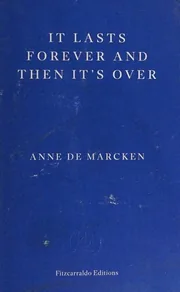
It Lasts Forever and Then It's Over
by Anne de Marcken · 2024
Best suited to adult readers and mature teens who like literary and speculative fiction.
138 pages, about 2 to 3 hours.
A dead woman walks west with a crow in her chest. 68% taste match
The story
Anne de Marcken's It Lasts Forever and Then It's Over is a work of literary fiction first published in 2024 and running to about 138 pages. It belongs to American literature and takes the form of a short novel told in the first person by a woman who has died and continues on in some form of afterlife.
The narrator has lost her name and much of what once tied her to her human life, yet she holds onto a strong memory of the place where she was known and loved. She moves steadily westward, crossing varied landscapes and stretches of time. A dead crow rides inside her chest and offers dry remarks along the way. As she travels, she gains and loses pieces of her body and of her sense of self, and the situations she meets range from frightening to comic to sorrowful.
The book turns on death and the way mortality alters nearly everything, with love as the one thing that may endure. Readers who like short, strange novels about the afterlife and longing for home may find it a fit.
By the numbers
- The median edition runs 138 pages. Counting about 275 words a page and an adult reading pace of 250 words a minute, that is about 2.5 hours of reading.
- Open Library tracks 2 editions from 2 publishers.
- On reader demand it ranks in the top 5% of the recent releases books in our catalog (1,627 of them).
- Libraries shelve it under Library of Congress class PS-3604.00000000.E1289I8 2024.
 BookWard’s take
A dead woman walks west with a crow in her chest
This is a very short novel with a very strange engine: a narrator who has died, forgotten her name, and keeps moving west while pieces of her body and self fall away. A dead crow in her chest supplies dry commentary. At 138 pages it is tight, and the compactness serves it well. The premise is far from the usual afterlife story. The first-person narration carries the whole book, funny and opinionated, with real sorrow running underneath. It is also more driven by ideas and images than by plot, and it moves freely across landscapes and time. Expect a book that is terrifying, comic and heartbreaking by turns, circling death and the one thing that may outlast it.
At 138 pages it is about as compact as a novel gets, which fits BookWard's love of tight books.
The westward journey keeps moving through short, varied episodes, brisk if not breathless.
The premise and the crow companion are decidedly its own, matching BookWard's appetite for the original.
Spare and haunting rather than ornate, with enough image-making to lift it above plain.
The journey matters mostly for what it does to the narrator and her memory of home.
It mixes terror and grief with the possibility that love endures, landing somewhere in the middle.
A journey told through shifting episodes, with a narrator losing parts of herself, bends convention without abandoning it.
Described as among the funniest recent novels, yet its subject keeps it close to serious.
Death and the loss of the self run through it, softened by humor and tenderness.
Longing and grief drive the book, described as heartbreaking as well as hilarious.
See all 50 dialsEvery position, side by side with this book
Where it lines up
- LengthBookWard 1 · book 1
- OriginalityBookWard 9 · book 9
- Authorial voiceBookWard 9 · book 9
Where it pulls apart
- Internal logicBookWard 10 · book 5
- OpeningBookWard 10 · book 8
- EndingBookWard 8 · book 5
At 138 pages it is about as compact as a novel gets, which fits BookWard's love of tight books.
A dead narrator on the move, with a crow in her chest, gives the book an unusual pull from the start.
An undead woman carrying a laconic dead crow avoids the familiar afterlife tropes, which BookWard rewards.
The afterlife runs on dream-like rules where body and self come and go, looser than BookWard's airtight ideal.
The westward journey keeps moving through short, varied episodes, brisk if not breathless.
The premise and the crow companion are decidedly its own, matching BookWard's appetite for the original.
One narrator stripped of her name still carries a deep, specific longing for the place she was loved.
The longing is strong, but the dry humor and strangeness keep it from turning syrupy.
The bodily losses and terrors serve the book's meditation on death rather than shock for its own sake.
This is fiction, so the rigor dial does not apply.
The narrator's wry, opinionated, heartbroken voice is the book's main draw and a strong match for BookWard.
The book leans on its ideas about mortality and love, though a journey still gives it a story shape.
The afterlife is revealed through what the narrator meets on the road, not through explanation.
At this length and with episodic variety, the momentum holds from start to finish.
Spare and haunting rather than ornate, with enough image-making to lift it above plain.
The journey matters mostly for what it does to the narrator and her memory of home.
It mixes terror and grief with the possibility that love endures, landing somewhere in the middle.
A journey told through shifting episodes, with a narrator losing parts of herself, bends convention without abandoning it.
Described as among the funniest recent novels, yet its subject keeps it close to serious.
Short and spare, but its dreamlike logic and themes ask for some attention.
A single first-person narrator carries the whole book.
She crosses stretches of time as well as space, so the timeline moves rather than runs straight.
An afterlife narrator with a dead crow in her chest sits firmly in the fantastical.
The focus stays on the narrator and the figures she meets along the way, a small core.
The travel across landscapes and time widens the canvas, while the feeling stays personal.
Her memories, longing and sense of self matter more than outward action.
Love is central to the book, yet it reads as longing for a place and a person rather than a love plot.
The afterlife landscape is strange and unfamiliar, which suits BookWard's taste for the new.
Framed as a tale for our dispossessed times, it speaks to the present while living in the afterlife.
Death, loss and love give it a lasting subject, even as it nods to recent times.
Her lost name and shifting self make her account feel slippery, though her feelings ring true.
The book turns on mortality and love, with no simple lesson on offer.
A road through varied landscapes and bodily change invites vivid, concrete imagery.
This is fiction, so the nonfiction style dial does not apply.
This is fiction, so the nonfiction perspective dial does not apply.
It is a single self-contained novel.
The episodes bring surprises through strange encounters more than plot reversals.
Its subject is heavy and its form unusual, so it asks more than a comfort read does.
Death and the loss of the self run through it, softened by humor and tenderness.
Longing and grief drive the book, described as heartbreaking as well as hilarious.
The humor reads as dry and laconic, courtesy of an opinionated crow and a wry narrator.
Parts of the body are lost along the way, so there is some physicality without a focus on violence.
It is called a tale for our dispossessed times, but politics sits in the background.
Spare and plainly written, so the language itself is not a hurdle.
The narrator notes every detail with strong opinions, and the crow adds more.
Her longing points back to a place where she was known and loved.
Love may survive everything, a hopeful thread within a clear-eyed look at death.
Review written by BookWard, dial version 1, November 2026.
Who is It Lasts Forever and Then It's Over right for?
Best suited to adult readers and mature teens who like literary and speculative fiction. It deals with death, grief and bodily loss, handled in a spare and sometimes comic way.
Short and spare, but its dreamlike logic and themes ask for some attention.
Death and the loss of the self run through it, softened by humor and tenderness.
Longing and grief drive the book, described as heartbreaking as well as hilarious.
Parts of the body are lost along the way, so there is some physicality without a focus on violence.
Book CompanionIt Lasts Forever and Then It's Over: ideas, characters, themes
A woman who has died keeps moving west, losing her name and parts of herself, while holding onto the memory of where she was loved.
- A narrator after death. The heroine is dead yet fully alert, noting every odd detail of her new reality.
- The journey west. She travels across landscapes of time and space, always heading west.
- The crow in her chest. A dead but laconically opinionated crow rides inside her and comments as she goes.
- Losing the self. She encounters and loses parts of her body and her self in one situation after another.
- Longing for home. Though her name is gone, she remembers with great longing the place where she loved and was loved.
Characters
The narrator
Undead protagonist
A woman who has forgotten her name but not her longing for the place where she was known and loved.
The crow
Companion
A dead, laconically opinionated bird she carries in her chest.
Themes
How death changes everything about how a life is seen.
The one thing that may survive even death.
What remains of a self once name and body begin to fall away.
The ache for a place and the people who knew you.
The sense of being cut off from home and belonging.
Discussion questions
- What does the narrator keep after losing her name, and why might that be what remains?
- How does the crow's dry commentary change the way the grief reads?
- Why might the journey head always west?
- Where do humor and heartbreak meet in this book?
- Does the book suggest love really outlasts death, or only that we long for it to?
Personalize your Book Companion
This is the general edition. In BookWard, the Companion is written for you: your reading profile, your notes, and spoiler-safe to the page you are on.
Buy, listen or borrow It Lasts Forever and Then It's Over
Each link opens a search for this book on that store, in a new tab.
Read on a device
Borrow
Reviews and community
If you liked It Lasts Forever and Then It's Over
A strange Kent tideline, and an object that won't hold still
The Ministry of TimeKaliane BradleyA time-travel romance that argues with Britain's past and present
This Is How You Lose the Time WarAmal El-MohtarTwo enemy agents, one letter, and a war across time
Cursed DaughtersOyinkan BraithwaiteA Lagos family curse, a reincarnation belief, and a girl fighting her fate
Sources: Open Library.
Track It Lasts Forever and Then It's Over and find your next favorite
Add it to your shelf, rate what you have read, and BookWard will recommend what fits you.
Free to start. No credit card needed.