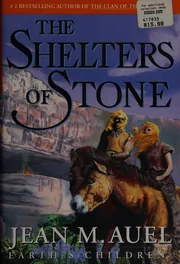
The Shelters of Stone
by Jean M. Auel · 2001
Best suited to adult and mature teen readers comfortable with a long novel.
832 pages, about 13 to 19.5 hours.
A vast, research-heavy ice age homecoming that rewards patience. 38% taste match
The story
The Shelters of Stone is a work of historical fiction by Jean M. Auel, first published in 2001. It is the fifth novel in the Earth's Children series and follows The Plains of Passage. Set in Europe during the ice age, it centers on Ayla and Jondalar, who arrive at the end of a long journey in the company of their animals Wolf, Whinney, and Racer.
They are received by the Zelandonii, Jondalar's people, and Ayla begins to learn the clothing, customs, and artifacts of the Ninth Cave, whose homes are set into tall limestone cliffs. There she meets Zelandoni, the Cave's spiritual leader and a healer, with whom she can exchange skills and knowledge. As a formal mating at the Summer Meeting approaches, Ayla expects a child, and she must find her place among people who do not all welcome her. Some distrust her unfamiliar ways and her bond with the Clan, whom they call flatheads. The book runs to roughly 832 pages in its median edition.
People were gathering on the limestone ledge, looking down at them warily.
Setting
Europe
Themes
Ayla (Fictitious character)Prehistoric peoplesGlacial epochPréhistoireRomans, nouvellesRoman américainJondalar (Fictitious character)Ice age
- Want to read 73
- Reading now 8
- Read 28
Most people shelving it are saving it for later.
Of 109 readers who put it on a shelf, 67% want to read it, 7% are reading it now, 26% have finished it and 0% stopped before the end.
By the numbers
- The median edition runs 832 pages. Counting about 275 words a page and an adult reading pace of 250 words a minute, that is about 15 hours of reading.
- Open Library tracks 49 editions from 36 publishers, the earliest dated 2001 and the latest 2020, across 8 languages.
- On reader demand it ranks in the top 10% of the modern books in our catalog (15,152 of them).
- Libraries shelve it under Dewey 813.54 and Library of Congress class PR-6051.00000000.U3 .S4.
 BookWard’s take
A vast, research-heavy ice age homecoming that rewards patience
The Shelters of Stone is the fifth Earth's Children novel, and it trades the road for a community. After the long journey of the previous book, Ayla and Jondalar reach the Zelandonii and the Ninth Cave, and the story turns on one question: where does a stranger with unfamiliar ways belong? At 832 pages, the sheer length is where it tests a reader most, and the slow pace and sagging middle come from the same cause, a sprawl of detailed daily life. Where it earns its keep is in its description and its characters, with a richly imagined cliff-dwelling society seen through Ayla's wonder. It also matters that this is a continuation, not a starting point.
At 832 pages it is a very long book, the opposite of BookWard's preference for tight, short reads.
Daily routines and customs get generous room, so the story moves slowly, well below BookWard's faster tempo.
A deep-past setting with a fully imagined society stands out, even though this is a fifth volume.
The prose is clear and plain, built to carry detail rather than ornament.
The drive comes from Ayla finding her place, so character carries more than plot.
Arrival, mating and a coming child tilt it toward a hopeful outlook despite some hostility.
It follows a conventional, chronological arc with no formal experiment.
The tone is earnest and serious, with little humor.
There is hostility and prejudice, but the overall tone stays gentle.
Fear, affection and anticipation are felt but handled at an even keel.
See all 50 dialsEvery position, side by side with this book
Where it lines up
- Character depthBookWard 8 · book 7
- Story or ideasBookWard 3 · book 4
- Internal logicBookWard 10 · book 7
Where it pulls apart
- LengthBookWard 1 · book 10
- Familiar tropesBookWard 10 · book 4
- OpeningBookWard 10 · book 5
At 832 pages it is a very long book, the opposite of BookWard's preference for tight, short reads.
It opens on a wary crowd gathered on a limestone ledge, a quiet arrival rather than a jolt.
The mating plot and the outsider-among-suspicious-hosts setup are familiar shapes, though the prehistoric setting freshens them.
Customs, tools and healing practices are worked out in coherent, detailed terms, which suits BookWard's liking for sturdy internal logic.
Daily routines and customs get generous room, so the story moves slowly, well below BookWard's faster tempo.
A deep-past setting with a fully imagined society stands out, even though this is a fifth volume.
Ayla's adaptation and her bonds with Jondalar and Zelandoni are drawn at length, close to BookWard's taste for depth.
As a mid-series book it leaves larger arcs for later, so resolution is partial.
Love, birth and belonging are played warmly and openly, less restrained than BookWard prefers.
Hostility toward Ayla creates tension without leaning on shock for its own sake.
Setting details are grounded in research, though this is fiction and not argued rigorously.
The narration is steady and recognizable but more functional than strikingly individual.
Story leads, with the ideas of belonging and cultural difference carried through scene and custom.
Customs and artifacts are often explained outright, far from BookWard's preference for showing in scene.
The long stretches of cultural description and preparation risk sagging, which BookWard dislikes.
The prose is clear and plain, built to carry detail rather than ornament.
The drive comes from Ayla finding her place, so character carries more than plot.
Arrival, mating and a coming child tilt it toward a hopeful outlook despite some hostility.
It follows a conventional, chronological arc with no formal experiment.
The tone is earnest and serious, with little humor.
The prose is accessible, though the length and density of detail ask for stamina.
The story stays chiefly with Ayla's perspective, giving a mostly single viewpoint.
Events unfold in a straightforward forward sequence.
It is grounded in a realistic, researched ice age with no fantastical elements.
The Ninth Cave and the wider Zelandonii bring in a large cast of named people.
The focus is on one community and one woman's place in it, more intimate than epic.
Ayla's perceptions and adjustments balance with the outward events of community life.
Conversation between Ayla, Jondalar and the Zelandonii carries much of the cultural exchange.
Ayla and Jondalar's coming mating is a central thread throughout.
A cliff-dwelling ice age society is about as unfamiliar a setting as fiction offers.
It is set in the distant prehistoric past, far from the present day.
Belonging and welcome are lasting concerns, but the book is tied to its series and its detail.
The narration is a straightforward, reliable guide to events.
Ayla's side is clearly the sympathetic one, so the moral lines are fairly plain.
Clothing, homes, artifacts and customs are described in abundant detail, a defining strength.
It is a novel, so it is narrative throughout.
The story is told close to its characters, not from a detached distance.
It is the fifth Earth's Children novel and picks up directly after The Plains of Passage.
The plot develops steadily with few sharp reversals.
It is a comfortable immersion with some social friction, not a challenging read.
There is hostility and prejudice, but the overall tone stays gentle.
Fear, affection and anticipation are felt but handled at an even keel.
Humor is rare and mild, nothing broad.
The conflict here is mostly social, with little violence on the page.
Mating and the Gift of Pleasure are part of the culture depicted, giving sexual content a real presence.
Questions of acceptance and who belongs give it a social edge without making it political.
The language is plain and readable despite invented customs and terms.
The narration openly admires Ayla's skills and the culture it depicts.
It looks to the past, reconstructing an ancient world.
Ayla's resilience and the promise of community lean the book toward idealism.
Review written by BookWard, dial version 1, November 2026.
Who is The Shelters of Stone right for?
Best suited to adult and mature teen readers comfortable with a long novel. It treats mating and sexuality openly as part of its culture and includes social hostility.
The prose is accessible, though the length and density of detail ask for stamina.
There is hostility and prejudice, but the overall tone stays gentle.
Fear, affection and anticipation are felt but handled at an even keel.
The conflict here is mostly social, with little violence on the page.
Book CompanionThe Shelters of Stone: ideas, characters, themes
After a vast journey, Ayla must find her place among Jondalar's people while some of them resist her unfamiliar ways.
- The arrival. Ayla and Jondalar reach the Zelandonii with Wolf, Whinney and Racer and meet a wary welcome.
- A cliff-dwelling society. The Ninth Cave lives in homes formed in tall limestone cliffs, and Ayla marvels at their clothing, customs and artifacts.
- A fellow healer. Ayla meets Zelandoni, the Cave's spiritual leader, and finds someone with whom to trade knowledge and skills.
- The coming mating. Preparations begin for the formal mating at the Summer Meeting, while Ayla expects a child.
- Resistance to Ayla. Some Zelandonii distrust her ways and her link to the Clan, whom they call flatheads.
Characters
Ayla
Protagonist
A skilled healer from outside the Zelandonii who must learn their world while earning her place.
Jondalar
Ayla's partner
A Zelandonii returning home with Ayla and preparing for their mating.
Zelandoni
Spiritual leader and healer
The Ninth Cave's leader, a fellow healer who shares skills with Ayla.
Wolf, Whinney and Racer
Animal companions
The animals who travel with Ayla and Jondalar.
Themes
Finding a place among people who do not all welcome you.
Fear of unfamiliar ways and of those linked to the Clan.
Skills shared between healers as a form of connection.
How shared rituals and homes shape a people.
A mating and a coming child anchor Ayla's future.
Discussion questions
- Why do some Zelandonii distrust Ayla, and is that fear understandable?
- How does the cliff-dwelling setting shape the way the Zelandonii live?
- What does Ayla's friendship with Zelandoni offer both women?
- How does the book's long attention to daily detail affect your experience of the story?
- What would a strong welcome look like for someone as unfamiliar as Ayla?
Personalize your Book Companion
This is the general edition. In BookWard, the Companion is written for you: your reading profile, your notes, and spoiler-safe to the page you are on.
Buy, listen or borrow The Shelters of Stone
Each link opens a search for this book on that store, in a new tab.
Read on a device
Borrow
Reviews and community
If you liked The Shelters of Stone
Faith and slavery in Rome, with a romance at its center
An echo in the darknessFrancine RiversRome's arena and a slave's faith, in a long, earnest sequel
ScarlettAlexandra RipleyA big, soapy sequel that picks up where Gone with the Wind stopped
The Immortals of MeluhaAmish TripathiShiva as a Tibetan chief, reimagined as myth rooted in history
Sources: Open Library.
Track The Shelters of Stone and find your next favorite
Add it to your shelf, rate what you have read, and BookWard will recommend what fits you.
Free to start. No credit card needed.