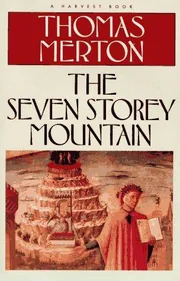
The Seven Storey Mountain
by Thomas Merton · 1948
Best suited to adult and mature teen readers interested in faith, memoir or monastic life.
435 pages, about 7 to 10 hours.
A restless young man's road from the world to a Trappist monastery. 50% taste match
What it covers
The Seven Storey Mountain is the autobiography of Thomas Merton, first published in 1948. It is a spiritual biography that follows Merton from his birth in France in 1915 through his upbringing and travels, and on to his decision to join the Trappists. The story moves across several places, including France, England, Scotland, Italy, London, New York, and Olean, before arriving in Kentucky, where Merton entered the Abbey of Gethsemani near Bardstown.
Merton finished the manuscript in 1946, a few years after taking up life as a monk. The title comes from the mountain of purgatory in Dante's Purgatorio. The book belongs to the tradition of conversion narratives and accounts of the spiritual life, and it also gives a picture of Catholic monastic life in the United States in the middle of the twentieth century. Its span of time runs from the years following the First World War to the late 1940s. Readers interested in monks, the Catholic Church, and the history of the Trappists in America will find the subject at the center of the book. It has been translated widely and appeared in many editions, with a typical printing running to about 435 pages.
On the last day of january 1915, under the sign of the water bearer, in a year of great war, and down in the shadow of some french mountains on the borders of spain, i came into the world.
Setting
United StatesLondonOleanNew YorkKentucky
Period
1918-1948
Themes
BiographyMerton, Thomas, 1915-1968TrappistsUnited StatesCatholic ChurchHistoryTrappists in the United StatesAutobiografías
- Want to read 123
- Reading now 12
- Read 19
Most people shelving it are saving it for later.
Of 154 readers who put it on a shelf, 80% want to read it, 8% are reading it now, 12% have finished it and 0% stopped before the end.
By the numbers
- The median edition runs 435 pages. Counting about 275 words a page and an adult reading pace of 250 words a minute, that is about 8.0 hours of reading.
- Open Library tracks 39 editions from 28 publishers, the earliest dated 1948 and the latest 2017, across 7 languages.
- On reader demand it ranks in the top 10% of the classic books in our catalog (8,749 of them).
- Libraries shelve it under Dewey 271.12502 and Library of Congress class BX-4705.00000000.M542 A3.
 BookWard’s take
A restless young man's road from the world to a Trappist monastery
Merton's 1948 memoir follows a gifted, restless young man through France, England, Scotland, Italy, London and New York before he enters the Abbey of Gethsemani in Kentucky. Its great strength is the voice: Merton's confiding, opinionated narration is unmistakable, and it carries the whole book. The characterization is just as good, since the entire memoir is one person examined without flattery. At 435 pages it runs long, and a reader who likes tight books may feel the length, especially because spiritual reflection often outweighs events and the book is driven more by ideas than by plot. The outlook is hopeful, and the ending resolves as a vocation found. Readers who value interior honesty over pace will find a lot here.
At 435 pages it is a substantial read, longer than BookWard's taste for tight books.
Reflection and travel give it a measured, unhurried pace, slower than BookWard prefers.
A spiritual autobiography by a Trappist monk was a distinctive proposition in 1948, and BookWard values that freshness.
The writing is rich and fervent, somewhat more ornate than BookWard's plainer preference.
The drama is Merton's inner change, so the book is firmly character-driven, as BookWard likes.
The journey ends in peace and purpose, a hopeful outlook that fits BookWard well.
It follows life in chronological order with a conventional memoir structure.
Mostly earnest and reflective, with little comedy.
Spiritual struggle and loss appear, but the book stays mostly contemplative.
Longing, doubt and devotion give it real feeling without melodrama.
See all 50 dialsEvery position, side by side with this book
Where it lines up
- EndingBookWard 8 · book 8
- Authorial voiceBookWard 9 · book 9
- Character depthBookWard 8 · book 9
Where it pulls apart
- LengthBookWard 1 · book 7
- OpeningBookWard 10 · book 6
- Familiar tropesBookWard 10 · book 6
At 435 pages it is a substantial read, longer than BookWard's taste for tight books.
A life story told from the start builds steadily rather than grabbing at once, so it only partly meets BookWard's love of instant hooks.
Conversion narratives have familiar shapes, though Merton's candid self-scrutiny keeps it from feeling formulaic.
The path from restless youth to the monastery is traced coherently, which suits BookWard's liking for sound internal logic.
Reflection and travel give it a measured, unhurried pace, slower than BookWard prefers.
A spiritual autobiography by a Trappist monk was a distinctive proposition in 1948, and BookWard values that freshness.
Merton examines himself closely and unsparingly, giving the depth of character BookWard rates highly.
The story arrives at a clear destination in the Kentucky abbey, a resolution BookWard appreciates.
Devotional feeling is present, but Merton's self-criticism tempers it, landing mid-range against BookWard's restraint.
Darkness comes from honest account of a life and its wanderings, not from shock for its own sake.
It is a personal testimony rather than a researched study, so rigor is moderate by BookWard's standard.
Merton's confiding, opinionated voice is unmistakable, exactly what BookWard prizes.
The narrative carries it, but spiritual reflection weighs heavily, leaning it slightly toward ideas.
Merton often explains his thoughts and beliefs outright instead of dramatizing them, which BookWard likes less.
Interior stretches can slow the middle, though the pull toward the monastery keeps it moving.
The writing is rich and fervent, somewhat more ornate than BookWard's plainer preference.
The drama is Merton's inner change, so the book is firmly character-driven, as BookWard likes.
The journey ends in peace and purpose, a hopeful outlook that fits BookWard well.
It follows life in chronological order with a conventional memoir structure.
Mostly earnest and reflective, with little comedy.
Religious reflection and period references ask for some effort but stay accessible.
The whole book is told from Merton's single point of view.
It moves forward through his life from birth to the late 1940s.
A grounded account of real places, people and events.
A life spanning several countries and many acquaintances brings a fairly sizeable cast.
It ranges across continents and decades, yet stays centered on one person's inner life.
The real action is spiritual and interior, far more than outward event.
Reflection and narration carry the book, with dialogue playing a minor role.
Romance is a minor strand beside the spiritual search.
Monastic life in Kentucky is unfamiliar to most readers, a draw for BookWard.
It belongs to the interwar and 1940s past rather than the present day.
The search for meaning and faith keeps it widely read decades on.
Merton narrates his own life candidly and with self-criticism, a largely trustworthy guide.
Merton frames his choices with fairly clear religious conviction, though he judges himself harshly.
Places and people are rendered in generous, vivid detail.
It reads as a story of a life, closer to narrative than analysis.
First-person memoir, intimate and subjective throughout.
A complete work that stands alone.
The surprises are life events and turns of heart rather than plot twists.
It questions worldly ambition and asks real spiritual commitment of the reader.
Spiritual struggle and loss appear, but the book stays mostly contemplative.
Longing, doubt and devotion give it real feeling without melodrama.
Humor is rare and mostly dry.
Violence is minimal in a reflective life story.
Sexual content is limited, handled in the context of confession.
The era's politics appear in the background, not at the center.
Dense in places with religious and period vocabulary, but generally readable.
Merton freely states strong views on the world and faith.
It looks mostly backward on a life, even as it moves toward a new vocation.
A sincere, hopeful belief in spiritual purpose runs through it.
Review written by BookWard, dial version 1, November 2026.
Who is The Seven Storey Mountain right for?
Best suited to adult and mature teen readers interested in faith, memoir or monastic life. It includes frank reflection on a restless youth and religious conviction that may not appeal to every reader.
Religious reflection and period references ask for some effort but stay accessible.
Spiritual struggle and loss appear, but the book stays mostly contemplative.
Longing, doubt and devotion give it real feeling without melodrama.
Violence is minimal in a reflective life story.
Book CompanionThe Seven Storey Mountain: ideas, characters, themes
A restless, brilliant young man tells how his wandering life led him to the Trappist monastery of Gethsemani.
- A life across many places. Merton moves through France, England, Scotland, Italy, London and New York before reaching Kentucky.
- A conversion narrative. The book belongs to the tradition of spiritual autobiography and accounts of conversion.
- Entering Gethsemani. His decision to take vows at the Abbey of Gethsemani near Bardstown drives the book's arc.
- The title's source. The title refers to the mountain of purgatory in Dante's Purgatorio.
- Monastic life in America. It gives a picture of Catholic Trappist life in the United States in the mid twentieth century.
Characters
Thomas Merton
Author and narrator
A passionate young man who becomes a Trappist monk and tells his own story.
Themes
The long pursuit of meaning and faith.
A turn from worldly life toward religious commitment.
Leaving society to live in silence and prayer.
The sense of being called to a particular way of life.
The abbey's walls become the setting of a new freedom.
Discussion questions
- Why does Merton believe he must first immerse himself in the world before withdrawing from it?
- How does the image of Dante's mountain of purgatory shape the way you read his journey?
- How does Merton's self-criticism affect whether you trust his account?
- What does the book suggest about the appeal of a demanding, silent way of life?
- How does the setting of mid-century America color his choices?
Personalize your Book Companion
This is the general edition. In BookWard, the Companion is written for you: your reading profile, your notes, and spoiler-safe to the page you are on.
Buy, listen or borrow The Seven Storey Mountain
Each link opens a search for this book on that store, in a new tab.
Read on a device
Borrow
Reviews and community
If you liked The Seven Storey Mountain
A son's memoir, and his mother's own voice breaking through it
Lust for LifeIrving StoneA long, devoted life of Van Gogh, told as fiction
Let Me Hear Your VoiceCatherine MauriceA mother's urgent, unsparing account of fighting her daughter's autism
The Hired GirlLaura Amy SchlitzA runaway farm girl keeps a diary and finds her voice
Sources: Open Library.
Track The Seven Storey Mountain and find your next favorite
Add it to your shelf, rate what you have read, and BookWard will recommend what fits you.
Free to start. No credit card needed.