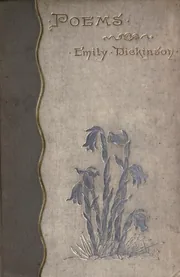
The Poems of Emily Dickinson Volume II
by Emily Dickinson · 1890
Suits teens and adults, and shorter poems work well for younger readers with some guidance.
255 pages, about 4 to 6 hours.
Dickinson's second posthumous volume: compressed, strange, and unmistakably hers. 57% taste match
What is inside
This is the second volume of Emily Dickinson's poems, first published in 1890, in the Poetry, Plays & Essays category. It belongs to the body of American poetry written in the 19th century by Emily Dickinson (1830-1886), who lived in Amherst, Massachusetts, and spent much of her life in seclusion. Most of her work stayed unpublished until after her death in 1886, and poems from her papers began reaching print in the years that followed.
The poems take up life and death, love and nature, and the inner life of the mind. The volume opens with a playful Valentine verse that calls on the nine muses. Her work has been translated into many languages, including Spanish, French, Italian, Russian, Ukrainian, Swedish, Frisian and Catalan, and it has attracted a good deal of criticism and interpretation. Some of her verse has also appeared in collections for children and in miniature editions. The book runs to roughly 255 pages in a typical edition, and it has appeared in 151 editions in all.
Awake ye muses nine, sing me a strain divine, Unwind the solemn twine, and tie my Valentine!
Period
19th century
Themes
American poetryCriticism and interpretationChildren's poetry, AmericanPoetryMiniature booksSpecimensAmerican Women poetsCollections
- Want to read 424
- Reading now 25
- Read 27
Most people shelving it are saving it for later.
Of 476 readers who put it on a shelf, 89% want to read it, 5% are reading it now, 6% have finished it and 0% stopped before the end.
By the numbers
- The median edition runs 255 pages. Counting about 275 words a page and an adult reading pace of 250 words a minute, that is about 4.7 hours of reading.
- Open Library tracks 151 editions from 108 publishers, the earliest dated 1890 and the latest 2009, across 12 languages.
- On reader demand it ranks in the top 4% of the classic books in our catalog (8,749 of them).
- Libraries shelve it under Dewey 811.49 and Library of Congress class PS-1541.00000000.Z5 A4 1985.
 BookWard’s take
Dickinson's second posthumous volume: compressed, strange, and unmistakably hers
This is the 1890 second volume of Dickinson's poems, and it shows why she stands in the front rank of American poets. Each poem is tiny, so the book never sags; nothing outstays its welcome, and the pace holds from start to finish. Where it shines is the voice: the energy is distinctive and sounds like no one else, and that is the quality I prize most in poetry. It is original, too, with dashes, slant thinking and sudden turns that dodge familiar tropes. The book is driven by ideas rather than story, and in place of character depth you get one searching mind turned on life, death, love and nature. Expect ambiguity over neat endings, and a kind of reading that rewards slow rereading rather than racing. For a reader who likes sharp, restrained, original writing, it fits.
At 255 pages of short poems, it is compact in each piece, matching BookWard's taste for tight work.
Short poems move quickly, but dense lines invite slowing down, so it reads at a moderate clip.
Her phrasing and compression were unlike anything in her era, squarely what BookWard rewards.
Spare lines and plain words, though her dashes and imagery add some richness.
With no plot, the pull comes from a searching mind.
Death and loss weigh heavily, though moments of nature and wonder lift it.
Short lyrics with unusual punctuation and slant rhyme, but still a collection of poems.
There is playfulness, such as a Valentine verse, but the dominant mood is serious.
Death and loss recur, treated with thoughtfulness more than horror.
Feeling runs deep but is delivered through restraint.
See all 50 dialsEvery position, side by side with this book
Where it lines up
- SentimentBookWard 8 · book 8
- ExpositionBookWard 2 · book 2
- LengthBookWard 1 · book 2
Where it pulls apart
- Internal logicBookWard 10 · book 6
- Story or ideasBookWard 3 · book 9
- EndingBookWard 8 · book 3
At 255 pages of short poems, it is compact in each piece, matching BookWard's taste for tight work.
Poems begin fast, often mid-thought, though a collection has no single gripping opening arc.
Dickinson's odd angles and fresh images sidestep stock poetic tropes, which BookWard values.
Poems follow their own associative logic; it is coherent in feeling more than airtight in argument.
Short poems move quickly, but dense lines invite slowing down, so it reads at a moderate clip.
Her phrasing and compression were unlike anything in her era, squarely what BookWard rewards.
There is no cast, but the speaker's inner life is drawn with real depth.
Poems often close on an open or unsettled note rather than a tidy resolution.
Feeling is delivered through compression and restraint, not gushing sentiment.
Her darkness about death is earned by the thought behind it, not used for effect.
Her tone is like no other, a voice that speaks to the reader directly.
These are poems of ideas about life, death, love and nature, not narrative.
She rarely explains; images and compression do the work in place of outright commentary.
Each poem is brief and charged, so the volume holds up without a slack stretch.
Spare lines and plain words, though her dashes and imagery add some richness.
With no plot, the pull comes from a searching mind.
Death and loss weigh heavily, though moments of nature and wonder lift it.
Short lyrics with unusual punctuation and slant rhyme, but still a collection of poems.
There is playfulness, such as a Valentine verse, but the dominant mood is serious.
Compressed, elliptical lines reward rereading and ask real attention.
One poetic sensibility speaks throughout, though poems shift speaker and mood.
Poems stand alone and read in no strict sequence of events.
Grounded in nature and the mind, with occasional figurative flights.
No cast to speak of, just the speaker and what she addresses.
An intimate, inward scale, though the themes of death and love are vast.
These poems are almost wholly inner thought and perception.
Essentially no dialogue; the poems are spoken meditations.
Love is one of its themes, though it is not a central plotline.
Rooted in 19th-century Amherst and the natural world, familiar in texture but strange in vision.
Written in the 19th century and published in 1890.
Still read and translated into many languages well over a century later.
The speaker is candid and personal, though poetic persona can shift and play.
Poems probe life, death and the soul without handing down clear verdicts.
Images of nature and the mind are vivid but pared down, not lavish.
An intensely personal, first-person sensibility throughout.
This is the second volume, so it belongs to a set of Dickinson collections.
Sudden turns of thought within poems, rather than plot surprises.
Unsettled thinking about death and the soul makes it quietly challenging.
Death and loss recur, treated with thoughtfulness more than horror.
Feeling runs deep but is delivered through restraint.
Where wit appears it is dry and light.
Almost none on the page; death is contemplated, not depicted.
Virtually absent.
Not a political book.
Compressed syntax and unusual punctuation make some lines dense.
The speaker voices views of her own, but through image and suggestion.
Preoccupied with mortality and what lies after, more than with the future.
Leans toward wonder and questioning rather than naive idealism or pure cynicism.
Review written by BookWard, dial version 1, November 2026.
Who is The Poems of Emily Dickinson Volume II right for?
Suits teens and adults, and shorter poems work well for younger readers with some guidance. Death is a frequent theme, handled thoughtfully rather than graphically.
Compressed, elliptical lines reward rereading and ask real attention.
Death and loss recur, treated with thoughtfulness more than horror.
Feeling runs deep but is delivered through restraint.
Almost none on the page; death is contemplated, not depicted.
Book CompanionThe Poems of Emily Dickinson Volume II: ideas, characters, themes
Compressed lyrics about life, death, love and nature, voiced by a recluse whose inner life is vast.
- Posthumous publication. Most of her work reached print only after her death in 1886, and this 1890 volume is part of that early wave.
- A Valentine opening. The volume opens with a playful Valentine verse that calls on the nine muses.
- The landscape of the soul. Her subjects include the mind's inner terrain, in a phrase Henry James used.
- A voice that speaks to you. Archibald MacLeish said reading her feels less like reading than being spoken to.
- Widely translated. Her poems have appeared in many languages, including Spanish, French, Italian and Russian.
Themes
Mortality is a recurring concern, treated with curiosity and nerve.
Feeling and longing appear, often obliquely.
The natural world supplies images for inner states.
The mind and soul are the true landscape of these poems.
A recluse's vantage shapes the intimate, watchful perspective.
Discussion questions
- How does Dickinson's compression change the way you read a single poem?
- What do her dashes and slant rhymes do to meaning and rhythm?
- Which poem made you feel most directly spoken to, and why?
- How does she treat death compared with how other poets you know do?
- What does it mean that most of this work appeared only after her death?
Personalize your Book Companion
This is the general edition. In BookWard, the Companion is written for you: your reading profile, your notes, and spoiler-safe to the page you are on.
Buy, listen or borrow The Poems of Emily Dickinson Volume II
Each link opens a search for this book on that store, in a new tab.
Read on a device
Borrow
Reviews and community
If you liked The Poems of Emily Dickinson Volume II
Three detective stories that quietly dismantle the detective story
Bartleby, the ScrivenerHerman MelvilleFive words, a lawyer's unease, and a office that cannot cope
ArielSylvia PlathPlath's last poems, tight, startling, and impossible to mistake for anyone else
A Grief ObservedC. S. LewisA short, unguarded record of faith tested by loss
Sources: Open Library.
Track The Poems of Emily Dickinson Volume II and find your next favorite
Add it to your shelf, rate what you have read, and BookWard will recommend what fits you.
Free to start. No credit card needed.