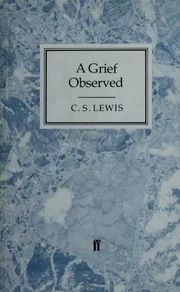
A Grief Observed
by C. S. Lewis · 1961
It suits thoughtful older teens and adults, especially readers interested in faith and loss.
64 pages, about 1 to 1.5 hours.
A short, unguarded record of faith tested by loss. 58% taste match
What it covers
A Grief Observed is a short work of nonfiction in the philosophy and religion category, made up of C. S. Lewis's reflections on bereavement. It follows the months after the death of his wife, Joy Davidman, in 1960. Lewis writes as a Christian, and the pages take up death, grief, affliction, and consolation, along with the questions that loss raises about belief and about how a person makes sense of the world. The text opens with the observation that grief felt much like fear, and it moves through a period in which a long-held faith comes under strain and then slowly finds its footing again.
The book first appeared in 1961 under the pseudonym N.W. Clerk, since Lewis preferred that readers not connect it to him. It was reissued in 1963 under his own name, after his death, though the text still calls his wife "H." Lewis, who lived from 1898 to 1963, wrote it as a way of getting through the worst hours of mourning. At around 64 pages, it is brief, and it has been published in 44 editions. It suits readers drawn to personal meditation on loss and religious faith.
No one ever told me that grief felt so like fear.
Characters
Joy Davidman
Themes
DeathMeditationsBereavementChristianityGriefReligionAddresses, essays, lecturesReligious aspects of Bereavement
- Want to read 166
- Reading now 10
- Read 23
Most people shelving it are saving it for later.
Of 199 readers who put it on a shelf, 83% want to read it, 5% are reading it now, 12% have finished it and 0% stopped before the end.
By the numbers
- The median edition runs 64 pages. Counting about 275 words a page and an adult reading pace of 250 words a minute, that is about 70 minutes of reading.
- Open Library tracks 44 editions from 19 publishers, the earliest dated 1961 and the latest 2021, across 2 languages.
- On reader demand it ranks in the top 7% of the classic books in our catalog (8,749 of them).
- Libraries shelve it under Dewey 242.4 and Library of Congress class BV-4905.20000000.L4 1989.
 BookWard’s take
A short, unguarded record of faith tested by loss
At 64 pages, A Grief Observed does not pad its length, and with no filler there is nothing to sag. Lewis wrote it in the months after his wife Joy Davidman died in 1960, and the voice is unmistakable: plain, argumentative, unwilling to flatter himself. It is personal rather than detached, a man thinking on the page while the pain is fresh. That makes it restrained in feeling in the way that counts, since he distrusts his own consolations and says so. The outlook is not bleak, though it earns any hope slowly. This is meditation, not narrative, so it leans toward ideas over story.
At 64 pages it is among the shortest books you can pick up, which suits BookWard's taste for tight work.
Few believers have recorded a crisis of faith this candidly while living through it, though grief writing is a known form.
The sentences are clear and conversational, with striking images arriving now and then.
There is no plot, only one man's changing state of mind, so it is wholly character-driven.
It starts in desolation and only slowly finds footing, so hope comes late and hard-won.
It is a serious work of mourning, with only a rare dry note.
The subject is death and despair, treated honestly rather than luridly.
The feeling is intense, expressed in measured sentences.
See all 50 dialsEvery position, side by side with this book
Where it lines up
- LengthBookWard 1 · book 1
- Character depthBookWard 8 · book 8
- SentimentBookWard 8 · book 8
Where it pulls apart
- Story or ideasBookWard 3 · book 8
- Rigor (nonfiction)BookWard 9 · book 5
- ExpositionBookWard 2 · book 6
At 64 pages it is among the shortest books you can pick up, which suits BookWard's taste for tight work.
It opens on grief feeling much like fear, a direct and unusual way in that draws you straight into the thought.
Lewis refuses the stock phrases of consolation and tests each one, so it avoids the familiar grief-book script.
Lewis reasons step by step and revisits his own claims when they fail him, which keeps the argument coherent.
Few believers have recorded a crisis of faith this candidly while living through it, though grief writing is a known form.
Lewis draws himself, and the absent H, with unsparing honesty, so the inner portrait runs deep.
It closes with his bearings partly regained rather than every question settled, which is truthful but not neatly resolved.
He distrusts easy comfort and his own self-pity, so the book stays restrained even at its rawest.
Any darkness here comes from real loss honestly faced, never from effect for its own sake.
It is careful personal reasoning about faith and loss, not a researched or evidenced study.
Lewis's blunt, self-questioning voice is distinctive from the first page and carries the whole book.
It is a sustained meditation on grief and belief with almost no plot, so the ideas lead.
He often states his reasoning outright, thinking aloud, though the feeling arrives through the telling too.
Brief enough that the attention never drifts, and each entry adds to the arc.
The sentences are clear and conversational, with striking images arriving now and then.
There is no plot, only one man's changing state of mind, so it is wholly character-driven.
It starts in desolation and only slowly finds footing, so hope comes late and hard-won.
It is a serious work of mourning, with only a rare dry note.
The language is plain, but the questions about God and suffering ask real effort of the reader.
We stay inside one mind throughout.
It moves forward through the months after the death, in a broadly linear way.
Entirely grounded in one man's lived loss.
Essentially Lewis alone, with H present mostly in memory.
Intimate to the point of confession, centered on one marriage and one death.
Nearly all of it happens in thought, with almost no outward action.
It is reflection, not conversation, so spoken exchange is almost absent.
Love is the ground of the grief, but the book is about loss, not courtship.
A recognizable mid-century English setting, hardly described.
Written in 1960 and 1961, so it belongs to the past, though the feelings read as current.
Grief and doubt do not date, and the book has stayed in print across many editions.
Lewis writes as himself and is hard on his own self-deceptions, so he reads as reliable.
He wrestles openly with hard questions about God and suffering without handing down a tidy verdict.
Spare on physical detail, rich instead in the description of states of mind.
It reads as personal reflection rather than analysis, with a loose narrative of the months of mourning.
It is first person and intimate, as close to a private notebook as published work gets.
A standalone work.
Surprises come as shifts in his thinking, not plot turns.
It asks hard questions about faith and loss and does not offer easy comfort.
The subject is death and despair, treated honestly rather than luridly.
The feeling is intense, expressed in measured sentences.
Whatever humor appears is dry and rare.
None on the page.
Essentially absent.
Not a concern here.
Plain, direct English, easy to follow.
Lewis argues his case, including with himself, so the narration is strongly opinionated.
It is mostly looking back at a marriage and at a faith under strain, with only a faint turn forward.
It begins close to despair yet does not give up on meaning, ending somewhere between cynicism and hope.
Review written by BookWard, dial version 1, November 2026.
Who is A Grief Observed right for?
It suits thoughtful older teens and adults, especially readers interested in faith and loss. It deals directly with death, bereavement, and despair, which may be hard for anyone recently bereaved.
The language is plain, but the questions about God and suffering ask real effort of the reader.
The subject is death and despair, treated honestly rather than luridly.
The feeling is intense, expressed in measured sentences.
None on the page.
Book CompanionA Grief Observed: ideas, characters, themes
After the death of his wife, Lewis records how grief shook a lifelong faith and how he slowly regained his footing.
- Grief like fear. The book opens by noting that grief felt much like fear, setting an honest tone from the start.
- Written to survive. Lewis used the writing as a way of getting through the worst hours of mourning.
- Faith under strain. A believer of long standing finds his sense of meaning tested by loss.
- Pseudonymous first printing. It first appeared in 1961 as by N.W. Clerk because Lewis did not want readers to connect it to him.
- The wife called H. Even in the 1963 edition under his own name, the text still refers to Joy Davidman as H.
Characters
C. S. Lewis
Author and narrator
The mourner at the center, writing as a Christian whose beliefs are shaken by his wife's death.
H (Joy Davidman)
His late wife
Present through memory and absence; her death in 1960 is the cause of the whole book.
Themes
The raw experience of losing someone, recorded as it is felt.
How belief is tested by suffering and may slowly recover.
What counts as real comfort, and what only sounds like it.
The problem of pain in the life of a person of faith.
The refusal to dress up feelings or arguments.
Discussion questions
- Why might Lewis have chosen a pseudonym for the first printing, and what changes when the author is known?
- How does the book's opening comparison of grief to fear shape the way you read the rest?
- Where does Lewis distrust his own comfort, and do you find that convincing?
- What does his regained footing look like, and has it resolved the questions or only eased them?
- How does reading grief as thought, not event, differ from reading a story of loss?
Personalize your Book Companion
This is the general edition. In BookWard, the Companion is written for you: your reading profile, your notes, and spoiler-safe to the page you are on.
Buy, listen or borrow A Grief Observed
Each link opens a search for this book on that store, in a new tab.
Read on a device
Borrow
Reviews and community
If you liked A Grief Observed
Letters on solitude, patience and the work of writing
John BarleycornJack LondonJack London's candid, argumentative memoir of drink and his long struggle
Le mythe de SisypheAlbert CamusCamus asks if life is worth living, then answers
La nauséeJean-Paul SartreA diary of disgust that turns philosophy into a story
Sources: Open Library.
Track A Grief Observed and find your next favorite
Add it to your shelf, rate what you have read, and BookWard will recommend what fits you.
Free to start. No credit card needed.