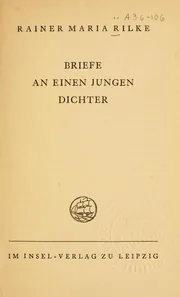
Letters to a young poet
by Rainer Maria Rilke · 1656
Suits thoughtful teenagers and adults, especially anyone drawn to writing or creative work.
101 pages, about 1.5 to 2.5 hours.
Letters on solitude, patience and the work of writing. 49% taste match
What is inside
Letters to a Young Poet gathers the correspondence of Rainer Maria Rilke (1875-1926), the German-language poet, with Franz Xaver Kappus (1883-1966). The letters were written to Kappus between 1903 and 1908, and the book opens with Rilke acknowledging that a letter from the younger man reached him only a few days earlier. It belongs to the category of poetry, plays and essays, and it sits within the tradition of published correspondence by authors of the twentieth century.
The letters are the heart of the volume, but the book also includes a chronicle of Rilke's own life covering those same years, 1903 to 1908, which appears near the end. At roughly one hundred pages in a typical edition, it is a compact work. It has been translated widely, including into Spanish, and it has appeared in well over a hundred editions. Readers interested in German authors, in letters between writers, or in the biography of Rilke during the early years of the century will find the exchange with Kappus at the center of this collection.
Your letter reached me just a few days ago.
Characters
Franz Xaver Kappus
Setting
Correspondence
Period
20th century20e siècle
Themes
CorrespondenceGerman Authors20th centuryAuthorsAutores alemanesBiographyCorrespondenciaTraducciones al español
- Want to read 334
- Reading now 16
- Read 54
- Stopped 1
Most people shelving it are saving it for later.
Of 405 readers who put it on a shelf, 82% want to read it, 4% are reading it now, 13% have finished it and 0% stopped before the end.
By the numbers
- The median edition runs 101 pages. Counting about 275 words a page and an adult reading pace of 250 words a minute, that is about 1.9 hours of reading.
- Open Library tracks 144 editions from 91 publishers, the earliest dated 1656 and the latest 2025, across 7 languages.
- On reader demand it ranks in the top 3% of the classic books in our catalog (8,749 of them).
- Libraries shelve it under Dewey 836.912 and Library of Congress class PT-2635.00000000.I65Z488 2000.
 BookWard’s take
Letters on solitude, patience and the work of writing
This is a short book that gets by on voice rather than plot. Rilke answers a stranger's request for judgment on his verse by turning the question inward, and the result is a voice that is unmistakable: no one else sounds like this. At around a hundred pages it is about as tight as a book gets, and the pace is unhurried but never sags. It asks for moderate effort, since the sentences are plain but the ideas ask you to slow down. There is little sentimentality despite the warmth; he stays restrained and exact. With no story to resolve, the ending is open, one letter simply following another. It rewards rereading more than speed.
At roughly one hundred pages, it is among the shortest books you can pick up, and that suits BookWard's taste for the tight.
The letters move at a contemplative pace, slower than BookWard likes, though the brevity keeps it from dragging.
A famous poet mentoring a stranger by post, with unexpected emphasis on solitude over technique, feels fresh even now.
The language is graceful and slightly elevated without turning ornate, landing a little above plain.
There is no plot; what holds attention is the character of the man writing.
Rilke urges patience and trust in one's own inner life, which gives the book a quietly hopeful lean.
A sequence of letters is a mildly unusual form, yet each one is conventional in shape.
The book is earnest and reflective, with little room for humor.
The subject matter is gentle overall, though it faces loneliness and doubt without flinching.
Feeling runs steady and sincere rather than intense or overwrought.
See all 50 dialsEvery position, side by side with this book
Where it lines up
- LengthBookWard 1 · book 1
- Sagging middleBookWard 8 · book 8
- OriginalityBookWard 9 · book 8
Where it pulls apart
- OpeningBookWard 10 · book 6
- Rigor (nonfiction)BookWard 9 · book 3
- Story or ideasBookWard 3 · book 9
At roughly one hundred pages, it is among the shortest books you can pick up, and that suits BookWard's taste for the tight.
It opens by acknowledging a letter that arrived days earlier, a quiet start rather than a hook, so it meets BookWard's appetite only partway.
Advice-to-a-beginner books often lean on stock encouragement, but Rilke avoids pep talk and offers hard, particular counsel.
Each letter follows from the last and the argument holds together, though it works through intuition more than strict reasoning.
The letters move at a contemplative pace, slower than BookWard likes, though the brevity keeps it from dragging.
A famous poet mentoring a stranger by post, with unexpected emphasis on solitude over technique, feels fresh even now.
We come to know Rilke closely through his own words, while Kappus appears mostly as the person being answered.
A collection of letters has no plotted close, so it settles rather than resolves, which sits looser than BookWard prefers.
The tone is tender but disciplined, steering clear of gush, which fits BookWard's preference for restraint.
Nothing here reaches for shock; the seriousness comes from the ideas, not from provocation.
This is personal counsel and reflection, not evidence-based argument, so it is far from the rigorous end of nonfiction.
Rilke's voice is unmistakable, intimate and unhurried, and it is the main reason the book endures.
Ideas about solitude, patience and creative work drive everything, with almost no narrative to speak of.
Rilke states his views directly to the reader, explaining rather than dramatizing, which runs against BookWard's liking for showing.
Across a hundred pages the quality holds steady, with no stretch that feels padded.
The language is graceful and slightly elevated without turning ornate, landing a little above plain.
There is no plot; what holds attention is the character of the man writing.
Rilke urges patience and trust in one's own inner life, which gives the book a quietly hopeful lean.
A sequence of letters is a mildly unusual form, yet each one is conventional in shape.
The book is earnest and reflective, with little room for humor.
The sentences are clear, but the ideas reward slow reading, so effort is moderate.
We hear almost entirely from one voice, Rilke's, speaking to a single correspondent.
The letters run in order across the years 1903 to 1908, so time moves straight forward.
Everything stays grounded in one writer's real thoughts and daily circumstances.
It is essentially two people, Rilke and the young man he writes to.
This is an intimate exchange between two individuals, about as small in scale as a book gets.
The focus is on inner life, feeling and creative necessity rather than outward events.
As a one-sided correspondence it has no conversation in the usual sense, so dialogue is minimal.
Love appears as one subject among others in the advice, never as a central thread.
Rilke's early twentieth-century European world is somewhat distant, though the concerns are easy to enter.
Written between 1903 and 1908, it belongs to the past, though its questions still feel current.
Its advice on solitude and creative work has kept readers across more than a century and many editions.
Rilke speaks plainly in his own name, so there is no unreliable narrator.
He offers guidance rather than verdicts, leaving the young poet's choices open, so clarity sits in the middle.
There is some imagery but the book is mostly argument and counsel, not scene painting.
It reads more as reflective counsel than as storytelling, leaning a little toward the analytical.
This is intensely personal, one man speaking directly and intimately to another.
It stands alone as a self-contained collection.
There are no plot surprises, only the occasional unexpected turn of thought.
The book asks you to question your motives and tolerate uncertainty, which is more challenging than comforting.
The subject matter is gentle overall, though it faces loneliness and doubt without flinching.
Feeling runs steady and sincere rather than intense or overwrought.
Any humor is faint and dry, and rarely the point.
There is no violence on the page.
The letters touch on sexuality only in passing and without explicit content.
Public affairs are essentially absent from these personal letters.
The language is plain enough in translation, with no dialect to wade through.
Rilke speaks with strong, personal conviction, so the narration is far from neutral.
It is rooted in its own moment yet speaks to the future of a writer's life.
It holds a high view of art and inner life, leaning idealistic.
Review written by BookWard, dial version 1, November 2026.
Who is Letters to a young poet right for?
Suits thoughtful teenagers and adults, especially anyone drawn to writing or creative work. The content is gentle, with only brief and non-explicit mentions of love and sexuality.
The sentences are clear, but the ideas reward slow reading, so effort is moderate.
The subject matter is gentle overall, though it faces loneliness and doubt without flinching.
Feeling runs steady and sincere rather than intense or overwrought.
There is no violence on the page.
Book CompanionLetters to a young poet: ideas, characters, themes
A great poet tells a young stranger that the only real answer to the question of whether to write lies in solitude and in his own inner necessity.
- Look inward, not outward. Rilke steers the young man away from seeking outside approval and toward asking whether he must write.
- Solitude as a resource. Being alone is treated as something to grow into rather than escape.
- Patience over haste. Creative growth is presented as slow and not to be forced.
- Live the questions. He encourages learning to hold unresolved questions instead of demanding quick answers.
- A life behind the letters. The chronicle of Rilke's own years from 1903 to 1908 sets his advice beside the life he was leading.
Characters
Rainer Maria Rilke
Letter writer
The German-language poet, 1875-1926, who answers with counsel drawn from his own life and work.
Franz Xaver Kappus
Recipient
The younger man, 1883-1966, whose letters to Rilke prompt the replies.
Themes
Being alone as a condition for deep work and growth.
The idea that one should write only if one truly must.
Allowing slow, unforced development over time.
Learning to live with open questions rather than rushing to answers.
Discussion questions
- Why does Rilke redirect a request for criticism into a question about why the young man writes?
- Is solitude as valuable as Rilke claims, or does it suit some temperaments more than others?
- How does reading Rilke's own chronicle alongside the letters change how you hear his advice?
- What does it mean to live the questions, and could you do it in your own life?
- Does advice written over a century ago still hold for creative work today?
Personalize your Book Companion
This is the general edition. In BookWard, the Companion is written for you: your reading profile, your notes, and spoiler-safe to the page you are on.
Buy, listen or borrow Letters to a young poet
Each link opens a search for this book on that store, in a new tab.
Read on a device
Borrow
Reviews and community
If you liked Letters to a young poet
A short, unguarded record of faith tested by loss
PoemsWilliam WordsworthWordsworth's 1807 verse: nature, childhood and feeling in plain speech
ScatteredGabor MatéA physician's personal, environment-first case about attention deficit disorder
La nauséeJean-Paul SartreA diary of disgust that turns philosophy into a story
Sources: Open Library.
Track Letters to a young poet and find your next favorite
Add it to your shelf, rate what you have read, and BookWard will recommend what fits you.
Free to start. No credit card needed.