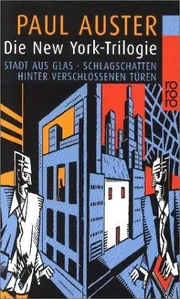
The New York Trilogy
by Paul Auster · 1987
Best suited to adult readers comfortable with ambiguity and philosophical puzzles.
364 pages, about 6 to 8.5 hours.
Three detective stories that quietly dismantle the detective story. 61% taste match
The story
The New York Trilogy is a work of psychological fiction by Paul Auster, first published in 1987. It gathers three linked novels that borrow the machinery of the detective story: a case, a trail to follow, a figure to be watched. The book sits in the mystery category, though it bends the conventions of that form into something of its own.
The novels are set in New York, and city life runs through all three. The opening scene is a telephone call in the dead of night, a wrong number that asks for someone the person answering is not, and it sets the chain of events in motion. From there, the act of following a man leads into questions of identity and what it means to be human. The book belongs to postwar American fiction and has appeared in around 70 editions, with a typical length of about 364 pages.
IT was a wrong number that started it, the telephone ringing three times in the dead of night, and the voice on the other end asking for someone he was not.
Setting
New York (N.Y.)New York (State)New YorkNowy Jork (Stany Zjednoczone)
Period
1945- ...
Themes
City and town lifeSocial life and customsIdentity (Psychology)Classic LiteratureMysteryLiteraturePs3551.u77 n49 1990813/.54
- Want to read 116
- Reading now 7
- Read 39
- Stopped 1
Most people shelving it are saving it for later.
Of 163 readers who put it on a shelf, 71% want to read it, 4% are reading it now, 24% have finished it and 1% stopped before the end.
By the numbers
- The median edition runs 364 pages. Counting about 275 words a page and an adult reading pace of 250 words a minute, that is about 6.7 hours of reading.
- Open Library tracks 70 editions from 48 publishers, the earliest dated 1987 and the latest 2021, across 12 languages.
- On reader demand it ranks in the top 6% of the modern books in our catalog (15,152 of them).
- Libraries shelve it under Dewey 813.54 and Library of Congress class PS-3551.00000000.U77.
 BookWard’s take
Three detective stories that quietly dismantle the detective story
Paul Auster takes the machinery of the detective novel, a case, a trail, a man to watch, and uses it to ask who anyone really is. It opens with a wrong number in the dead of night and never loosens its grip, so you are hooked from the first page. It is short and tight at 364 pages for three novels, and its logic stays strict even as the stories turn strange. What makes it interesting is how it handles the genre: it keeps the familiar furniture while refusing the usual payoffs. Expect a restrained, distinctive voice and a New York that feels both ordinary and uncanny. If you want your mysteries solved and tied off, this will frustrate you. If you like them dissolving into questions, it is a landmark.
Three linked novels fit into 364 pages, so it reads compact for its ambition, which suits BookWard's taste for the tight.
The trails move steadily without rushing, a little slower than BookWard's brisk preference.
Turning the detective story into an inquiry about identity makes it feel genuinely new, which BookWard rewards.
Plain, clean sentences carry the weight rather than ornament, leaning toward BookWard's middle ground.
Plot machinery drives events but the real interest is interior, so it balances toward plot slightly more than BookWard.
The tone is bleak and isolating, sitting lower than BookWard's mild optimism.
Three interlocked novels that undermine detective form make this notably experimental, above BookWard's usual range.
A serious, uneasy book with little comedy, below BookWard's lightly funny taste.
The unease and isolation give it a moderate darkness without graphic content.
Emotion is held at a cool, controlled distance.
See all 50 dialsEvery position, side by side with this book
Where it lines up
- OpeningBookWard 10 · book 10
- OriginalityBookWard 9 · book 9
- Authorial voiceBookWard 9 · book 9
Where it pulls apart
- Internal logicBookWard 10 · book 6
- EndingBookWard 8 · book 2
- Story or ideasBookWard 3 · book 7
Three linked novels fit into 364 pages, so it reads compact for its ambition, which suits BookWard's taste for the tight.
A wrong number in the dead of night starts the book immediately, exactly the instant hook BookWard likes.
It borrows detective conventions on purpose, then bends them away from the expected shapes, so it mostly avoids cliche.
The stories chase coincidence and identity rather than clean deduction, so the logic is deliberate but not airtight, short of BookWard's ideal.
The trails move steadily without rushing, a little slower than BookWard's brisk preference.
Turning the detective story into an inquiry about identity makes it feel genuinely new, which BookWard rewards.
Characters serve the investigation of selfhood more than they are fully fleshed out, below BookWard's preference for depth.
The stories lean toward open, unsettled conclusions rather than neat resolution, which pulls against BookWard's taste for closure.
Cool and unsentimental throughout, matching BookWard's liking for restraint.
Its unease is earned through ideas and tension rather than gratuitous shocks, which BookWard values.
This is fiction, so the rigor dial does not apply.
Auster's spare, controlled voice is unmistakable and distinctive, a strong match for BookWard.
The detective plots are vehicles for ideas about identity, so it leans idea-led, more than BookWard usually prefers.
Ideas surface through scenes and pursuit more than lectures, close to BookWard's preference for showing.
The compelling premise holds across three novels, with only minor slackening.
Plain, clean sentences carry the weight rather than ornament, leaning toward BookWard's middle ground.
Plot machinery drives events but the real interest is interior, so it balances toward plot slightly more than BookWard.
The tone is bleak and isolating, sitting lower than BookWard's mild optimism.
Three interlocked novels that undermine detective form make this notably experimental, above BookWard's usual range.
A serious, uneasy book with little comedy, below BookWard's lightly funny taste.
It asks the reader to follow slippery ideas about identity, moderately more demanding than BookWard usually likes.
Each novel stays close to a single central figure, fewer viewpoints than BookWard tends to enjoy.
Grounded in a real New York but drifting toward the uncanny, so it sits in the middle.
A small, focused set of figures drives each story.
The stakes are personal and psychological rather than epic.
Interior questions about self dominate over outward action, even as people follow each other through the city.
Talk matters but narration and pursuit carry more of the book.
Romance is not a focus of the stories.
New York is a familiar setting made strange.
Rooted in the postwar and 1980s city, not the present day.
Its questions about identity and the detective form have kept it in print across many editions.
Slippery storytelling and shifting identities make the narration hard to trust, matching BookWard's taste.
It offers questions rather than verdicts, leaving moral ground unclear, which BookWard enjoys.
Description serves mood and place in a spare, economical way.
This is fiction, so the nonfiction style dial does not apply.
This is fiction, so the nonfiction perspective dial does not apply.
Three linked novels share one volume, so it works as a connected set rather than a standalone.
Coincidence and reversal recur, though they unsettle more than they shock.
It deliberately unsettles expectations of the genre and the self, leaning toward challenge.
The unease and isolation give it a moderate darkness without graphic content.
Emotion is held at a cool, controlled distance.
Humor is dry and sparse when it appears.
Violence is minimal on the page.
Sexual content is minimal.
Politics stays in the background of the personal quest.
The language is clean and accessible with no heavy dialect.
The narration stays neutral and observational rather than preaching.
It dwells on the past and on identity rather than looking ahead.
The mood leans cynical and disillusioned about certainty and self.
Review written by BookWard, dial version 1, November 2026.
Who is The New York Trilogy right for?
Best suited to adult readers comfortable with ambiguity and philosophical puzzles. The tone is unsettling and isolating, though not graphic.
It asks the reader to follow slippery ideas about identity, moderately more demanding than BookWard usually likes.
The unease and isolation give it a moderate darkness without graphic content.
Emotion is held at a cool, controlled distance.
Violence is minimal on the page.
Book CompanionThe New York Trilogy: ideas, characters, themes
Using detective fiction's tools, the trilogy turns the act of following a man into a search for what identity means.
- A wrong number starts it. The book opens with a phone call in the dead of night asking for someone the answerer is not.
- Three linked novels. The volume gathers three interconnected novels that share a concern with watching and being watched.
- Detective form, bent. A case, a trail and a figure to watch are present, but the conventions are stretched into something new.
- New York as setting. City life runs through all three stories and shapes their atmosphere.
- Identity at the center. Pursuit becomes an investigation into selfhood and what it means to be human.
Themes
Who a person is, and whether that can be fixed or is always slipping.
Chance events that feel like meaning, or like its absence.
Surveillance as a way of understanding, or losing, oneself.
New York as a maze that both hides and exposes people.
What happens when detective conventions refuse to deliver answers.
Discussion questions
- How does the wrong-number opening set the tone for the rest of the book?
- What does following someone reveal about the follower?
- Did the lack of tidy resolution frustrate or satisfy you, and why?
- How does New York function as more than a backdrop?
- In what ways does the book honor and betray the detective genre?
Personalize your Book Companion
This is the general edition. In BookWard, the Companion is written for you: your reading profile, your notes, and spoiler-safe to the page you are on.
Buy, listen or borrow The New York Trilogy
Each link opens a search for this book on that store, in a new tab.
Read on a device
Borrow
Reviews and community
If you liked The New York Trilogy
A slim 1895 horror collection built around a play that ruins its readers
The Poems of Emily Dickinson Volume IIEmily DickinsonDickinson's second posthumous volume: compressed, strange, and unmistakably hers
The Virgin SuicidesJeffrey EugenidesA haunting chorus of boys circles five sisters they never knew
Uno, nessuno e centomilaLuigi PirandelloOne man unravels his own identity, one nose-tilt at a time
Sources: Open Library.
Track The New York Trilogy and find your next favorite
Add it to your shelf, rate what you have read, and BookWard will recommend what fits you.
Free to start. No credit card needed.