Best suited to mature teens and adults, and widely taught in American literature courses.
96 pages, about 1.5 to 2 hours.
Plath's last poems, tight, startling, and impossible to mistake for anyone else. 61% taste match
What is inside
Ariel is a collection of poems by Sylvia Plath, first published in 1965. It was her second book of poetry and appeared two years after her death in 1963. It belongs to American poetry and sits in the tradition of American literature. The poems mark a turn away from the work gathered in her earlier collection, The Colossus.
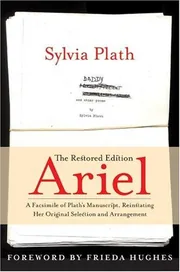
The volume exists in more than one form. The version first printed in the mid-1960s was edited by her husband, Ted Hughes, and differs from the draft Plath left behind at the time of her death. A later facsimile edition restores the selection and arrangement of the poems as she had set them. It reproduces the pages of her manuscript, includes the complete working drafts of the title poem, "Ariel," and presents notes she prepared for the BBC about some of the poems. The foreword is by Frieda Hughes, Plath's daughter, who explains why the earlier edition differs from her mother's original version. The book runs to about 96 pages and has appeared in 57 editions.
Characters
Sylvia Plath
Themes
American poetryPoetryTextual CriticismPoetry (poetic works by one author)American literaturePoésie américaine
- Want to read 160
- Reading now 6
- Read 26
Most people shelving it are saving it for later.
Of 192 readers who put it on a shelf, 83% want to read it, 3% are reading it now, 14% have finished it and 0% stopped before the end.
By the numbers
- The median edition runs 96 pages. Counting about 275 words a page and an adult reading pace of 250 words a minute, that is about 1.8 hours of reading.
- Open Library tracks 57 editions from 28 publishers, the earliest dated 1965 and the latest 2025, across 6 languages.
- On reader demand it ranks in the top 7% of the classic books in our catalog (8,749 of them).
- Libraries shelve it under Dewey 811.54 and Library of Congress class PS-3566.00000000.L27 A7 2004b.
 BookWard’s take
Plath's last poems, tight, startling, and impossible to mistake for anyone else
Ariel is a short book that does not waste a line. At about 96 pages it is tight, and that economy suits it. The voice is where it shines: these poems sound like no one else, with free-flowing images and menacing psychic landscapes that mark a clear break from The Colossus. The originality is striking too, and the work steers clear of tired poetic habits. Feeling runs hot here, yet the poems stay restrained rather than sentimental. They earn their darkness instead of chasing shock. The challenge is real, so this is not a comforting read. The restored edition adds a second layer: her own selection and arrangement, facsimile manuscript pages, and the working drafts of the title poem.
At about 96 pages it is compact, which fits BookWard's taste for short, tight books.
Short poems with a driving rhythm keep it moving quickly, close to BookWard's preferred speed.
The free-flowing images and menacing psychic landscapes were a dramatic turn from her earlier work, and BookWard prizes that freshness.
The language is heightened and richly figured, more ornate than BookWard's usual plain-leaning taste.
There is no plot to speak of; the drive comes from the speaker's inner life.
The collection is dominated by menace and despair, far from BookWard's mildly hopeful middle.
A collection of separate poems is looser than a novel, with the arrangement itself part of the story of the book.
The tone is overwhelmingly serious, with only occasional bitter edges.
Menacing psychic landscapes define the book, and it was published after her death by suicide.
The emotional temperature is very high throughout.
See all 50 dialsEvery position, side by side with this book
Where it lines up
- LengthBookWard 1 · book 1
- PaceBookWard 8 · book 8
- ExpositionBookWard 2 · book 2
Where it pulls apart
- Internal logicBookWard 10 · book 6
- EndingBookWard 8 · book 5
- Story or ideasBookWard 3 · book 6
At about 96 pages it is compact, which fits BookWard's taste for short, tight books.
Plath's poems tend to seize the reader within a few lines, which suits BookWard's love of fast openings.
Its imagery is strange and its own, steering clear of stock poetic phrases, which BookWard rewards.
Poetic logic runs on image and association rather than argument, so it is coherent but not airtight.
Short poems with a driving rhythm keep it moving quickly, close to BookWard's preferred speed.
The free-flowing images and menacing psychic landscapes were a dramatic turn from her earlier work, and BookWard prizes that freshness.
The speaker is drawn through intensity of feeling rather than a built-out character, so depth is real but compressed.
A poetry collection resolves poem by poem, with many closing on sharp notes rather than tidy conclusions.
The feeling is raw and controlled, never syrupy, which sits well with BookWard's preference for restraint.
The darkness comes from the poems' own pressure and craft rather than from effect for its own sake.
Rigor is a nonfiction dial and does not apply to a book of poems.
The voice is unmistakable, which is exactly the quality BookWard values most in an author.
Poems carry images and states of mind more than narrative, so it leans toward ideas over story.
Nothing is explained outright; meaning arrives through images and scenes, in line with BookWard's taste.
With short poems there is no middle to sag, and the intensity holds across the collection.
The language is heightened and richly figured, more ornate than BookWard's usual plain-leaning taste.
There is no plot to speak of; the drive comes from the speaker's inner life.
The collection is dominated by menace and despair, far from BookWard's mildly hopeful middle.
A collection of separate poems is looser than a novel, with the arrangement itself part of the story of the book.
The tone is overwhelmingly serious, with only occasional bitter edges.
The imagery rewards slow rereading, so it asks more of the reader than easy fiction.
A single speaking voice anchors the poems, so the viewpoint is essentially one.
Poems move through moments and memories rather than a sequenced plot, so time is mostly straightforward.
The imagery stretches reality into the surreal and mythic, though the settings stay rooted in lived experience.
Few figures appear beyond the speaker and the people she addresses.
The focus is intimate, on one mind and its pressures.
The action happens inside the speaker's thoughts and perceptions.
Spoken exchanges are almost absent; poems rely on address and image.
Relationships appear as part of the emotional landscape but are not the organising subject.
The settings are mostly recognisable domestic and natural scenes, rendered strange by the language.
Written in the early 1960s, it belongs to a past era, though its feeling travels easily.
Decades on, these poems are still read and taught, and they have not dated in force.
The speaker's perceptions are shaped by extreme states of mind, so they cannot be taken entirely at face value.
The poems rarely settle into clear judgments; they hold conflicting feelings together.
Vivid, dense imagery is the engine of nearly every poem.
These are intensely personal poems, spoken from inside the experience.
A standalone collection, though it follows her earlier book, The Colossus.
Surprise comes at the level of image and turn of phrase, not plot reversals.
The material is unsettling and does not offer comfort.
Menacing psychic landscapes define the book, and it was published after her death by suicide.
The emotional temperature is very high throughout.
Any humor is dry and sharp, not broad.
Violence appears mostly in imagery and metaphor rather than described action.
Politics sits in the background rather than at the center.
The language is dense and compressed, though not dialect-heavy.
The speaker's voice is forceful and unmistakably her own.
The mood leans cynical and despairing rather than idealistic.
Review written by BookWard, dial version 1, November 2026.
Who is Ariel right for?
Best suited to mature teens and adults, and widely taught in American literature courses. It deals with dark emotional states and is shadowed by the author's death by suicide, so readers in a fragile place may want to approach it with care.
The imagery rewards slow rereading, so it asks more of the reader than easy fiction.
Menacing psychic landscapes define the book, and it was published after her death by suicide.
The emotional temperature is very high throughout.
Violence appears mostly in imagery and metaphor rather than described action.
Book CompanionAriel: ideas, characters, themes
Ariel gathers Plath's late poems, charged with free-flowing images and menacing psychic landscapes, and the restored edition shows the book as she arranged it.
- Her second collection. Ariel is Sylvia Plath's second book of poetry, following The Colossus.
- Published after her death. It first appeared in 1965, two years after her death in 1963.
- A turn from The Colossus. The poems mark a dramatic shift from the work in her earlier collection.
- Two versions exist. The first printed edition was edited by Ted Hughes and differs from the draft Plath left behind.
- The restored edition. A facsimile edition restores her own selection and arrangement, with manuscript pages, drafts of the title poem, and BBC notes.
Themes
The poems dwell in the speaker's most intense states of mind.
Ordinary scenes turn threatening through striking, unsettling imagery.
The restored edition raises the question of whose arrangement defines a book.
The working drafts of the title poem show how a poem gets made.
Discussion questions
- How does the free-flowing imagery change what the poems make you feel?
- What do you gain from reading the book in the arrangement Plath left?
- How do these poems differ in tone and force from what you might expect of earlier work?
- Which poem's opening grabbed you fastest, and why?
- Does knowing the circumstances of its publication shape how you read it?
Personalize your Book Companion
This is the general edition. In BookWard, the Companion is written for you: your reading profile, your notes, and spoiler-safe to the page you are on.
Buy, listen or borrow Ariel
Each link opens a search for this book on that store, in a new tab.
Read on a device
Borrow
Reviews and community
If you liked Ariel
A thirty-four page descent that still unsettles, over a century on
The Virgin SuicidesJeffrey EugenidesA haunting chorus of boys circles five sisters they never knew
WintergirlsLaurie Halse AndersonA short, raw novel of hunger and haunting
Les fleurs du malCharles BaudelaireBaudelaire's scandalous, tightly built verse collection that founded modern poetry
Sources: Open Library.
Track Ariel and find your next favorite
Add it to your shelf, rate what you have read, and BookWard will recommend what fits you.
Free to start. No credit card needed.