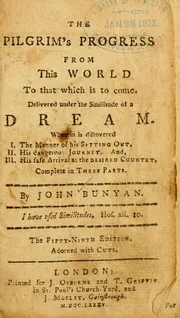
The Pilgrim's Progress
by John Bunyan · 1678
Suits older teens and adults, and can be read aloud to younger readers with help on the older language.
308 pages, about 5 to 7 hours.
Bunyan's dreamed road to the heavenly city, still walking. 47% taste match
What it covers
John Bunyan's The Pilgrim's Progress, first published in 1678, is a Christian allegory that treats the ordinary world as a picture of the soul's journey toward God. It opens with a narrator walking through the wilderness of the world who lies down in a den to sleep and dreams. The dreamer follows a hero named Christian, whose road leads through the Valley of the Shadow of Death, Vanity Fair, and Doubting Castle, past the Wicket Gate, and into the company of figures such as Talkative, Mr. Worldly Wiseman, and the Giant Despair. His journey ends at Beulah Land, where he waits to cross the river of death and enter the heavenly city.
Bunyan was an English nonconformist preacher, and the book belongs to Protestant devotional writing of the early modern period. It spread quickly beyond England, appearing in Dutch and in a North American edition in 1681, then in German in 1703 and Swedish in 1727, and it has since been translated into more than 200 languages. It is also often cited as an early English novel. This edition runs to around 308 pages in its median form.
AS I WALKED through the wilderness of this world, I lighted on a certain place where was a den, and laid me down in that place to sleep; and as I slept, I dreamed a dream.
Setting
England
Period
Early modern, 1500-17001800-1870
Themes
BibliographyReadersSpiritual lifeChurch of EnglandChristian biographyGerman languageAneityumese languageCree (Langue)
- Want to read 380
- Reading now 30
- Read 36
Most people shelving it are saving it for later.
Of 446 readers who put it on a shelf, 85% want to read it, 7% are reading it now, 8% have finished it and 0% stopped before the end.
By the numbers
- The median edition runs 308 pages. Counting about 275 words a page and an adult reading pace of 250 words a minute, that is about 5.6 hours of reading.
- Open Library tracks 683 editions from 477 publishers, the earliest dated 1678 and the latest 2021, across 32 languages.
- On reader demand it ranks in the top 3% of the classic books in our catalog (8,749 of them).
- Libraries shelve it under Dewey 828.42 and Library of Congress class PR-3330.00000000.A1 1900a.
 BookWard’s take
Bunyan's dreamed road to the heavenly city, still walking
Bunyan's 1678 allegory turns the ordinary world into a map of the soul, and it does so with unusual clarity. The opening hooks at once: a dreamer, a den in the wilderness, a man named Christian setting out. It is hardly a book of subtle suggestion, since the meaning is stated outright rather than left to emerge from scenes. Yet the voice is unmistakable, plain English delivered with a preacher's directness. Ideas drive the whole thing, and the moral picture is strikingly clear, with little ambiguity about right and wrong. The set pieces, Vanity Fair, Doubting Castle, the Valley of the Shadow of Death, still stick in the mind. Read it for its lasting influence and its confident, concrete imagery rather than for nuanced character work.
At around 308 pages it is moderate in size, longer than BookWard's short-and-tight preference but never sprawling.
Episodes move briskly from place to place, though long speeches and theological exchanges slow it at points.
Original in its day and an ancestor of the English novel, though its allegorical method is now familiar.
The language is plain and direct, with biblical rhythm, rather than ornate.
The journey and its set-piece stations drive the book far more than any inner change in Christian.
The whole road points toward salvation, and the arrival at Beulah Land closes on hope despite real dangers.
A dream frame around a linear pilgrimage is a simple, conventional shape.
It is earnest throughout, with only occasional sharp irony in figures like Talkative.
Despair, death, and temptation are real presences, though the tone stays guided and ultimately redemptive.
Christian's fear, burden, and joy are felt strongly, if expressed in plain terms.
See all 50 dialsEvery position, side by side with this book
Where it lines up
- EndingBookWard 8 · book 8
- Authorial voiceBookWard 9 · book 9
- OpeningBookWard 10 · book 8
Where it pulls apart
- Familiar tropesBookWard 10 · book 5
- ExpositionBookWard 2 · book 9
- Story or ideasBookWard 3 · book 9
At around 308 pages it is moderate in size, longer than BookWard's short-and-tight preference but never sprawling.
A dreamer lying down in a den and a man setting out on a journey gets the story moving immediately.
It created many images later writers borrowed, though its allegorical figures are now familiar, so it feels well-worn by modern standards.
Each obstacle and companion stands for a clear spiritual idea, and the journey follows a consistent, orderly path that BookWard values.
Episodes move briskly from place to place, though long speeches and theological exchanges slow it at points.
Original in its day and an ancestor of the English novel, though its allegorical method is now familiar.
Characters are named for their traits, such as Talkative and Giant Despair, so they function as types rather than deeply drawn people.
Christian reaches Beulah Land and the threshold of the heavenly city, a destination the whole book has been building toward.
It is openly devotional and warm, but its images are stark and concrete rather than syrupy.
Its darker stretches, such as Doubting Castle and the Valley of the Shadow of Death, serve the spiritual argument rather than shock.
It is an allegory, so it works through imagery rather than evidence, though its structure is carefully built.
Bunyan's plain, urgent preacher's voice is unmistakable and sets it apart from generic devotional writing.
Every place and person exists to carry a spiritual idea, which puts it well toward the idea-led end, away from BookWard's story-led lean.
Meanings are spelled out outright through names and speeches, the opposite of BookWard's preference for showing in scene.
The episodic road keeps introducing new places and figures, though some discussion-heavy stretches loosen the grip.
The language is plain and direct, with biblical rhythm, rather than ornate.
The journey and its set-piece stations drive the book far more than any inner change in Christian.
The whole road points toward salvation, and the arrival at Beulah Land closes on hope despite real dangers.
A dream frame around a linear pilgrimage is a simple, conventional shape.
It is earnest throughout, with only occasional sharp irony in figures like Talkative.
The plot is easy to follow, but the older English and scriptural references take some effort.
Everything is seen through the dreamer's single watching eye, following Christian.
The journey proceeds in order from start to end.
Giants, castles named for despair, and allegorical towns make a dream world far from realism.
A long procession of named figures meets Christian along the way, though each appears briefly.
It carries a whole life and the afterlife's threshold, though told through a single traveler on one road.
The spiritual struggle is dramatized as outward encounters and places rather than private thought.
Much of the book is conversation between Christian and those he meets, often long and doctrinal.
Romance plays essentially no part in this spiritual journey.
Its allegorical landscape is unlike any real place, though its roots in common experience keep it readable.
It is a seventeenth-century work and reads as one.
Never out of print and translated into more than 200 languages, its images still circulate in everyday speech.
The dreamer simply reports what he sees and is plainly reliable.
Right and wrong are labelled by name and outcome, leaving almost no moral ambiguity, which sits opposite BookWard's taste.
Places like Vanity Fair and Doubting Castle are vivid, but described briefly and functionally.
Though shelved as nonfiction, it reads as narrative, a story told through a dream.
It is intimate in its concern with one soul's fate, and the narrator is close to the action.
The route is signposted by its allegory, so the dangers are expected rather than surprising.
It challenges the reader's conscience and beliefs, even where the story itself is simple.
Despair, death, and temptation are real presences, though the tone stays guided and ultimately redemptive.
Christian's fear, burden, and joy are felt strongly, if expressed in plain terms.
Any humor is dry and satirical, aimed at worldliness.
Violence is present in places like Vanity Fair, but kept brief and symbolic.
Sexual content is essentially absent.
Church and worldly power appear mainly as spiritual matters, with no program pushed.
Seventeenth-century English and biblical phrasing give moderate density.
Bunyan's convictions run through every page and the narration pushes plainly toward one conclusion.
The whole book faces forward, toward the heavenly city.
It holds firmly to a hopeful belief in salvation and moral progress.
Review written by BookWard, dial version 1, November 2026.
Who is The Pilgrim's Progress right for?
Suits older teens and adults, and can be read aloud to younger readers with help on the older language. It is openly Christian devotional writing, with themes of death, despair, and judgment.
The plot is easy to follow, but the older English and scriptural references take some effort.
Despair, death, and temptation are real presences, though the tone stays guided and ultimately redemptive.
Christian's fear, burden, and joy are felt strongly, if expressed in plain terms.
Violence is present in places like Vanity Fair, but kept brief and symbolic.
Book CompanionThe Pilgrim's Progress: ideas, characters, themes
A man's journey from the City of Destruction to the heavenly city serves as a vivid picture of the soul's path toward God.
- The dream frame. The narrator lies down in a den in the wilderness of the world and dreams the whole journey.
- Places as ideas. Locations such as Vanity Fair, Doubting Castle, and the Valley of the Shadow of Death stand for spiritual trials.
- Named figures. Characters like Talkative, Mr. Worldly Wiseman, and the Giant Despair embody the temptations Christian meets.
- The destination. The road ends at Beulah Land, where Christian awaits the crossing of the river of death into the heavenly city.
- A lasting influence. A Protestant devotional landmark, it is often cited as an ancestor of the English novel.
Characters
Christian
The pilgrim
The hero whose road runs through trials toward the heavenly city.
Talkative
A tempter off the path
One of the figures who tests Christian's journey.
Mr. Worldly Wiseman
A tempter off the path
A figure who draws Christian away from the true road.
Giant Despair
An obstacle
The figure associated with Doubting Castle.
Themes
Life understood as a road toward God, with stages and obstacles.
Figures and places that pull the traveler from the right path.
The inner struggles given physical form as castles, giants, and valleys.
The pull of comfort and appearances, shown in Vanity Fair.
The river of death and the heavenly city as the journey's end.
Discussion questions
- Why might Bunyan choose allegory rather than a straightforward sermon?
- Which obstacle on the road feels most true to ordinary life, and why?
- How does naming characters for a single trait help or limit them?
- What does Vanity Fair suggest about the pull of worldly things?
- Why has this book stayed in print and been translated into so many languages?
Personalize your Book Companion
This is the general edition. In BookWard, the Companion is written for you: your reading profile, your notes, and spoiler-safe to the page you are on.
Buy, listen or borrow The Pilgrim's Progress
Each link opens a search for this book on that store, in a new tab.
Read on a device
Borrow
Reviews and community
If you liked The Pilgrim's Progress
A quest through Narnia that rewards the sharp-eyed and the stubborn
Autobiography of a YogiYogananda ParamahansaA sprawling spiritual memoir that opened yoga to the West
The Greatest Salesman in the WorldOg MandinoA short parable that turns selling into a philosophy of living
Tunnel in the skyRobert A. HeinleinHeinlein strands a class of students and watches society form
Sources: Open Library.
Track The Pilgrim's Progress and find your next favorite
Add it to your shelf, rate what you have read, and BookWard will recommend what fits you.
Free to start. No credit card needed.