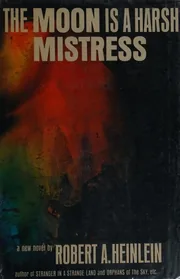
The moon is a harsh mistress
by Robert A. Heinlein · 1965
Best suited to older teens and adults who enjoy political and technical ideas in their fiction.
332 pages, about 5.5 to 7.5 hours.
A lunar revolution told in a voice you won't forget. 59% taste match
The story
The Moon Is a Harsh Mistress is a science fiction novel by Robert A. Heinlein, first published in 1965. It is set in 2078, when the Moon serves as a penal colony governed from Earth by the Federated Nations through its Lunar Authority. Much of the action takes place in Luna City and in Hong Kong Luna, and the story is told in the voice of a resident of the colony who follows the local news and city politics.
The book follows a small group of conspirators: a computer technician, a self-aware computer, a professor with anarchist views, and a young revolutionary. Together they set out to overthrow the authority that rules their world. The novel belongs to the tradition of stories about revolutions and imaginary wars, and it takes up artificial intelligence as part of its plot. It won the Hugo Award for best novel in 1967. The edition in circulation runs to roughly 332 pages, and the book has appeared in 53 editions. Readers looking for American science fiction about life in a lunar colony and the conflict between its settlers and Earth's government will find that subject at the center of this one.
I see in Lunaya Pravda that Luna City Council has passed on first reading a bill to examine, license, inspect-and tax-public food vendors operating inside municipal pressure.
Setting
MoonLuna CityChadHong Kong Luna
Period
2078
Themes
Imaginary wars and battlesPenal coloniesRevolutionsArtificial intelligenceLong Now Manual for Civilization
- Want to read 344
- Reading now 12
- Read 117
Most people shelving it are saving it for later.
Of 473 readers who put it on a shelf, 73% want to read it, 3% are reading it now, 25% have finished it and 0% stopped before the end.
By the numbers
- The median edition runs 332 pages. Counting about 275 words a page and an adult reading pace of 250 words a minute, that is about 6.1 hours of reading.
- Open Library tracks 53 editions from 34 publishers, the earliest dated 1965 and the latest 2018, across 6 languages.
- On reader demand it ranks in the top 2% of the classic books in our catalog (8,749 of them).
- Libraries shelve it under Dewey 813.54 and Library of Congress class PS-3515.00000000.E288.
 BookWard’s take
A lunar revolution told in a voice you won't forget
Heinlein sets a prison-colony revolt on the Moon in 2078 and lets a resident of the colony tell it in his own distinctive idiom. That voice is the book's signature, and it gives the novel a quick, confident start and one of the strongest narrative personalities you'll find in the genre. It is driven more by ideas than by story, with politics and the logic of revolution front and center, and the internal logic is tight because the conspiracy is planned like an engineering problem. The pace is brisk for a 332-page novel, and the cast stays small and memorable: a technician, a professor, a young agitator and a self-aware computer. The ending is largely resolved. The mix of dry wit and argument suits readers who like their science fiction smart and talkative.
At 332 pages it is mid-length, a little longer than BookWard's love of tight books, but it keeps moving.
Events move at a steady clip with plenty of talk and planning, close to BookWard's preferred speed.
A sentient computer and a lunar penal colony were fresh when published, and the combination still reads as inventive.
The prose is plain and conversational by design, near BookWard's slightly unadorned leaning.
The revolution's plot leads, with characters serving the cause, more plot-driven than BookWard's usual taste.
One narrator tells the story in order, a conventional shape that is less adventurous than BookWard likes.
Wry asides and sardonic remarks lighten a serious subject, giving a dry streak that BookWard enjoys.
Rebellion carries real danger, yet the tone stays wry rather than grim.
Feeling runs through loyalty and loss, but it is expressed with restraint, a reasonable fit for BookWard.
See all 50 dialsEvery position, side by side with this book
Where it lines up
- Internal logicBookWard 10 · book 9
- PaceBookWard 8 · book 7
- EndingBookWard 8 · book 7
Where it pulls apart
- Familiar tropesBookWard 10 · book 6
- Story or ideasBookWard 3 · book 8
- ExpositionBookWard 2 · book 7
At 332 pages it is mid-length, a little longer than BookWard's love of tight books, but it keeps moving.
The narrator's colloquial voice and the colony premise pull you in fast, which suits BookWard's taste for immediate hooks.
Revolution stories are well-worn ground, but the lunar setting and the sentient computer freshen it more than BookWard usually demands.
The conspiracy is worked out step by step with practical, technical reasoning, a strong match for BookWard's love of airtight plotting.
Events move at a steady clip with plenty of talk and planning, close to BookWard's preferred speed.
A sentient computer and a lunar penal colony were fresh when published, and the combination still reads as inventive.
The central group is sharply sketched and vivid, though ideas often matter more than inner lives.
The revolution reaches a clear outcome rather than drifting, which fits BookWard's liking for resolved endings.
Warmth shows up in the friendships, but the tone stays more practical than tearful, a fair fit for BookWard.
Darker turns come from the logic of rebellion rather than from gratuitous jolts, which BookWard rewards.
The politics and technical speculation are argued with care, though this is fiction rather than a rigorous study.
The narrator's invented lunar idiom is unmistakable and carries the whole book, exactly what BookWard prizes.
Political philosophy and the mechanics of revolution drive much of the book, more idea-led than BookWard usually likes.
Characters often explain systems and arguments outright, leaning more explanatory than BookWard's preference for showing.
The planning stretches in the middle can feel talky, but the stakes keep the momentum largely intact.
The prose is plain and conversational by design, near BookWard's slightly unadorned leaning.
The revolution's plot leads, with characters serving the cause, more plot-driven than BookWard's usual taste.
One narrator tells the story in order, a conventional shape that is less adventurous than BookWard likes.
Wry asides and sardonic remarks lighten a serious subject, giving a dry streak that BookWard enjoys.
The idiom and the political talk ask for some attention, but the story stays accessible.
A single narrator tells everything, narrower than BookWard's taste for many viewpoints.
Events unfold in a straight line, simpler than BookWard's comfort with shifting time.
A sentient computer and a lunar colony stretch reality, though the technology is treated with plausible detail.
The core conspirators form a small, memorable group, matching BookWard's comfort with compact casts.
A whole world is at stake, giving the story real breadth for a book with such a tight circle of leads.
Planning, speeches and action dominate over private reflection, leaning outward more than BookWard's balance.
Talk drives the book, with debates, plans and banter filling many pages, which BookWard enjoys.
Personal bonds appear, but the revolution remains the main concern.
A colonized Moon with its own customs and politics feels richly unfamiliar, a good match for BookWard.
Set in 2078, it is a distant-future story rather than a present-day one.
Its questions of freedom and authority keep it relevant long after 1965, a quality BookWard values.
The narrator tells his story plainly and can be taken at his word, more reliable than BookWard's preference.
The book argues for freedom while letting the costs of rebellion complicate easy answers.
Setting is given through practical detail and voice more than lush description, sparser than BookWard's lean.
It stands on its own as a single complete novel, matching BookWard's standalone-friendly stance.
Plans go awry and fortunes shift, though the book is more about method than shocks.
It pushes political ideas hard and invites argument, a challenge BookWard welcomes.
Rebellion carries real danger, yet the tone stays wry rather than grim.
Feeling runs through loyalty and loss, but it is expressed with restraint, a reasonable fit for BookWard.
The humor is dry and sardonic, on the quieter side of the scale.
Conflict and fighting appear as part of a revolution, but they are not lingered over.
Relationships and unconventional social arrangements appear, though not as a focus.
Politics is the engine of the book, front and center from first page to last.
The narrator's invented lunar speech takes adjusting to, though it becomes natural quickly.
The narration carries strong views about government and liberty, more opinionated than BookWard's usual taste.
It imagines a future shaped by new political and technological choices, looking forward.
It champions individual freedom and the belief that people can remake their world, leaning idealistic.
Review written by BookWard, dial version 1, November 2026.
Who is The moon is a harsh mistress right for?
Best suited to older teens and adults who enjoy political and technical ideas in their fiction. It includes revolutionary conflict and unconventional social arrangements that some readers may want to be aware of.
The idiom and the political talk ask for some attention, but the story stays accessible.
Rebellion carries real danger, yet the tone stays wry rather than grim.
Feeling runs through loyalty and loss, but it is expressed with restraint, a reasonable fit for BookWard.
Conflict and fighting appear as part of a revolution, but they are not lingered over.
Book CompanionThe moon is a harsh mistress: ideas, characters, themes
A lunar penal colony, a sentient computer and a small band of conspirators challenge the Earth authority that rules them.
- A colony ruled from Earth. In 2078 the Moon serves as a penal colony governed by the Federated Nations through its Lunar Authority.
- An unlikely band. A computer technician, a professor with anarchist views, a young revolutionary and a self-aware computer join forces.
- A distinctive narrator. The story is told in the voice of a colony resident who follows local news and city politics.
- Planning a revolution. The conspirators approach rebellion as a problem to be organized and solved.
- Prize-winning status. The novel won the Hugo Award for best novel in 1967 and is often named among Heinlein's finest.
Characters
Mike
Self-aware supercomputer
A sentient machine whose awareness is known only to the inner circle and who commits to the revolution's success.
The computer technician
Narrator and conspirator
A resident of the colony who tells the story and joins the plot.
The professor
Anarchist conspirator
An elderly academic with anarchist views who helps lead the rebel movement.
The young revolutionary
Agitator
A vigorous young woman who works to rouse the colony against its rulers.
Themes
The book argues for individual liberty against distant, controlling authority.
It examines how a rebellion is planned, organized and carried out.
A sentient computer raises questions about mind, loyalty and what counts as a person.
It questions who has the right to rule and how rulers justify control.
There is no free lunch, and freedom demands sacrifice from everyone who seeks it.
Discussion questions
- Why do you think Heinlein chose a first-person narrator with such a distinctive way of speaking?
- Is the revolution portrayed as justified, and does the book let you question that?
- What does Mike's sentience add to the story beyond being a useful tool for the plot?
- How does the idea that nothing is free apply to the choices the conspirators make?
- Which political ideas in the book feel dated, and which still feel relevant today?
Personalize your Book Companion
This is the general edition. In BookWard, the Companion is written for you: your reading profile, your notes, and spoiler-safe to the page you are on.
Buy, listen or borrow The moon is a harsh mistress
Each link opens a search for this book on that store, in a new tab.
Read on a device
Borrow
Reviews and community
If you liked The moon is a harsh mistress
Heinlein strands a class of students and watches society form
The Day of the TriffidsJohn WyndhamA quiet-voiced catastrophe where the walking plants are the lesser danger
Fahrenheit 451Ray BradburyA short, fierce warning about a world that burns its books
The player of gamesIain BanksA bored game master walks into an empire built on one game
Sources: Open Library.
Track The moon is a harsh mistress and find your next favorite
Add it to your shelf, rate what you have read, and BookWard will recommend what fits you.
Free to start. No credit card needed.