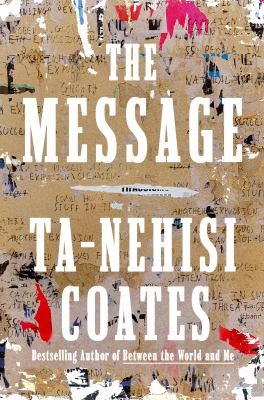
The Message
by Ta-Nehisi Coates
Ta-Nehisi Coates blends memoir, travelogue and a guide to writing, reflecting on visits to Senegal, South Carolina and the West Bank. The latter half argues that moral clarity should outweigh endless factual complexity regarding Israel-Palestine.
Best for: Readers who want a personal, argumentative nonfiction work on morality and writing
The Message ranked #15 on BookWard's Best Books of 2024 when we last measured it, in October 2026.
What The Message is about
Part memoir, part travelogue, and part lesson in writing, the book draws on his visits to Dakar in Senegal, to Chapin in South Carolina, and to the West Bank and East Jerusalem. The second half centres on a ten-day trip to Israel and Palestine in the summer of 2023, his first time in the region. There he argues against putting factual complexity above plain moral judgment, and he makes the case that the occupation is a moral wrong the West has largely hidden from itself. He also writes of racism he found there, stranger and more intense than he had felt elsewhere. It is a nonfiction book that the Associated Press described as "part memoir, part travelogue, and part writing primer", reflecting on Coates's visits to Dakar, Chapin, and the West Bank and East Jerusalem, and including his argument that the Israeli occupation is a moral crime.
The Message on the Best Books of 2024
The Message came out in 2024. When we last measured it, in October 2026, it ranked #15 on our Best Books of 2024 list. It is not among the top books of 2024 on this month’s list, and the numbers on this page are the latest we have.
The numbers behind it
- Readers: 24 want to read it, 0 are reading it now and 9 have read it, according to Open Library.
- Wikipedia: its article averaged 2,947 views a month recently.
| Signal | This book (0 to 100) | Weight |
|---|---|---|
| Reach | 79 | 45% |
| Reader love | 85 | 20% |
| Being read right now | 45 | 15% |
| Attention | 39 | 20% |
Questions about The Message
When was The Message published?
The Message by Ta-Nehisi Coates was first published in 2024.
Was The Message one of the best books of 2024?
The Message ranked #15 on BookWard's Best Books of 2024 when we last measured it, in October 2026. 300 readers have shelved it on Open Library; its Wikipedia page averaged 2,947 views a month recently.
Why is The Message on the Best Books of 2024 list?
300 readers have shelved it on Open Library; its Wikipedia page averaged 2,947 views a month recently.
More of the best books of 2024
- Wind and Truth Brandon Sanderson, #1
- The Let Them Theory Mel Robbins, #2
- The Tainted Cup Robert Jackson Bennett, #3
- Lights Out Navessa Allen, #4
- The Women Kristin Hannah, #5
- Funny Story Emily Henry, #6
See the full Best Books of 2024, the Top 100, or new books on Rising.
How we know
This page uses public data: Open Library reader counts and ratings, and Wikipedia page views for recent years. The description is paraphrased from real source text. Rankings reflect reading interest, not quality or sales, and can be affected by data gaps. Lists update monthly.
Suits mature teens and adults interested in politics, memoir and the craft of writing.
Depends on the edition you pick.
Coates on writing, witness, and a ten-day trip to Israel-Palestine. 52% taste match
 BookWard’s take
Coates on writing, witness, and a ten-day trip to Israel-Palestine
Ta-Nehisi Coates's 2024 book moves between Dakar, a South Carolina town and the West Bank and East Jerusalem, and works as memoir, travelogue and a primer on writing. The second half turns to his first visit to Israel-Palestine and makes a plain moral argument against the Israeli occupation. The voice is unmistakable, personal and distinctive from the first pages. The book is also openly political: it argues its case and never pretends to be neutral. Rigor is the real question. This is closer to reported witness than to a studied survey, so readers who prize painstaking rigor will find that expectation tested, even as the voice earns their attention.
A compact work built from a few trips and essays, closer to tight than sprawling, which suits BookWard.
Brisk movement between places keeps it going, though it is reflective rather than propulsive.
The blend of memoir, travelogue and writing primer is a fresh shape, even with a well-known argument inside it.
The prose is lyrical and deliberate, richer than BookWard's plainer middle.
It follows one writer's perception and growth, far more than any plot.
The tone is sober and morally heavy, with little consolation offered.
Three places and a writing thread braid the book, a modest departure from conventional chronology.
This is a serious book with almost no comic register.
It deals with occupation, racism and injustice, though without lingering on cruelty for its own sake.
Moral urgency gives it real intensity, held in check by control of tone.
See all 50 dialsEvery position, side by side with this book
Where it lines up
- SentimentBookWard 8 · book 7
- Shock for effectBookWard 9 · book 8
- Authorial voiceBookWard 9 · book 10
Where it pulls apart
- Story or ideasBookWard 3 · book 8
- OpeningBookWard 10 · book 7
- Internal logicBookWard 10 · book 7
A compact work built from a few trips and essays, closer to tight than sprawling, which suits BookWard.
It opens through the writer's own voice and stakes, though it builds by reflection more than by an immediate grab.
It resists boilerplate takes on its subjects, though the moral frame will be familiar to readers of the surrounding debate.
It argues from personal witness to a clear conclusion, a coherent line even where evidence is lived experience rather than data.
Brisk movement between places keeps it going, though it is reflective rather than propulsive.
The blend of memoir, travelogue and writing primer is a fresh shape, even with a well-known argument inside it.
The author is drawn with real depth and candor, while the people he meets are rendered more briefly.
It builds to a stated moral conclusion rather than leaving its position open, which BookWard values.
Feeling is present but disciplined, delivered through observation instead of sentimental appeal.
Its hardest moments come from what he sees and states plainly, not from provocation for effect.
It is anchored in reported experience over ten days rather than systematic study, so it sits mid-scale against BookWard's high bar.
Coates writes in a distinctive, unmistakable register, exactly the kind of voice BookWard prizes.
The argument drives the book, with scenes serving the ideas, which is idea-led where BookWard leans story-led.
It states its moral case outright in places, more explained than dramatized, against BookWard's preference for scene.
Its short span and clear arc keep attention steady from the first trip to the last.
The prose is lyrical and deliberate, richer than BookWard's plainer middle.
It follows one writer's perception and growth, far more than any plot.
The tone is sober and morally heavy, with little consolation offered.
Three places and a writing thread braid the book, a modest departure from conventional chronology.
This is a serious book with almost no comic register.
It asks for patience and openness to hard moral argument, a step above easy reading.
One author's lens dominates, with other voices appearing as encounters rather than parallel narrators.
It moves from place to place without strict sequence, though anchored by a recent trip.
Entirely grounded in real places and events.
The focus stays on the author and a handful of encounters in each place.
Personal in method but concerned with a large moral and political question.
Reflection and interpretation outweigh action, with travel as the occasion for thought.
Scenes include some conversation, but the book runs mostly on narration and argument.
Romance plays no part.
Its places will be unfamiliar to many readers, from Dakar to the West Bank.
Set in the present, anchored in a summer 2023 trip and a 2024 publication.
Tied to a specific political moment, though its writing reflections may outlast it.
The author speaks in the first person and his stance is stated, never concealed.
It argues for self-evident morality over factual complexity, which makes its position very clear.
Places are rendered richly through the traveler's eye.
Scene, travel and memoir carry the argument more than formal analysis does.
Wholly first-person, grounded in the author's own experience and feeling.
A standalone book.
It argues and observes rather than springing surprises.
It confronts the reader and expects to be argued with.
It deals with occupation, racism and injustice, though without lingering on cruelty for its own sake.
Moral urgency gives it real intensity, held in check by control of tone.
Humor is nearly absent and what exists is dry.
Violence is acknowledged as context but is not dwelt on page by page.
Sexual content is not a feature.
Politics is the central subject, argued openly and without apology.
The language is clear and literate, with no dialect barrier.
The narration takes a strong, explicit stand throughout.
It looks at present conditions and what the West has overlooked, with a gaze that is partly forward.
It holds a moral standard firmly, an idealism that stays clear-eyed about injustice.
Review written by BookWard, dial version 1, November 2026.
Who is The Message right for?
Suits mature teens and adults interested in politics, memoir and the craft of writing. It discusses racism, occupation and violence in the context of a contested political subject.
It asks for patience and openness to hard moral argument, a step above easy reading.
It deals with occupation, racism and injustice, though without lingering on cruelty for its own sake.
Moral urgency gives it real intensity, held in check by control of tone.
Violence is acknowledged as context but is not dwelt on page by page.
Book CompanionThe Message: ideas, characters, themes
Coates argues that writers must tell the truth plainly and that moral clarity should not be buried under factual complexity, especially on the Israeli occupation.
- A hybrid form. The book blends memoir, travelogue and a primer on writing, as the Associated Press described it.
- Dakar. One strand of the book reflects on his visit to Dakar, Senegal.
- Chapin, South Carolina. Another strand centers on a visit to Chapin, South Carolina.
- The West Bank and East Jerusalem. The latter half covers a ten-day trip in summer 2023, his first time in Israel-Palestine.
- Morality over complexity. He argues against elevating factual complexity over self-evident morality.
Themes
The claim that some wrongs are self-evident and should be named.
The weight of seeing a place firsthand and reporting what you saw.
How a writer chooses honesty, voice and responsibility.
How power and prejudice shape life under the occupation.
How stories get told, or covered up, in the West.
Discussion questions
- Is moral clarity compatible with factual complexity, or does one threaten the other?
- How does a first visit shape what a writer is able to claim?
- What does the writing-primer thread add to the political argument?
- How do the Dakar and Chapin sections prepare the reader for the second half?
- What responsibilities does a writer with a large platform carry?
Personalize your Book Companion
This is the general edition. In BookWard, the Companion is written for you: your reading profile, your notes, and spoiler-safe to the page you are on.
Buy, listen or borrow The Message
Each link opens a search for this book on that store, in a new tab.
Read on a device
Borrow
Reviews and community
If you liked The Message
A meditation on Blackness, told through one color
Notes of a Native SonJames BaldwinBaldwin's first essays: personal, exacting, and still sharp
Permanent RecordEdward SnowdenA whistleblower's memoir that explains the machine he helped build
Is a River Alive?Robert MacfarlaneA lyrical argument that rivers deserve to be treated as living beings
Find your own best books
Add what you have read, rate it, and BookWard will recommend what to read next.
Free to start. No credit card needed.