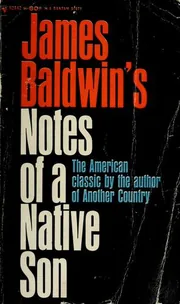
Notes of a Native Son
by James Baldwin · 1955
Suited to mature teens and adults, and often read in school and university courses.
175 pages, about 3 to 4 hours.
Baldwin's first essays: personal, exacting, and still sharp. 60% taste match
What it covers
Notes of a Native Son is a collection of ten essays by James Baldwin, issued in 1955 as his first book of nonfiction. Baldwin, who lived from 1924 to 1987, wrote the pieces as an African American author looking at race and identity, drawing on the Black experience in the United States and in Europe.
The essays range across several subjects, among them daily life in Harlem, the protest novel, film, and the situation of African Americans living overseas. Placed within the history of American race relations and the civil rights era, the book deals with the social conditions of Black Americans up to the mid-1960s. It runs to roughly 175 pages in a typical edition, and it has been reissued in 36 editions since it first appeared. Readers interested in essays on race, American society and the work of a major twentieth-century writer will find it a natural starting point in Baldwin's nonfiction.
Setting
United States
Period
To 1964
Themes
African AmericansRace relationsSocial conditionsCivil rightsAfro-AmericansAfrican americans, civil rightsAfrican americans, social conditionsUnited states, race relations
- Want to read 207
- Reading now 8
- Read 17
Most people shelving it are saving it for later.
Of 232 readers who put it on a shelf, 89% want to read it, 3% are reading it now, 7% have finished it and 0% stopped before the end.
By the numbers
- The median edition runs 175 pages. Counting about 275 words a page and an adult reading pace of 250 words a minute, that is about 3.2 hours of reading.
- Open Library tracks 36 editions from 17 publishers, the earliest dated 1955 and the latest 2017, across 3 languages.
- On reader demand it ranks in the top 8% of the classic books in our catalog (8,749 of them).
- Libraries shelve it under Dewey 301.451* and Library of Congress class E--0185.86000000.
 BookWard’s take
Baldwin's first essays: personal, exacting, and still sharp
Notes of a Native Son gathers ten essays that mix memoir, criticism and reportage, and Baldwin's voice is the draw: distinctive, controlled, and unwilling to flatter anyone. As nonfiction prose goes, it is about as strong as it gets. At 175 pages the book is short, and the writing never sags in the middle. Where it falls short is rigor in the strict sense: these are argued, lived essays more than data-driven studies. Politics is front and center, as the subject demands, and the moral picture is ambiguous in the best way, since Baldwin distrusts easy verdicts. The staying power is considerable: the questions of race and identity he raises in 1955 still read as current.
At 175 pages and ten essays, it is compact, which sits well with BookWard's preference for tight books.
The essays move steadily but take time for reflection, so the pace is moderate rather than fast.
The mix of memoir, criticism and social analysis in a single voice was fresh in 1955 and still feels so.
The sentences are long, rhythmic and richly built without tipping into decoration.
The essays follow a mind and a life in motion more than any plot, so character leads.
The outlook leans somber, though Baldwin's insistence on honest reckoning carries a tough hope.
A collection of separate essays gives it a conventional, orderly shape.
Wry moments surface, but the tone is overwhelmingly serious.
The subject matter is grim, though handled with care rather than lingering on it.
Feeling runs high beneath a controlled surface, especially in the pieces about his father.
See all 50 dialsEvery position, side by side with this book
Where it lines up
- Character depthBookWard 8 · book 8
- Shock for effectBookWard 9 · book 9
- Sagging middleBookWard 8 · book 8
Where it pulls apart
- Story or ideasBookWard 3 · book 8
- OpeningBookWard 10 · book 7
- ExpositionBookWard 2 · book 6
At 175 pages and ten essays, it is compact, which sits well with BookWard's preference for tight books.
Baldwin tends to open an essay with a pointed personal image or claim, so most pieces grip quickly.
Baldwin refuses stock positions on race and the protest tradition, which suits BookWard's dislike of familiar tropes.
Each essay builds its argument carefully from experience to conclusion, so the reasoning holds together.
The essays move steadily but take time for reflection, so the pace is moderate rather than fast.
The mix of memoir, criticism and social analysis in a single voice was fresh in 1955 and still feels so.
Baldwin draws himself, his father and the people of Harlem with real psychological depth.
Each essay lands on a considered final note, though the larger questions stay open.
Even at his most personal, Baldwin writes with restraint and avoids easy emotion, which BookWard rewards.
The hard material is there to serve the argument, never for effect, which earns it BookWard's trust.
The reasoning is exact and well supported by lived evidence, though it is essayistic rather than statistical.
Baldwin's cadence and authority are unmistakable and among the most distinctive in American prose.
The book is built on ideas about race and identity, though anecdote and scene carry them.
Baldwin often states his analysis outright, but he anchors it in concrete scenes and memory.
With ten essays of focused length, the energy holds from the first piece to the last.
The sentences are long, rhythmic and richly built without tipping into decoration.
The essays follow a mind and a life in motion more than any plot, so character leads.
The outlook leans somber, though Baldwin's insistence on honest reckoning carries a tough hope.
A collection of separate essays gives it a conventional, orderly shape.
Wry moments surface, but the tone is overwhelmingly serious.
The prose and ideas reward slow reading, but nothing here is impenetrable.
The vantage is Baldwin's own throughout, though he engages many people and positions.
The essays are largely chronological within each piece, with some looking back to childhood.
This is entirely grounded in real people, places and events.
The people who appear are few and tightly drawn, mostly family and neighbors.
The scope reaches from one Harlem household to American society and Europe, so it is both intimate and broad.
The weight falls on Baldwin's reflection and interpretation rather than on action.
Reported speech appears now and then, but the essays rest on narration and argument.
Romance is not a concern of these essays.
For many readers, Harlem and the expatriate Black experience in Europe are worlds new to them.
The setting is mid-century America and Europe, so it sits in the past.
The questions about race, identity and national self-image remain pressing decades later.
Baldwin speaks plainly as himself and examines his own position candidly, so the narrator is reliable.
He resists simple verdicts and shows how each stance carries its own tangle.
Baldwin renders places and moments vividly, though description serves the argument.
It balances personal narrative with analysis, ending up in between.
The perspective is deeply personal, rooted in Baldwin's own life and family.
It is a standalone collection.
Essays rarely turn on plot reversals, though Baldwin's conclusions can surprise.
It unsettles comfortable ideas about race and American self-image on purpose.
The subject matter is grim, though handled with care rather than lingering on it.
Feeling runs high beneath a controlled surface, especially in the pieces about his father.
Where humor appears it is dry and biting.
Racial violence is part of the material but is handled with restraint.
Sexual content is minimal.
Race and American society are the subject, so politics sits front and center.
The language is standard English, though the sentences are long and dense.
Baldwin's judgments are strong, explicit and unmistakably his own.
It looks both back at history and forward toward what America must face.
A demand for honesty and dignity coexists with clear-eyed skepticism.
Review written by BookWard, dial version 1, November 2026.
Who is Notes of a Native Son right for?
Suited to mature teens and adults, and often read in school and university courses. It deals directly with racism and its violence, which some readers may find heavy.
The prose and ideas reward slow reading, but nothing here is impenetrable.
The subject matter is grim, though handled with care rather than lingering on it.
Feeling runs high beneath a controlled surface, especially in the pieces about his father.
Racial violence is part of the material but is handled with restraint.
Book CompanionNotes of a Native Son: ideas, characters, themes
Baldwin uses his own life and observations to examine how race shapes identity and American society.
- Ten essays, one voice. The book collects ten pieces unified by Baldwin's perspective on race and identity.
- Harlem at close range. Several essays draw on daily life in Harlem to ground larger claims.
- Rethinking the protest novel. Baldwin examines the protest novel tradition and questions what it achieves.
- Film and culture. He turns to movies as a way of reading how America sees itself.
- Black Americans abroad. The collection looks at African Americans living overseas and what distance reveals.
Characters
James Baldwin
Author and narrator
He examines his own experience as an African American writer.
Themes
How racial categories shape lives and institutions in America.
The struggle to define oneself against inherited expectations.
Whether literature of protest can tell the full human truth.
What living abroad shows about home.
Facing hard truths without comfort or evasion.
Discussion questions
- How does Baldwin's personal voice strengthen or complicate his arguments?
- What does he find lacking in the protest novel?
- How do the Harlem essays connect to the wider claims about America?
- What does living abroad change in Baldwin's view of race?
- Which of his observations feel most current today?
Personalize your Book Companion
This is the general edition. In BookWard, the Companion is written for you: your reading profile, your notes, and spoiler-safe to the page you are on.
Buy, listen or borrow Notes of a Native Son
Each link opens a search for this book on that store, in a new tab.
Read on a device
Borrow
Reviews and community
If you liked Notes of a Native Son
A meditation on Blackness, told through one color
The MessageTa-Nehisi CoatesCoates on writing, witness, and a ten-day trip to Israel-Palestine
Eichmann in JerusalemHannah ArendtA courtroom report that changed how we think about evil
Black BoyRichard WrightA hungry boy in the Jim Crow South, told without flinching
Sources: Open Library.
Track Notes of a Native Son and find your next favorite
Add it to your shelf, rate what you have read, and BookWard will recommend what fits you.
Free to start. No credit card needed.