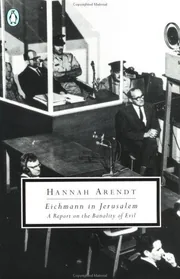
Eichmann in Jerusalem
by Hannah Arendt · 1963
Best suited to mature teens and adults with an interest in history and political thought.
320 pages, about 5 to 7.5 hours.
A courtroom report that changed how we think about evil. 56% taste match
What it covers
Eichmann in Jerusalem is a work of nonfiction history and political writing by Hannah Arendt, first published in 1963. Arendt was a Jewish political thinker who left Germany as Hitler rose to power. She attended the trial of Adolf Eichmann in Jerusalem, Israel, and wrote about it as a correspondent for The New Yorker. The book carries the subtitle A Report on the Banality of Evil.
The trial of Eichmann, who lived from 1906 to 1962, took place in 1961 and 1962 and dealt with his part in organizing the Holocaust. The book follows the proceedings in the courtroom and places them within the wider history of the persecution of Jews in Europe, the Shoah, and the war crime trials that came after the war. Arendt revised and enlarged the text for a new edition in 1964. It runs to roughly 320 pages in a typical printing, and it has appeared in many editions since. It suits readers interested in the Eichmann case, the history of genocide, and the way courts have dealt with war criminals.
Setting
EuropeJerusalem (Israel)IsraelMiddle EastJerusalem
Themes
HistoryHolocaust, Jewish (1939-1945)JewsJews in EuropePersecutionsWar crime trialsHolocaustEichmann case, 1961-1962
- Want to read 281
- Reading now 23
- Read 27
Most people shelving it are saving it for later.
Of 331 readers who put it on a shelf, 85% want to read it, 7% are reading it now, 8% have finished it and 0% stopped before the end.
By the numbers
- The median edition runs 320 pages. Counting about 275 words a page and an adult reading pace of 250 words a minute, that is about 5.9 hours of reading.
- Open Library tracks 53 editions from 34 publishers, the earliest dated 1963 and the latest 2023, across 14 languages.
- On reader demand it ranks in the top 5% of the classic books in our catalog (8,749 of them).
- Libraries shelve it under Dewey 341.690268 and Library of Congress class DD-0247.00000000.E5 A7.
 BookWard’s take
A courtroom report that changed how we think about evil
Arendt covered Adolf Eichmann's trial in Jerusalem for The New Yorker, and the book opens in the courtroom itself, with the usher's cry and the judges' entrance, so it grips you at once. Her voice is unmistakable: opinionated, exacting, unwilling to flatter anyone, and the narration is distinctly her own. The reporting is rigorous, tying the proceedings to the wider history of the persecution of Jews in Europe and to the war crime trials that followed. Its moral clarity is deliberately uncomfortable, since the subtitle, A Report on the Banality of Evil, refuses an easy monster. This is a book driven by ideas and analysis, with little in the way of scene-setting or romance, but a sustained argument carries it from first page to last. A serious, demanding read that rewards close attention.
At around 320 pages it is compact for its subject, and the argument stays focused on one trial.
It moves at the measured speed of a trial report, steady rather than fast.
The idea in its subtitle reframed how readers think about evil, and it still feels fresh.
The prose is controlled and precise rather than ornate, though never flat.
The trial gives it a spine, but the interest lies in a mind and its choices more than in events.
The subject is genocide and the book offers little consolation, though it values judgment and thought.
It follows the order of the trial, a fairly conventional shape for a report.
The subject allows almost no lightness, though Arendt's irony surfaces now and then.
Its subject is the organization of the Holocaust, and it does not look away.
The emotion is held under control, but the weight of the subject is felt throughout.
See all 50 dialsEvery position, side by side with this book
Where it lines up
- OriginalityBookWard 9 · book 9
- Shock for effectBookWard 9 · book 9
- Familiar tropesBookWard 10 · book 9
Where it pulls apart
- Story or ideasBookWard 3 · book 9
- ExpositionBookWard 2 · book 8
- LengthBookWard 1 · book 4
At around 320 pages it is compact for its subject, and the argument stays focused on one trial.
It begins inside the courtroom with the usher's cry and the judges walking in, which pulls you straight into the scene.
It declines the expected portrait of a monster, and that refusal is what sets it apart from familiar accounts.
The argument is built step by step from the proceedings, and its reasoning holds together well.
It moves at the measured speed of a trial report, steady rather than fast.
The idea in its subtitle reframed how readers think about evil, and it still feels fresh.
Eichmann is examined closely as a person, though the book is about an argument rather than a rounded cast.
It closes its argument and the case, though the questions it raises stay open.
Arendt writes with cool restraint about terrible events, never reaching for easy emotion.
The darkness comes from the facts of the case and the argument, never from effect for its own sake.
It follows the courtroom proceedings and sets them within the wider history, with a reporter's attention to detail.
Arendt's judgments are sharp and personal, and no one else could have written this report.
The trial supplies the frame, but the book exists to press a argument about responsibility and evil.
Arendt explains and argues outright, interpreting events for the reader rather than leaving them to speak.
The argument stays purposeful across the whole report, with little drift.
The prose is controlled and precise rather than ornate, though never flat.
The trial gives it a spine, but the interest lies in a mind and its choices more than in events.
The subject is genocide and the book offers little consolation, though it values judgment and thought.
It follows the order of the trial, a fairly conventional shape for a report.
The subject allows almost no lightness, though Arendt's irony surfaces now and then.
It asks for sustained attention and a willingness to sit with an uncomfortable argument.
Judges, prosecution, defendant and witnesses all appear, filtered through Arendt's own view.
It follows the trial in sequence while reaching back into the wider history of the persecution.
This is entirely grounded in real events and a real courtroom.
A courtroom full of judges, lawyers, witnesses and officials gives it a fair-sized cast.
One trial in one city, but it speaks to the history of genocide across Europe.
It weighs the defendant's mind and motives as much as the outward events of the trial.
Testimony and courtroom exchange feature, but the book is mostly Arendt's own commentary.
Romance has no place in this book.
A Jerusalem courtroom and the wartime machinery of persecution are unfamiliar ground for most readers.
The trial took place in 1961 and 1962, and the events it examines are from the war years.
Its questions about obedience, responsibility and justice remain live decades on.
Arendt reports as a named witness and states her judgments openly, so she is reliable and up front.
Few books are as unwilling to give a comfortable verdict on guilt and responsibility.
There is some courtroom scene-setting, but argument and fact take precedence over detail.
It reports a trial in sequence but spends more energy analyzing than telling.
Arendt is a Jewish survivor of Nazi Germany who writes with a distinct, engaged stance, not detached neutrality.
It stands alone as a single report.
There are few surprises of plot; the surprise is in the argument.
It confronts the reader with a deeply unsettling idea about ordinary people and atrocity.
Its subject is the organization of the Holocaust, and it does not look away.
The emotion is held under control, but the weight of the subject is felt throughout.
Any humor is a dry irony and nothing broader.
Violence is described through testimony and reportage, not rendered scene by scene.
Sexual content does not figure in the book.
It deals directly with law, the state, war crimes and the politics of the trial.
The language is formal and dense in places but not dialect-heavy.
Arendt states her judgments openly and often provocatively.
It looks back at a past catastrophe, though its lessons point toward how courts and societies judge.
It is clear-eyed about human failing and distrustful of easy moral comfort.
Review written by BookWard, dial version 1, November 2026.
Who is Eichmann in Jerusalem right for?
Best suited to mature teens and adults with an interest in history and political thought. It deals directly with the Holocaust and genocide, so the subject matter is heavy.
It asks for sustained attention and a willingness to sit with an uncomfortable argument.
Its subject is the organization of the Holocaust, and it does not look away.
The emotion is held under control, but the weight of the subject is felt throughout.
Violence is described through testimony and reportage, not rendered scene by scene.
Book CompanionEichmann in Jerusalem: ideas, characters, themes
By watching Adolf Eichmann in a Jerusalem courtroom, Arendt argues that great evil can be carried out by an ordinary functionary, a point captured in the phrase the banality of evil.
- A reporter in the courtroom. Arendt attended Eichmann's trial in Jerusalem as a correspondent for The New Yorker, and the book grew from that reporting.
- The trial in context. The proceedings are placed within the wider history of the persecution of Jews in Europe and the Shoah.
- The banality of evil. The subtitle names her central and most debated idea about the kind of person who carries out atrocity.
- Law and war criminals. The book considers how courts deal with war criminals and what a trial can and cannot do.
- A revised edition. Arendt revised and enlarged the text for a new edition in 1964.
Characters
Adolf Eichmann
The defendant
One of the key organizers of the Holocaust, tried in Jerusalem in 1961 and 1962.
Hannah Arendt
Author and observer
A Jewish political thinker who fled Germany as Hitler rose, reporting on the trial for The New Yorker.
Themes
What it means to answer for actions carried out within a system.
What a court can achieve when judging crimes on this scale.
Whether great wrongdoing needs great monstrousness.
How the persecution of Jews in Europe is recorded and understood.
The duty to think and form a view, even when it is uncomfortable.
Discussion questions
- What does Arendt mean by the banality of evil, and do you find the idea persuasive?
- How does her position as a Jewish exile shape the way she reports the trial?
- What can a courtroom achieve when the crimes are on this scale?
- Why might this book have provoked such strong reactions?
- Where does individual responsibility end and the system begin?
Personalize your Book Companion
This is the general edition. In BookWard, the Companion is written for you: your reading profile, your notes, and spoiler-safe to the page you are on.
Buy, listen or borrow Eichmann in Jerusalem
Each link opens a search for this book on that store, in a new tab.
Read on a device
Borrow
Reviews and community
If you liked Eichmann in Jerusalem
Baldwin's first essays: personal, exacting, and still sharp
V for VendettaAlan MooreA masked saboteur takes on a fascist Britain, with eyes open
The Spirit Catches You and You Fall DownAnne FadimanA child's illness becomes a study of two worlds colliding
Vom KriegeCarl von ClausewitzThe foundational theory of war as politics, dense and unhurried
Sources: Open Library.
Track Eichmann in Jerusalem and find your next favorite
Add it to your shelf, rate what you have read, and BookWard will recommend what fits you.
Free to start. No credit card needed.