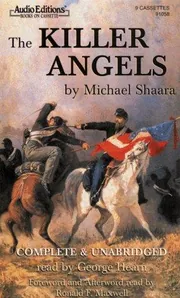
The Killer Angels
by Michael Shaara · 1974
Suited to mature teens and adults who are comfortable with a long, talky war novel.
374 pages, about 6 to 8.5 hours.
Gettysburg through the eyes of the men who fought it. 56% taste match
What it covers
The Killer Angels is a historical novel by Michael Shaara, first published in 1974. It centers on the Battle of Gettysburg, fought in Pennsylvania during the American Civil War, and follows the march toward the town in the final days of June 1863 before turning to the battle itself on July 1, 2, and 3. The book won the Pulitzer Prize for Fiction in 1975.
Rather than following a single hero, the narrative moves between several protagonists, drawing on real figures from both the Union and the Confederacy. This gives the account of the fighting a character-driven shape, with the campaign seen through the people who commanded and fought on each side. The setting is the United States in 1863, within the wider years of the war, 1861 to 1865. A film adaptation titled Gettysburg was released in 1993. The novel has appeared in 54 editions, including audiobook versions, and the usual print edition runs to roughly 374 pages. It sits comfortably alongside war stories and other fiction rooted in American history.
El 19 de noviembre de 1863 un hombre alto y desgarbado se puso de pie para hacer unos pocos «comentarios apropiados» durante la consagración de un cementerio.
Setting
GettysburgPennsylvaniaUnited States
Period
1861-18651963
Themes
Battle of GettysburgAmerican Civil WarRomansWar storiesUnited States Civil WarPennsylvania Civil WarHistoryAudiobooks
- Want to read 115
- Reading now 5
- Read 25
Most people shelving it are saving it for later.
Of 145 readers who put it on a shelf, 79% want to read it, 3% are reading it now, 17% have finished it and 0% stopped before the end.
By the numbers
- The median edition runs 374 pages. Counting about 275 words a page and an adult reading pace of 250 words a minute, that is about 6.9 hours of reading.
- Open Library tracks 54 editions from 29 publishers, the earliest dated 1974 and the latest 2019, across 2 languages.
- On reader demand it ranks in the top 8% of the classic books in our catalog (8,749 of them).
- Libraries shelve it under Dewey [Fic] and Library of Congress class PS-3569.00000000.H2 K5 1975.
 BookWard’s take
Gettysburg through the eyes of the men who fought it
Michael Shaara's Pulitzer-winning novel covers the march to Gettysburg and the three days of battle, July 1 to 3, 1863, by moving between commanders on both sides. It is a character-driven book, and that is where its strength lies: the characters feel real, and the rotating viewpoints let Union and Confederate officers each make their case without a single hero. The mood is not bleak, but it is not cheerful either, since the story knows how the days end. I tend to prefer ideas shown rather than told, and here the exposition can lean toward the explained, with soldiers reasoning aloud about duty and war. It is a book of talk, tents and tense decisions as much as combat, so the dialogue runs heavy. Strong for anyone who wants history felt from the inside.
At roughly 374 pages it is a moderate length for a battle novel, though not as tight as BookWard prefers.
The book moves steadily toward the battle days, quick in the fighting and slower in the camp scenes.
Gettysburg is well-trodden ground, but the novel's approach of rotating through commanders on both sides gives it a distinct angle.
The prose is clean and direct, plain enough to serve the drama rather than call attention to itself.
It is character-driven by design, tracing the battle through what commanders think and decide.
Knowing how the war goes, the book carries a grave, elegiac tone with only modest hope, a bit darker than BookWard's lean.
It follows the calendar of the battle in a conventional way, with no formal experiments.
This is a grave book about war, with humor little more than passing relief among the men.
War and its toll are central, making this a serious book, though not relentlessly bleak.
The commanders' burdens and losses give the book real emotional weight.
See all 50 dialsEvery position, side by side with this book
Where it lines up
- Character depthBookWard 8 · book 8
- EndingBookWard 8 · book 8
- Shock for effectBookWard 9 · book 8
Where it pulls apart
- OpeningBookWard 10 · book 6
- Familiar tropesBookWard 10 · book 6
- LengthBookWard 1 · book 4
At roughly 374 pages it is a moderate length for a battle novel, though not as tight as BookWard prefers.
It opens on the march toward Gettysburg, a purposeful start that builds momentum rather than grabbing you in the first line.
War fiction carries familiar beats, but treating both armies' commanders as full people keeps it from reading as stock heroics.
The campaign unfolds in clear order across fixed dates, so cause and effect hold together, which suits BookWard.
The book moves steadily toward the battle days, quick in the fighting and slower in the camp scenes.
Gettysburg is well-trodden ground, but the novel's approach of rotating through commanders on both sides gives it a distinct angle.
Real figures from both armies are drawn through thought and doubt, which is exactly the depth BookWard values.
The battle reaches a definite close on July 3, giving the story firm resolution, in line with BookWard's taste.
It honors its subjects without tipping fully into melodrama, though some passages are openly feeling-driven.
Violence serves the weight of the battle rather than spectacle, and BookWard rewards darkness that is earned.
It is a novel built on a real campaign and real people, so the history is solid even though the dialogue is imagined.
Shaara writes with a clear, earnest and recognizable voice that stays out of the way of the soldiers.
The story leads, with questions of duty and war emerging through the people rather than argued as abstract ideas.
Characters often reason and reflect aloud about war and loyalty, which is more explained than BookWard likes.
The tension of the approaching battle and then the fighting itself keeps the middle from slackening.
The prose is clean and direct, plain enough to serve the drama rather than call attention to itself.
It is character-driven by design, tracing the battle through what commanders think and decide.
Knowing how the war goes, the book carries a grave, elegiac tone with only modest hope, a bit darker than BookWard's lean.
It follows the calendar of the battle in a conventional way, with no formal experiments.
This is a grave book about war, with humor little more than passing relief among the men.
The writing is accessible, though keeping track of many officers and units takes some attention.
The narrative moves among several protagonists on both sides, matching BookWard's liking for many viewpoints.
The story runs in order from the march through the three days of battle.
It is firmly grounded in real events, with no fantastical elements at all.
Officers from both armies and their staff fill the book, a larger cast than BookWard usually favors.
The subject is one of the largest battles of the war, though the book stays close to individual commanders.
It balances the commanders' inner doubts with the outward action of marching and fighting.
Much of the book is conversation among officers, debating plans and weighing duty, which fits BookWard's dialogue-friendly side.
Romance has essentially no place in this battlefield story.
The 1863 military world is unfamiliar to most modern readers, which suits BookWard's taste for the unfamiliar.
Set in 1863 and published in 1974, it reaches well back into the past, unlike BookWard's present-day lean.
It won the Pulitzer in 1975 and has stayed in print across many editions, a durability BookWard admires.
The narration is straightforward and trustworthy, in contrast to BookWard's taste for unreliable narrators.
It lets both sides argue their cause, leaving the moral picture complicated, which BookWard enjoys.
Camps, terrain and battle are evoked with real texture, richer than BookWard's usual preference.
Despite its nonfiction shelving, it reads as a story told through people rather than as analysis.
Close access to the commanders' thoughts gives it a personal, inside view of events.
The outcome is historical fact, so the book offers little in the way of surprise.
It asks readers to sit with the cost of war and with sympathy for men on both sides.
War and its toll are central, making this a serious book, though not relentlessly bleak.
The commanders' burdens and losses give the book real emotional weight.
What humor there is stays dry and brief, soldiers easing tension.
The battle scenes carry real violence, though the focus stays on the men rather than gore.
Sexual content is effectively absent.
The war's causes and loyalties shape the characters' arguments, but the book stays focused on the soldiers.
The language is plain and readable, with some period flavor in the officers' speech.
The narration stays largely even-handed, letting the commanders speak for themselves.
Its gaze is fixed on a moment already past, looking back at a defining chapter of American history.
Duty, honor and conviction run through the book, balanced by a clear view of war's cost.
Review written by BookWard, dial version 1, November 2026.
Who is The Killer Angels right for?
Suited to mature teens and adults who are comfortable with a long, talky war novel. It contains battlefield violence and death, handled seriously rather than graphically for effect.
The writing is accessible, though keeping track of many officers and units takes some attention.
War and its toll are central, making this a serious book, though not relentlessly bleak.
The commanders' burdens and losses give the book real emotional weight.
The battle scenes carry real violence, though the focus stays on the men rather than gore.
Book CompanionThe Killer Angels: ideas, characters, themes
Gettysburg is a battle decided by men with doubts, loyalties and differing convictions, told from both the Union and the Confederate side.
- Four days, one battle. The story follows the march into Gettysburg on June 29 or 30, then the fighting on July 1, 2 and 3, 1863.
- Many protagonists. Instead of one hero, the book moves between several real figures from both armies.
- Character over spectacle. The battle is understood through the choices and thoughts of those who commanded and fought.
- Both sides given a voice. Union and Confederate perspectives share the page, so neither is reduced to a villain.
- A Pulitzer-winning novel. It won the Pulitzer Prize for Fiction in 1975 and later inspired the 1993 film Gettysburg.
Themes
What men owe their cause, their commanders and one another.
The ties that hold armies and individuals to a side.
How battle weighs on those who lead and fight it.
How the same battle looks different from each side.
Famous events seen as decisions made by real, uncertain people.
Discussion questions
- Why might the author have chosen several protagonists instead of one hero?
- How does seeing both armies' commanders change how you judge the battle?
- What does the book gain or lose by being a novel rather than a straight history?
- Which decisions in the story felt most weighted by duty versus doubt?
- How does knowing the outcome in advance shape the way you read each day of the fight?
Personalize your Book Companion
This is the general edition. In BookWard, the Companion is written for you: your reading profile, your notes, and spoiler-safe to the page you are on.
Buy, listen or borrow The Killer Angels
Each link opens a search for this book on that store, in a new tab.
Read on a device
Borrow
Reviews and community
If you liked The Killer Angels
Four generations of a Korean family in Japan, told with patience
A Beautiful MindSylvia NasarA mathematician's genius and illness, told with a reporter's patience
The Power and the GloryGraham GreeneA hunted, drinking priest and the faith he cannot shed
Arrow of GodChinua AchebeA proud priest and a changing world, told without a false note
Sources: Open Library.
Track The Killer Angels and find your next favorite
Add it to your shelf, rate what you have read, and BookWard will recommend what fits you.
Free to start. No credit card needed.