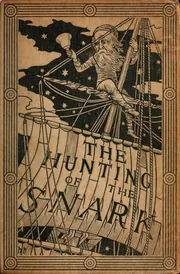
The Hunting of the Snark
by Lewis Carroll · 1876
It suits children who enjoy rhymes and silly words, and adults who enjoy Victorian nonsense.
83 pages, about 1.5 to 2 hours.
Carroll's nonsense expedition: eight fits, one elusive creature, wild invention. 60% taste match
The story
The Hunting of the Snark is a nonsense poem by the English writer Lewis Carroll, first published in 1876. Its subtitle is An Agony, in Eight Fits, and the poem is divided into eight sections accordingly. It follows the Bellman and his crew as they set out on an expedition to hunt a creature called the Snark, meeting a series of difficulties along the way.
Carroll composed the poem between 1874 and 1876. It returns to the world of his earlier poem "Jabberwocky," from the children's novel Through the Looking-Glass (1871), taking over its setting, a few of its creatures, and eight of its portmanteau words. The poem has been issued many times in illustrated editions and in collections of English nonsense verse, and it has been translated into French. Editions of around eighty pages are typical, and the poem is often shelved with children's poetry. Lewis Carroll lived from 1832 to 1898.
Themes
BibliographyHistory and criticismChildren's poetry, EnglishPoetryCollectionsEnglish poetryNonsense versesIllustrations
- Want to read 76
- Reading now 1
- Read 13
Most people shelving it are saving it for later.
Of 90 readers who put it on a shelf, 84% want to read it, 1% are reading it now, 14% have finished it and 0% stopped before the end.
By the numbers
- The median edition runs 83 pages. Counting about 275 words a page and an adult reading pace of 250 words a minute, that is about 1.5 hours of reading.
- Open Library tracks 255 editions from 115 publishers, the earliest dated 1876 and the latest 2022, across 5 languages.
- On reader demand it ranks in the top 19% of the classic books in our catalog (8,749 of them).
- Libraries shelve it under Dewey 821.89 and Library of Congress class PR-4611.00000000.H8 2010.
 BookWard’s take
Carroll's nonsense expedition: eight fits, one elusive creature, wild invention
The Hunting of the Snark is short, strange and fast. At around eighty pages it is a tight read, and the Bellman's voyage sets off almost at once, so there is no slow wind-up to sit through. Its originality is the real draw: Carroll builds on the world and portmanteau words of "Jabberwocky" yet produces something unlike anything else. The voice is unmistakable, with a mock-solemn tone that makes the whole thing quietly funny. Where it parts ways with a more conventional appetite is in its approach to familiar ground and internal logic: nonsense is the point, so the rules are gleefully loose. Read it as a rhythmic comic poem rather than a plotted tale, and it rewards a slow, aloud, second pass.
At around eighty pages in eight short fits, it is compact, which suits BookWard's love of tight books.
The eight fits move briskly, with verse rhythm propelling the voyage, close to BookWard's quick preference.
Few poems read like this one, with its invented creatures and portmanteau words, matching BookWard's high bar.
Rhymed, rhythmic verse with invented words is more ornamented than plain prose, though never dense.
The comic voyage and its episodes drive it more than any inner character development.
Neither cheerful nor grim, it keeps a wry distance, leaving the mood balanced.
Eight numbered fits and a poem made of invented words are unusual, a mild experiment compared to BookWard's usual.
The absurdity is its signature, and it plays for humor throughout, well above BookWard's comfort level.
The tone is lighthearted, with only faint shadows around the edges of the joke.
It is played for wit and absurdity rather than intense feeling.
See all 50 dialsEvery position, side by side with this book
Where it lines up
- LengthBookWard 1 · book 1
- PaceBookWard 8 · book 8
- SentimentBookWard 8 · book 8
Where it pulls apart
- Internal logicBookWard 10 · book 2
- Character depthBookWard 8 · book 3
- OpeningBookWard 10 · book 8
At around eighty pages in eight short fits, it is compact, which suits BookWard's love of tight books.
The crew is already assembled and the hunt under way almost at once, though it asks you to adjust to the verse.
It reuses the world of "Jabberwocky" but follows no standard adventure formula, which BookWard welcomes.
Nonsense verse bends rules on purpose, so its logic is deliberately loose, which sits against BookWard's airtight preference.
The eight fits move briskly, with verse rhythm propelling the voyage, close to BookWard's quick preference.
Few poems read like this one, with its invented creatures and portmanteau words, matching BookWard's high bar.
The crew are sketched as comic figures rather than deeply drawn people, short of BookWard's character depth.
Its humor is dry and unsentimental, with mock gravity in place of warmth, fitting BookWard's restraint.
Its strangeness is playful rather than gratuitous, and it earns its odd edges without leaning on shock.
Carroll's mock-solemn, playful narration is unmistakable and could not be mistaken for anyone else's.
It is a quest narrative but wrapped in wordplay and absurd ideas, so it sits slightly toward ideas.
Carroll shows the crew and their mishaps through scene and verse rather than explaining the world.
Eight brief fits keep it from dragging, though the nonsense can feel repetitive in a single sitting.
Rhymed, rhythmic verse with invented words is more ornamented than plain prose, though never dense.
The comic voyage and its episodes drive it more than any inner character development.
Neither cheerful nor grim, it keeps a wry distance, leaving the mood balanced.
Eight numbered fits and a poem made of invented words are unusual, a mild experiment compared to BookWard's usual.
The absurdity is its signature, and it plays for humor throughout, well above BookWard's comfort level.
It is short but asks for attention to rhythm and coined words, a moderate effort.
It is told by a single narrator observing the crew from one steady vantage.
The voyage unfolds in order, one fit after another, with no jumps in time.
Invented creatures and a nonsense world place it at the fantastical extreme.
The crew is a modest band, small enough to keep track of in a short poem.
It is a self-contained expedition, more whimsical than epic in feel.
Action and incident outweigh interior thought, as the crew keep busy with the hunt.
Speech appears now and then within the verse but narration carries most of the poem.
Romance plays no part in the voyage.
The Snark's world is invented and strange, far from anything familiar.
Published in 1876, it comes from the Victorian past rather than the present.
Its nonsense has outlasted its era and keeps being reissued in illustrated editions.
The narrator is mostly straightforward about events, however absurd they are.
It offers little in the way of a plain lesson, leaving the meaning for you to work out.
Verse and invented words conjure a vivid, odd picture without long descriptive passages.
It borrows from "Jabberwocky" but stands on its own as a poem.
Episodes surprise through oddity rather than plot reversals.
It is playful and approachable, more entertaining than demanding.
The tone is lighthearted, with only faint shadows around the edges of the joke.
It is played for wit and absurdity rather than intense feeling.
Humor is wordplay and absurdity with a straight face, closer to dry than broad.
Little physical harm is on the page, and the tone stays light.
There is none.
It is not a political poem.
Invented portmanteau words and Victorian verse make the language a touch tricky.
Carroll's narrator offers sly, wry commentary in a distinct, playful stance.
It is more a whimsical tale of its own time than a vision of what is ahead.
Its wry detachment leaves it neither cynical nor idealistic.
Review written by BookWard, dial version 1, November 2026.
Who is The Hunting of the Snark right for?
It suits children who enjoy rhymes and silly words, and adults who enjoy Victorian nonsense. It is gentle, though some wordplay and puzzling episodes may need explaining for younger readers.
It is short but asks for attention to rhythm and coined words, a moderate effort.
The tone is lighthearted, with only faint shadows around the edges of the joke.
It is played for wit and absurdity rather than intense feeling.
Little physical harm is on the page, and the tone stays light.
Book CompanionThe Hunting of the Snark: ideas, characters, themes
A mock-heroic expedition to find an unknowable creature becomes a showcase for Carroll's love of nonsense and invented words.
- A subtitle with a joke. The poem is called An Agony, in Eight Fits, and the eight sections are the fits.
- A world borrowed. It reuses the setting, some creatures and eight portmanteau words from "Jabberwocky."
- The hunt itself. The Bellman and his crew set out to hunt a creature called the Snark.
- Trouble along the way. Their expedition meets a series of difficulties as it goes on.
- Many editions. It has been reissued in many illustrated editions and translated into French.
Characters
The Bellman
Leader of the expedition
He leads the crew on the hunt for the Snark.
Themes
Playful language and logic that delight in not making ordinary sense.
A journey toward a goal that may not be what it seems.
Invented and combined words as a source of fun.
Solemn behavior applied to ridiculous aims.
Discussion questions
- Why might Carroll have chosen eight fits to structure the poem?
- How does the reuse of Jabberwocky's world change the way you read it?
- What makes invented words funny or meaningful without definitions?
- Does a quest need a clear goal to be satisfying?
- How does reading it aloud differ from reading it silently?
Personalize your Book Companion
This is the general edition. In BookWard, the Companion is written for you: your reading profile, your notes, and spoiler-safe to the page you are on.
Buy, listen or borrow The Hunting of the Snark
Each link opens a search for this book on that store, in a new tab.
Read on a device
Borrow
Reviews and community
If you liked The Hunting of the Snark
Two dream-logic classics where nonsense follows its own rules
Norse MythologyNeil GaimanGaiman retells the Norse myths in clean, witty, storyteller's prose
The Last UnicornPeter S. BeagleA lyrical fantasy quest that earns its sorrow and wonder
The Jungle BookRudyard KiplingKipling's jungle tales: short, vivid, and nothing like the cartoon
Sources: Open Library.
Track The Hunting of the Snark and find your next favorite
Add it to your shelf, rate what you have read, and BookWard will recommend what fits you.
Free to start. No credit card needed.